





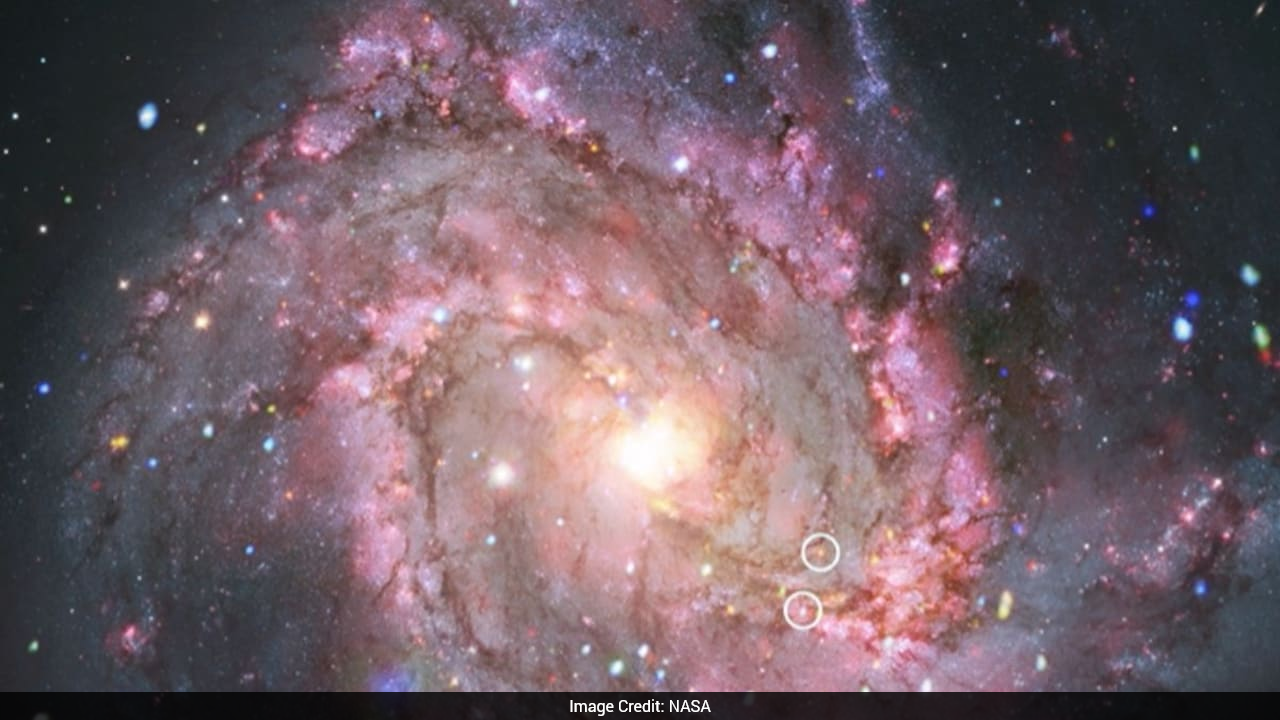
A new study has surprised astronomers after unusual changes were spotted in the remains of exploded stars in a nearby galaxy. Instead of fading steadily over time as expected, many of these stellar remnants showed dramatic changes in brightness, leading researchers to investigate what could be causing the unexpected behaviour, reported NASA.
The findings were presented at the American Astronomical Society meeting in Pasadena, California, and published in The Astrophysical Journal.
Astronomers used NASA's Chandra X-ray Observatory to study the nearby galaxy Messier 83 (M83), located about 15 million light-years from Earth. The galaxy is forming stars at a high rate, making it an important place to study stellar explosions. Researchers analysed 14 years of Chandra observations collected between 2000 and 2014.
Supernova remnants are the clouds of hot gas left behind after massive stars explode. Scientists expected these remnants, especially those older than about 100 years, to slowly fade in X-ray brightness over time. However, the new observations revealed something very different.
The research team found that about half of the 22 X-ray sources linked to supernova remnants changed significantly in brightness during the 14-year observation period. This result was completely unexpected.
Andrea Prestwich of the Catholic University of America, who led the study, said the team already knew that individual X-ray sources could vary dramatically. However, finding that so many supernova remnants behaved this way came as a real surprise. She added that something unusual is happening in these objects, but identifying the exact cause remains difficult because M83 is too far away to observe them in greater detail.
One of the 22 variable supernova remnants has a simple explanation. Known as SN 1957D, it is the debris from a supernova first observed nearly 70 years ago. Scientists believe it is crashing into material surrounding the explosion site, creating the observed X-ray flares. However, researchers said this explanation does not apply to the remaining objects, as there is no evidence suggesting that all of them were formed within the last century.
The researchers believe the most likely explanation is that they have discovered a population of surviving stars that remained alive after their companion stars exploded in supernova events. In this scenario, each system originally consisted of two massive stars orbiting one another. The larger star eventually collapsed and exploded, leaving behind either a black hole or an extremely dense neutron star, while its companion survived.
Scientists said this material becomes extremely hot because of the strong gravitational pull, producing the X-rays detected by Chandra. These systems are known as high-mass X-ray binaries (HMXBs) and are among the most variable X-ray sources in the universe. Researchers believe they may be responsible for the brightness changes observed in M83.
Astronomers have known about HMXBs for many years, but researchers said what makes the M83 discoveries unusual is their connection with supernova remnants. Previously, only a small number of supernova remnants linked with HMXBs had been identified across all galaxies. Finding more than 20 strong candidates in a single galaxy is unprecedented.
The study also found that the variable supernova remnants are located in regions containing higher concentrations of massive stars than other parts of M83. Researchers said this strengthens the possible connection between the remnants and HMXBs.
Scientists also suggested another possible explanation. Instead of pulling material from a surviving companion star, the black hole or neutron star could be recapturing some of the material that was blasted outward during the original explosion.
Track Latest News Live on NDTV.com and get news updates from India and around the world

