





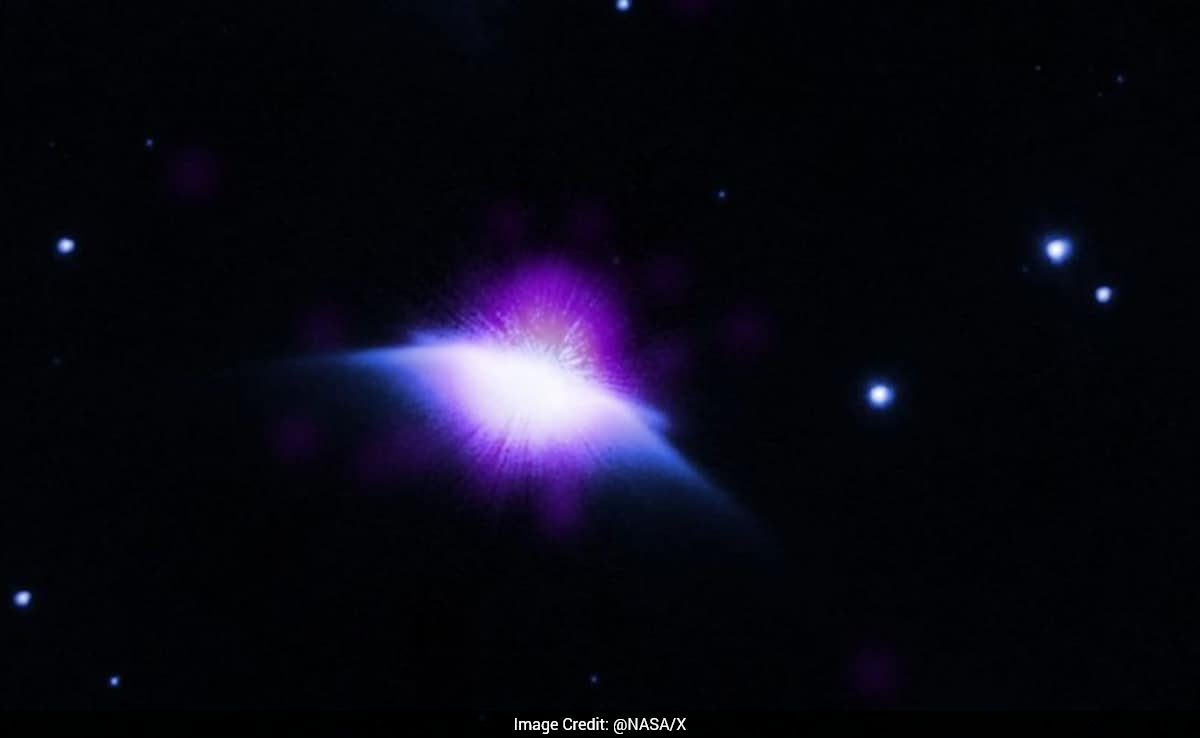
For the first time, astronomers have caught a much younger version of the Sun creating a giant bubble in space. The discovery was made using NASA's Chandra X-ray Observatory. This gaseous bubble, called the "astrosphere," completely envelops the young star. Strong particle winds emanating from the star's surface create this bubble, filling it with hot gas. As it expands, it pushes back the cold gas and dust of the surrounding galaxy, reported NASA.
A similar envelope exists around our Sun, called the "heliosphere." It is formed by the solar wind and acts as a protective shield. It extends far beyond the planets in our solar system and shields Earth from harmful cosmic rays.
This is the first time scientists have obtained a clear image of the astrosphere around a Sun-like star. Normally, such stars appear as a single bright point, but this image also reveals a faint diffuse radiation surrounding the star.
Carey Lisse of Johns Hopkins University in Baltimore, who led the research, which was published in the Astrophysical Journal, explained that scientists have been studying the Sun's astrosphere for decades, but it hasn't been possible to see it from the outside. He said that the new information from Chandra helps us understand the structure of the Sun's astrosphere and how it has changed over billions of years, during the Sun's evolution and its journey through the galaxy.
About The Star HD 61005
This star, HD 61005, is about 120 light-years from Earth, which is considered relatively close in space. Its mass and temperature are similar to the Sun's, but it is much younger. HD 61005 is about 100 million years old, while the Sun is about 5 billion years old.
Due to its young age, the particle winds emanating from HD 61005's surface are much more powerful. These winds are approximately three times faster than the Sun's and about 25 times denser. These intense winds fuel the formation of this gaseous bubble and provide clues to how active our Sun may have been billions of years ago.
Co-author Scott Wolk of the Center for Astrophysics | Harvard & Smithsonian stated that people are affected by the Sun every day-not just by its light, but also by the solar wind that radiates into space. This wind could affect satellites and possibly astronauts traveling to the Moon or Mars. He explained that this image of HD 61005's astrosphere provides important clues about the Sun's wind patterns in its early stages.
Why It Was Named "Moth"
Astronomers named the HD 61005 star system "Moth" because of the large amount of dust surrounding it, which, when viewed through infrared telescopes, resembles the wings of a moth. These plume-like structures are made of material left over from star formation, similar to the Kuiper Belt in our solar system.
Observations by NASA's Hubble Space Telescope have revealed that the interstellar material surrounding HD 61005 is about a thousand times denser than the material found around our Sun.
Track Latest News Live on NDTV.com and get news updates from India and around the world

