





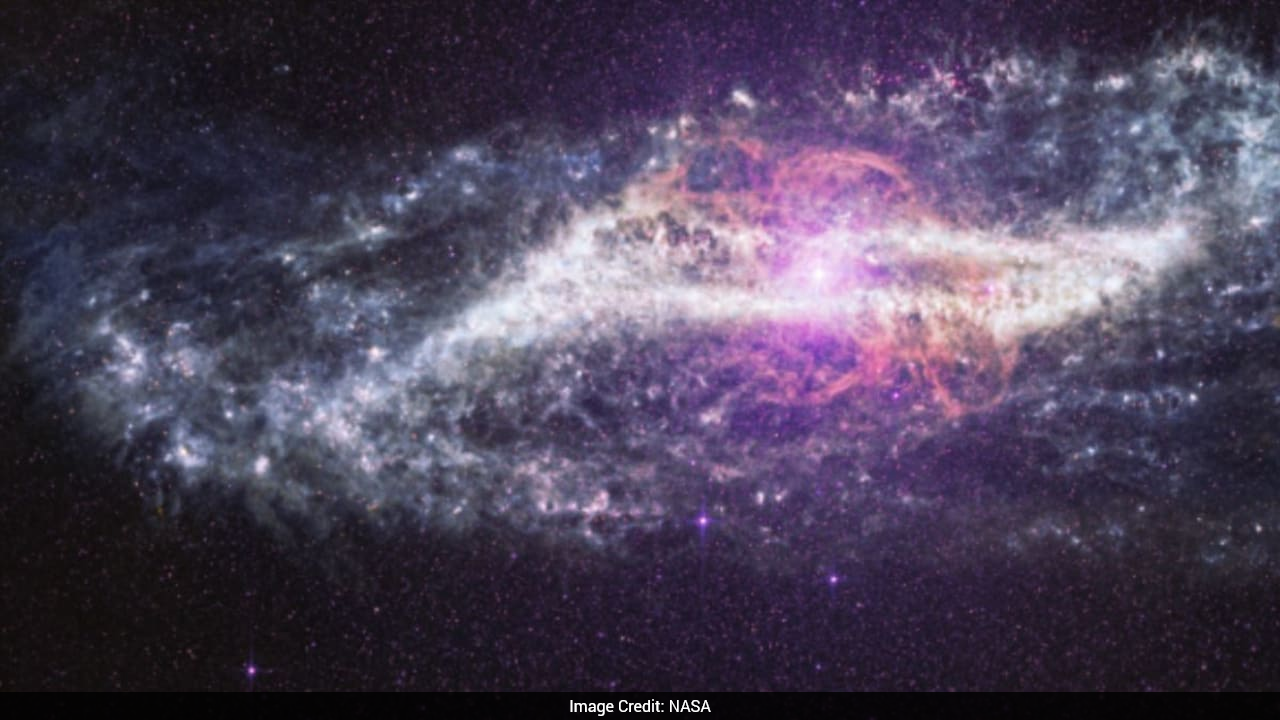
- NASA’s James Webb Space Telescope reveals Centaurus A galaxy in unprecedented detail
- The galaxy is 11 million light-years away and hosts an active supermassive black hole
- Webb’s infrared imaging penetrates dust to show individual stars in the galaxy’s core
A galaxy located millions of light-years away has been revealed in remarkable new detail by NASA's James Webb Space Telescope. New images from NASA's James Webb Space Telescope, released to celebrate its fourth science anniversary, show the familiar galaxy Centaurus A in far greater detail than ever before. Webb's sensitivity across near- and mid-infrared wavelengths cuts through the thick dust covering the galaxy's center in visible light, revealing a dense collection of individual stars and an active, ever-changing galaxy, reported NASA.
The images mark four years of better-than-anticipated performance and successful science operations for the most powerful space telescope in history.
Centaurus A is 11 million light-years away from Earth, making it relatively close in cosmic terms. Unlike most nearby galaxies, it is highly active, making it an important place for scientists to study how galaxies and black holes grow and evolve together.
At the centre of the galaxy is a supermassive black hole that is actively feeding on surrounding material. As it does so, it sends out powerful jets and releases enormous amounts of energy that shape the galaxy. Centaurus A also shows signs of a major collision with another galaxy that happened about two billion years ago. The effects of that merger can still be seen today in its unusual structure and ongoing star formation.
Earlier visible-light observations by NASA's Hubble Space Telescope could not show the galaxy's central region because dust blocked the view. NASA's retired Spitzer Space Telescope revealed large-scale structures in infrared light but could not clearly show individual stars. Webb now provides both clarity and depth, revealing the galaxy's inner regions star by star.
Shawn Domagal-Goldman, division director for Astrophysics at NASA Headquarters in Washington, said no single telescope tells the whole story. He said discoveries build over time, and new observatories expand on the work of earlier missions.
Webb's mid-infrared observations highlight the galaxy's rich dust structures, which glow in detailed shapes that surprise and even puzzle astronomers. A warped, parallelogram-like band stretches across the galaxy's center, while wisps of material extend outward like cosmic clouds.
Track Latest News Live on NDTV.com and get news updates from India and around the world

