





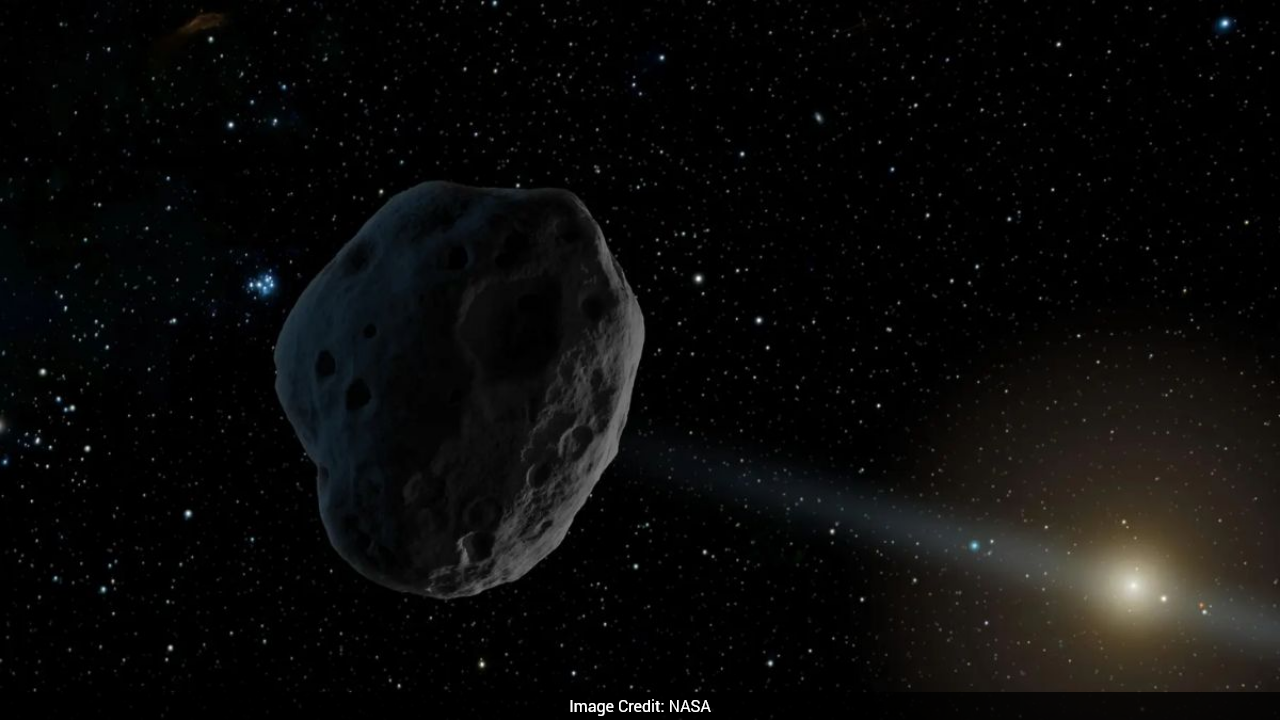
- NASA tracked near-Earth object 1998 SH2, revealing its dual asteroid-comet nature
- The object showed irregular motion changes inconsistent with typical asteroids
- Gas release from heating ice caused a small thrust, altering its predicted orbit
New research led by scientists at NASA's Jet Propulsion Laboratory in Southern California has revealed the identity of a puzzling near-Earth object by precisely tracking its motion through space and using powerful observatories to image faint celestial objects, reported NASA.
The object had a dual personality. Earlier images had not shown clear comet-like activity, suggesting that it could be an asteroid. However, its motion later showed irregular changes similar to a comet. The scientists detailed their findings in a study published in the journal Nature Astronomy.
The puzzle began on August 28, 2025, when the object, provisionally known as asteroid 1998 SH2, passed safely within 3 million kilometers of Earth.
Researchers observing 1998 SH2 with NASA's Deep Space Network planetary radar system had calculated its expected position using data from previous orbits and the effects of the gravity of the Sun and planets. However, when the object did not appear where expected, scientists realised that something unexpected was affecting its movement.
By using optical astrometry to precisely measure the object's position in the sky, researchers identified the reason behind the change.
Davide Farnocchia, a navigation engineer with NASA's Center for Near-Earth Object Studies at JPL and the study lead, said that after measuring the nongravitational changes affecting the motion of 1998 SH2 and recognising that they were not consistent with an asteroid, researchers suspected that the object could be an active comet.
Although 1998 SH2's orbit around the Sun had been tracked from 1998 to 2016, the object completed two solar orbits without additional telescope observations until the 2025 Deep Space Network attempts. After analysing all observations collected since its discovery, researchers determined that the object may have been producing a small thrust by releasing gas into space, causing it to move away from its predicted path.
This gas release happens when the Sun heats ice mixed with rocky material, turning the ice into gas. In regular comets, this activity creates a bright tail and coma, which is the gas and dust surrounding a comet's nucleus. However, when an object produces gas and dust in much smaller amounts, the tail and coma may not be visible to most observatories.
The August 2025 close approach of 1998 SH2 gave researchers an opportunity to gather evidence of visible comet activity. They contacted astronomers at the Canada-France-Hawaii Telescope in Hawaii, the European Southern Observatory's Danish Telescope in Chile, and the Very Large Telescope on Cerro Paranal in Chile to observe the object.
Olivier Hainaut, an astronomer with the European Southern Observatory and coauthor of the study, said that images collected from the observatories showed a weak but clear tail, confirming that 1998 SH2 was actually a comet. He added that the data confirmed the hypothesis that the object was a comet.
Following the investigation, 1998 SH2 received an additional comet provisional designation, P/1998 SH2.
The research also provided information about another unusual group of objects called dark comets. Like 1998 SH2, dark comets show irregular changes in their movement but do not display visible signs of comet activity, such as a coma, tail or visible gas release.
Track Latest News Live on NDTV.com and get news updates from India and around the world

