





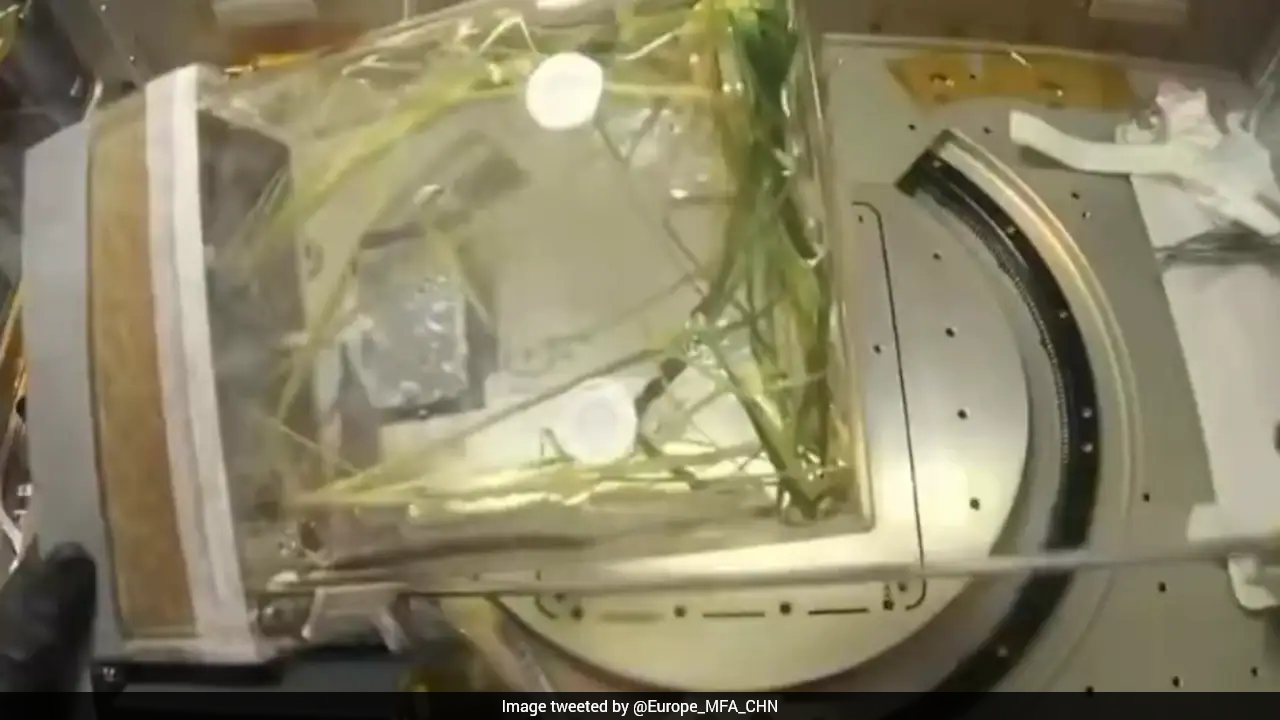
What once sounded like science fiction is moving closer to reality. Chinese astronauts aboard the Tiangong space station have successfully harvested the first batch of rice grown in orbit, marking another step towards producing food in space for future long-duration missions. The achievement could help scientists develop ways to grow food on the Moon, Mars and other deep-space destinations without depending entirely on supplies from Earth.
First Rice Harvest in Orbit
According to Global Times, the rice seeds were taken to the Tiangong space station aboard the Shenzhou-23 mission, which launched on May 24. After more than two months of careful cultivation, astronauts Zhu Yangzhu, Zhang Zhiyuan, and Lai Ka-ying collected the first rice samples.
A video released by the China Manned Space Agency shows the crew harvesting the rice and storing the samples for further research.
Aiming for world's first two-generation rice cultivation in orbit! China's Shenzhou-23 astronauts have completed a new rice-growing experiment aboard China's space station, comparing two types of rice seeds to advance space farming. pic.twitter.com/oyzfMxbRSz
— LI Jian (@Europe_MFA_CHN) August 3, 2026
The latest experiment builds on China's earlier achievement in 2022, when astronauts completed the world's first full life-cycle rice cultivation experiment aboard the Tiangong space station. During that mission, six rice seeds spent 120 days in orbit and produced 59 space-grown seeds that were returned to Earth for further study.
For the current mission, scientists are using two types of japonica rice - ordinary seeds that have never been to space and seeds descended from the rice grown aboard Tiangong in 2022.
Why this Experiment Matters
The goal is to learn whether food can be grown entirely in space. Scientists hope this will eventually make long-term space missions more self-sufficient by reducing the need for regular food deliveries from Earth.
Researchers are also studying how microgravity affects rice over multiple generations. For the first time, they aim to grow two consecutive generations of rice in orbit - from seed to plant, then from the new seeds to another generation.
Two Different Growing Methods
The experiment includes four cultivation units, each containing six rice seeds. They are divided into two groups that test different ways of growing rice. One group follows the normal seed-to-seed reproduction process. Scientists will study whether rice whose ancestors have already been exposed to space becomes better adapted to the space environment.
The second group uses a method called ratooning, where new shoots grow from the remaining roots after the first crop is harvested. This allows researchers to compare how different reproduction methods perform in microgravity.
Besides collecting rice grains, the astronauts are preserving stems and leaves at low temperatures. These samples will be brought back to Earth, where scientists will examine them to better understand how plants respond to space conditions and to improve future space farming techniques.
Track Latest News Live on NDTV.com and get news updates from India and around the world

