






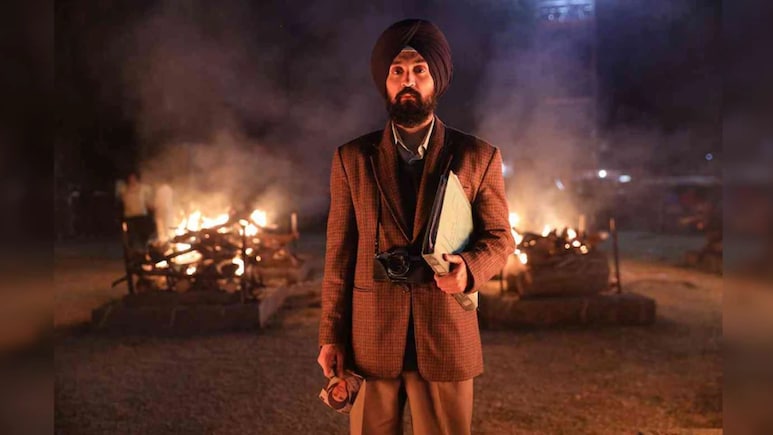
The controversy surrounding Satluj has moved far beyond a debate over a film. It has become a political litmus test for every major party in Punjab, exposing decades of contradictions on the issue of justice for the victims of militancy, counter insurgency and the human rights violations of the 1980s and 1990s.
For years, Punjab's mainstream parties have largely treated this painful chapter as an issue to be managed rather than confronted. Satluj has disrupted that equilibrium. Every statement, every silence and every political calculation is now being closely scrutinised.
The sharpest intervention has come not from a political party but from Paramjit Kaur Khalra, widow of human rights activist Jaswant Singh Khalra, whose investigation into the alleged secret cremation of unidentified bodies cost him his life.
In a strongly worded message ahead of the Harike Pattan remembrance ceremony, Paramjit Kaur Khalra refused to spare any political formation. She accused the Congress of presiding over widespread human rights violations, alleged that successive Shiromani Akali Dal governments protected and rewarded police officers accused in such cases, charged the Aam Aadmi Party government with failing to ensure that convicted officials were brought to justice, and also referred to allegations against the BJP led Union government over targeted killings abroad.
Her intervention is politically significant because it exposes a different vulnerability for each party. For the Congress, Satluj inevitably revives allegations linked to the counter insurgency period under its governments.
For the Shiromani Akali Dal, which seeks to reclaim the Panthic space, the film also brings renewed scrutiny of its own tenure in power, when critics allege successive governments did little to pursue accountability against police officers facing serious allegations.
The Aam Aadmi Party, despite presenting itself as a break from traditional politics, is now being asked whether it has fundamentally altered the state's approach to these unresolved cases. The BJP, meanwhile, must balance its national security narrative with its efforts to expand politically among Sikhs, making the debate particularly sensitive. Rather than allowing any one party to claim the moral high ground, her statement places the entire political establishment under scrutiny.
The political dilemma is evident. It explains why almost every political party has adopted a guarded approach. Their responses suggest they are still trying to assess how Punjab's Hindu and Sikh voters will react before taking an unequivocal stand.
For the BJP, the issue carries particular sensitivity because any perception of endorsing a narrative critical of the state's counter insurgency operations could alienate sections of its core support base. At the same time, appearing insensitive to Sikh grievances risks reinforcing political barriers that have historically limited its expansion in Punjab.
The Congress has to balance acknowledging historical wrongs without accepting political responsibility for decisions taken during its tenure. The Akali Dal cannot afford to alienate its traditional Panthic constituency but also faces uncomfortable questions about its own record in government. The AAP government, which came to power promising clean governance and change, is under pressure to demonstrate that it is willing to revisit unresolved questions of justice rather than merely administer the status quo.
Yet, electoral evidence suggests that Panthic politics has not disappeared from Punjab.
The victories of Amritpal Singh from Khadoor Sahib and Sarabjeet Singh Khalsa from Faridkot in the 2024 Lok Sabha elections demonstrated that there remains significant political space for candidates campaigning around Sikh identity, justice and unresolved historical issues. Amritpal Singh's victory reflected the continuing appeal of Panthic mobilisation centred on questions of Sikh identity and perceived injustice, while Sarabjeet Singh Khalsa's election carried its own symbolism.
As the son of Beant Singh, one of the two bodyguards who assassinated then Prime Minister Indira Gandhi after Operation Blue Star, his victory underscored that the legacy of 1984 and its aftermath continues to influence sections of Punjab's electorate. Together, these victories showed that Panthic politics remains electorally relevant despite repeated assertions that it has receded.
Satluj taps directly into that sentiment. For mainstream parties, this creates a dilemma. Remaining silent risks ceding political space to Panthic voices, while taking a clear position could unsettle carefully cultivated support bases across communities. The film, therefore, has the potential to reshape political messaging even if it does not immediately alter electoral outcomes.
That is precisely why Satluj has become politically consequential. The film is not merely reopening old wounds; it is reopening unresolved political questions. Every party recognises that an aggressive embrace of the film's narrative could consolidate one section of voters while alienating another. Conversely, distancing itself from the issue risks appearing indifferent to demands for justice. The result is a carefully calibrated politics of ambiguity.
Satluj has already achieved one political outcome: it has forced every major party to revisit questions that have remained politically unresolved for four decades, how Punjab remembers the excesses of the militancy and counter insurgency years, whether successive governments did enough to deliver justice to victims' families, and how the State should reconcile competing narratives of national security, human rights and Sikh identity. These questions have rarely found political consensus, making them among Punjab's most enduring fault lines.
In that sense, Satluj is no longer just a film. It has become a test of political credibility, revealing not only how parties remember Punjab's past, but also how they intend to navigate its future.

