







A US-based firm recently shared a post on LinkedIn explaining how Pakistan's earth observation satellite, PRSC EO3, is an anomaly because of its orbit. The US-based company COMSPOC found that the electro-optical imagery satellite, which requires sunlight to capture images of the ground, was placed in a 38-degree inclined orbit around Earth. The orbit is unusual for an optical imagery satellite, with a sun-synchronous inclination of nearly 90 degrees.
COMSPOC says the satellite sacrifices global coverage, but it allows it to capture Pakistan, Jammu and Kashmir and the rest of India, with frequent visits. Additionally, ThePrint, in its investigation, found that Pakistan's latest earth observation satellite network has grown since 2025, allowing it to capture changes in India and the Indian Ocean region through its orbital architecture. ThePrint's report states that these satellites are mapping India at least twice every two days.
I dug deeper into Pakistan's satellite network, tracking its position and revisit rates using open-source satellite monitoring platforms, and found that its Low-Earth Orbit (LEO) satellites capture India, the Bay of Bengal, and the Arabian Sea multiple times, providing nearly real-time intelligence on activities in India. While the counterargument to the observation from Pakistan could be that they share a border with India, therefore, it will naturally capture, however, each satellite, especially PRSC EO3, makes multiple visits over India, covering territory from south to north during the entire day.
During this investigation, I monitored five Pakistani satellites: PRSC EO1, PRSC EO2, PRSC EO3, PRSC HS-1, PRSS-1, and PakTes-1a. While PRSS-1 was a joint venture between Pakistan and China, the others were developed by Pakistan's Space and Upper Atmosphere Research Commission (SUPARCO). These assets, launched in 2018 (PRSS-1 and PakTES-1A) and between 2025 and 2026, comprise a seven-satellite constellation. Additionally, although PRSS-2 is another Sino-Pakistani project, its real-time location remains unconfirmed for this investigation.
What Makes It Unusual?
ThePrint's report provides a useful starting point for understanding the orbital configuration of Pakistan's satellites. My investigation found that three of Pakistan's low Earth orbit (LEO) Earth-observation satellites-PRSC-HS1, PRSS-EO1 and PakTES-1A-orbit at inclinations between 97 and 98 degrees, placing them in near-polar sun-synchronous orbits.
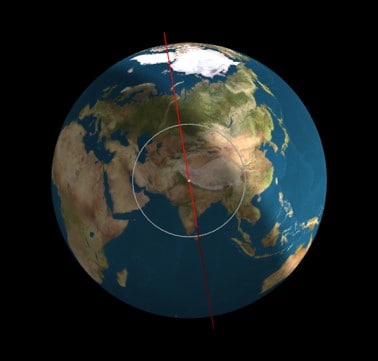
The sun synchronous orbit of PakTES-1a. Time: Unknown
Sun-synchronous orbits are particularly useful for surveillance, reconnaissance and Earth observation missions because they allow satellites to pass over the same location at nearly the same local time during each revisit. For example, if a satellite images Delhi at 10 a.m. IST during one pass, it will capture the city at roughly the same time on subsequent passes. This ensures consistent lighting conditions, enabling analysts to compare imagery over time and detect changes more accurately. As a result, most optical Earth-observation satellites operate in sun-synchronous orbits.
What stands out, however, is the role of PRSC-EO3. Unlike the other satellites, EO3 operates in an inclined orbit of 38 degrees. Consequently, around an hour after the sun-synchronous satellites pass over India, EO3 crosses southern India and the Indian Ocean Region (IOR). While sun-synchronous satellites image territory along a north-south ground track, EO3 maps the region along a west-east path, providing a different viewing geometry and expanding overall coverage of a landmass.
A similar pattern emerges with PRSC-EO2. The satellite has a Right Ascension of the Ascending Node (RAAN) of 298 degrees, compared to 243 degrees for EO1. RAAN determines the orientation of a satellite's orbital plane in space. Consider the Earth as a clock, so 298 degrees means that EO2's orbit points roughly at 10 o'clock and EO1's orbit roughly at 8 o'clock. Similarly, EO3's orbit is at 1 o'clock. RAAN is crucial to understanding the orbital planes of satellites and their revisit rates.
The 55-degree difference between the two satellites places them in distinct orbital planes, offering important clues about how Pakistan has distributed its satellites to improve revisit opportunities over India. This separation in orbital planes enables EO2 to observe areas from different geometries and at different times than EO1, PakTES-1A and PRSC-HS1. When those satellites cross India, EO2 typically follows roughly 90 minutes later, passing over parts of the country, particularly the north-east, during certain orbital cycles. This staggered arrangement increases the frequency with which specific regions can be observed.
The effect becomes more apparent when Earth's rotation is taken into account. A satellite in low Earth orbit completes one revolution in approximately 95 minutes. During that time, the Earth rotates eastward by nearly 24 degrees. As a result, when EO2 returns for its next orbit, the ground track beneath it has shifted westward. In one pass, the satellite may image north-eastern India; on the next, it can cover parts of central India before continuing over Pakistan. This orbital configuration allows successive passes to capture different parts of the subcontinent, improving overall coverage and observation opportunities. Therefore, the satellites capture changes in India multiple times during daylight alone, providing nearly real-time intelligence on activities in India.
Satellite orbits, accessed through open-source platforms, show how Pakistan's orbital architecture is designed to monitor changes in the Indian and Pakistani landmasses. Beyond Islamabad, one element is common in all the satellites - China.
China's Space Diplomacy
All Pakistani satellites have been launched by China at the Jiuquan, Xichang, Yangjiang and Taiyuan launch centres. While ideally launch centres are located near the sea, ocean or the Equator, for example, India's Satish Dhawan Space Centre in Andhra Pradesh's Sriharikota, is located along the Bay of Bengal. In the case of Pakistan, a launch centre in Karachi or Balochistan is difficult due to heavy air traffic over the region and security concerns due to the Baloch insurgency in the region.
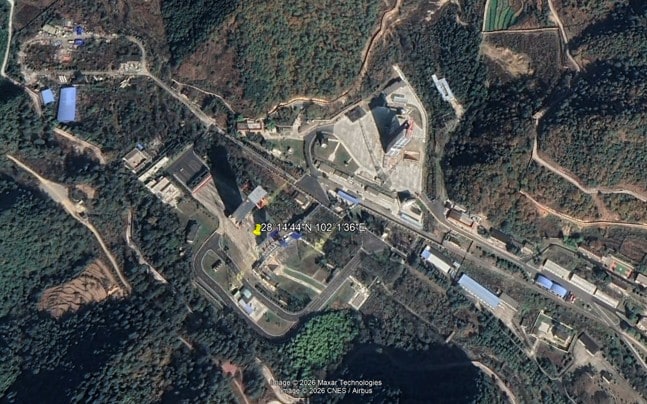
The Xichang space centre is located in China's Sichuan province. The 2007 ASAT test satellite was launched from here.
Recently, a leaked Iranian military document showed that Tehran secretly acquired a Chinese satellite, TEE-01B, to target US military bases in the Middle East. The satellite surveilled Saudi Arabia's Prince Sultan Air Base between March 13 and 15. On March 14, Donald Trump confirmed that the air base was hit and five US planes were damaged. China has actively provided the services of its satellites to Pakistan, especially during Operation Sindoor, when Chinese satellites reportedly provided real-time intelligence on Indian activities at air bases for Pakistan to target the sites.
Interestingly, ThePrint's report highlights how after Operation Sindoor in May 2025, Pakistan's LEO satellite network has grown exponentially, with four satellites launched in a year compared to three in the last seven years.
A report from CSIS, a US-based policy think tank, shows that in the race for the space economy, China holds dominance in the market in Global South countries, especially in Africa, a region where China runs multiple projects with different African countries. Meanwhile, the US targeted developed countries, and China went after developing economies. The report identified five indicators to analyse China's participation in space programmes of different countries. The indicators are - Ground segments, satellite contracting, satellite launch, bilateral partnerships, and China-led multilateral agreements. In the CSIS index, Pakistan ranks number 1, scoring 79.5, followed by Egypt and Venezuela at number 2 and 3, respectively.
Although China has effectively outperformed the US in securing the space economy market within the Global South, its reputation faces scrutiny due to its support for private military organisations. For instance, China has reportedly provided the Wagner Group with satellite imagery of Ukraine to support their combat missions. Furthermore, the Wagner Group itself has faced allegations of committing human rights abuses in Mali. The US supply of arms to Israel in its genocide in Gaza and Lebanon serves as a counter to China's offering of services to the Wagner Group.
Space, The Ultimate High Ground
The phrase 'Ultimate high ground' was popularised by Star Wars: Episode III - Revenge of the Sith, in which Obi-Wan Kenobi attempts to end his duel with Anakin Skywalker by taking the higher ground for advantage. The US is an established space power, China is quickly catching up and has emerged as a counterforce to the US, and Russia is a declining power, but it is falling from a high peak. Meanwhile, India has emerged as a global space power and a force to reckon with because of its success in Mars, Moon, and the Sun missions, affordable launch capabilities, and the creation of its own navigation system (NavIC), even though it is facing several issues.
The dual-use nature of Earth observation satellites makes it difficult to distinguish between civilian and military applications. A satellite tasked with monitoring agriculture, disaster relief or urban development can also collect imagery of military bases, troop movements and critical infrastructure. In Pakistan's case, where the military remains deeply involved in national security decision-making, it is reasonable to assume that these capabilities contribute to military planning and contingency operations.
Space-based Intelligence, Surveillance and Reconnaissance (ISR), including imagery intelligence (IMINT), signals intelligence (SIGINT) and geospatial intelligence (GEOINT), has transformed the intelligence cycle. Persistent overhead surveillance has reduced the monopoly that states once held over intelligence, while allowing both states and private actors to monitor developments across vast geographic areas in near real time. The result is a battlefield that is increasingly transparent to those with access to space-based assets.
Pakistan's expanding Earth-observation constellation demonstrates how even middle powers can leverage space to strengthen their intelligence architecture. By distributing satellites across different orbital planes and inclinations, Islamabad has increased revisit opportunities over India and the Indian Ocean Region, improving its ability to monitor changes on the ground. While these capabilities do not provide continuous surveillance, they significantly shorten the interval between observations and contribute to faster intelligence collection.
Yet dependence on space creates new vulnerabilities. Satellites operate in a contested domain where the legal framework governing military activity remains underdeveloped. The 1967 Outer Space Treaty was negotiated in an era when space-based warfare was largely theoretical. Today, states possess a growing range of counterspace capabilities, including electronic warfare systems, cyber tools, direct-ascent anti-satellite weapons and co-orbital systems designed to interfere with or disable satellites.
The Secure World Foundation's 2026 report on Global Counterspace Capabilities highlights how major powers are investing heavily in such technologies. The report notes that while direct-ascent anti-satellite weapons remain a threat, increasing attention is being given to co-orbital systems capable of operating in proximity to enemy satellites. These developments underpin that space is no longer a sanctuary but an increasingly contested domain.
GPS spoofing and jamming are common along the Indo-Pak border, but in the next conflict between the two neighbours, space-based capabilities will play a crucial role in target acquisition and surveillance for precision strikes, making the contest between reconnaissance and concealment a defining feature of any future India-Pakistan conflict.
(Divyam Sharma was a journalist at NDTV. He is currently studying Terrorism, Security and Society at King's College London, with a specialisation in wargaming and OSINT.)

