






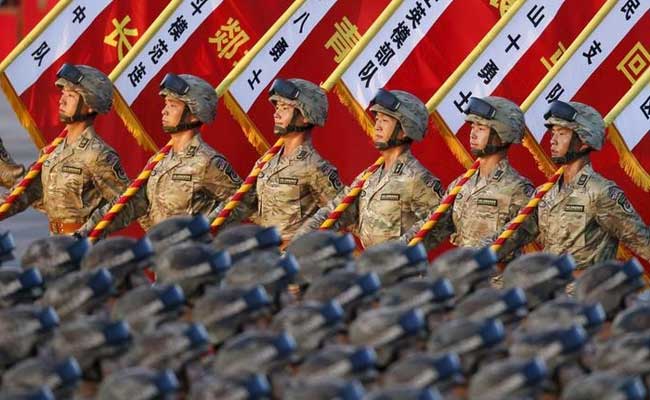
Amid tumultuous times and a looming modernisation deadline, August 1 this year marked 99 years since the founding of the Chinese People's Liberation Army (PLA). As the final year in the run-up to the PLA's centenary goals commences, three problems stand out as unresolved. These are the slow speed of "intelligentisation", the persistence of "official airs" and military graft, and an inability to prioritise quality over quantity. The West's sustained technology-denial efforts against Beijing, and the curbs placed on its defence state-owned enterprises (SOEs) by a growing roster of American lists, only add to the headwinds.
At the outset, it is important to understand the 2027 timeline. It is not more than a capability milestone, part of a "new three-step strategy": basically complete informatisation and enter the advanced stage of intelligentisation by 2027, achieve basic realisation of defence modernisation by 2035, and become a world-class military by 2049. Hence, it is notable that while operationally, an invasion of Taiwan is possible tomorrow, the PLA's sustained strategy of consistent modernisation and militarisation is the threat to look out for and prepare for, especially for decision-makers sitting in Washington and Delhi.
So what were the key signals emergent from the varied meetings, commentaries, and lectures that set the stage for the anniversary? The first was the emphasis on political building, framed as the foundation governing the "direction and fundamental character" of modernisation. The second was combat effectiveness, described, as always, the fundamental standard for testing it. The third was the Integrated National Strategic System and Capabilities theory - which can be understood as a modern successor to 'Military-Civil Fusion' - presented as the only route to achieving it. Together, these point to a framework likely to structure every military work report until the 21st Party Congress in October 2027. They also confirm that 'political building', which loosely means creating a more red, more loyal army, comes ahead of combat preparedness.
The candour over quality is more remarkable still. A Collective Study Session held by the highest CPC decision-making body, the Politburo, just before the anniversary, highlighted that development without quality is useless, however much of it is done, and that some of it becomes a "burden" and "hindrance" to the armed forces. This is the Party conceding, however obliquely, that parts of the past decade's modernisation and reform budget were wasted, or worse. The correction prescribed is "high efficiency, low cost, and sustainable development", which fundamentally shifts the focus away from quantitative growth to qualitative improvement. The era of throwing money at the problem has hence been formally declared over.
On discipline, Xi instructed the force to fold political rectification into daily life and make it a regular practice. The corresponding PLA Daily commentary of August 1 articulated that more sharply, and explained that there are no unrestrained special people. Conceptually, this moves the conversation a step past bribery towards the condemnation of privilege itself. It was likened to the "invisible arsenic" that is infamous for poisoning groundwater and going undetected. In a system that has just purged the man long described as Xi's closest military aide and childhood friend - former Central Military Commission Vice Chairman Zhang Youxia - the new reality expressed is that no one is beyond cleansing.
Finally, in terms of tactical modernisation, the elevation of "intelligentisation" from one leg of that sequence to the decisive one, came along obvious lines. To this end, a Xinhua explainer from August 3 argued that whoever builds an intelligent military system first will hold the initiative on the future battlefield. Warfare, it contends, has entered a stage where algorithms determine victory and detection equals destruction. An illustrative example is the fibre-optic-enabled first-person-view drone, costing a few thousand dollars and capable of destroying armour worth millions. Unmanned and intelligent forces, it insists, must be treated as the main force and protagonist - given a fixed place in organisational structure, used as simulated adversaries in training, and pushed to the last mile in tactics. Hence, a four-level architecture of perception, decision-making, operations and institutional support, with human-machine collaborative decision-making as the endpoint (for now), becomes evident. Notably, the explainer also flags poor integration of intelligent systems, insufficient algorithm adaptation, and weak combat effectiveness as weaknesses ailing the Chinese military today.
Going forward, two notable points of focus remain useful as one prepares to counter the ever-modernising and ever-militarising PLA. One is self-reliance. Anniversary celebrations clearly demarcate a newfound emphasis on key core technologies, which cannot be obtained by begging, buying, or demanding. Beijing's experience of recently expanding technology and market-access denial regimes of the West, and the repeated listing of its defence SOEs on instruments such as the US's Section 1260H, translates into a requirement that its military-industrial complex bridge the last mile from research to battlefield before 2027.
The second point is a shift in the employment model - from "raising troops for a thousand days to use them for one day", to "raising them for a thousand days to use them for a thousand days". This is the normalisation of continuous deployment through combat patrols, far-seas training, and grey-zone manoeuvres.
Defence Minister Dong Jun called 2026 a crucial year for winning the battle to achieve the centenary goal, and asked for "shedding feathers and rebirth". The expectation before August 1 next year is a force cleansed of its diseased trees, leaner and more loyal, under a rebuilt Central Military Commission presented at or before the 21st Party Congress. Till such a time as Xi restacks his deck of cards and a new, non-experienced but ever-ready leadership is constituted to take on the task of building a "world-class" fighting force, the window for India's armed forces to prepare and adapt is more expansive - and yet, shorter than ever before.
(Anushka Saxena is Associate Fellow, Geostrategy Programme, The Takshashila Institution. Views expressed are personal and do not represent those of the Institution)
Disclaimer: These are the personal opinions of the author

