Demography Awaits Dividend: BRIC By Brick, India Built Growth But Not Jobs
Twenty-five years, five governments and several hundred investment summits later, demography is waiting for politics to propel the promise.
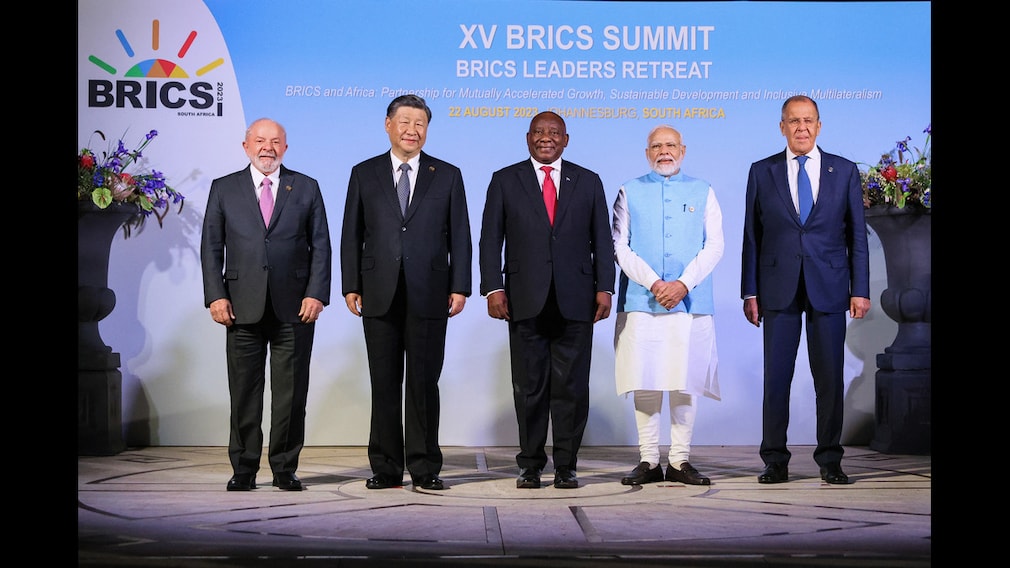
On 30 November 2001, Jim O'Neill at Goldman Sachs published twelve pages titled Building Better Global Economic BRICS and handed the decade its acronym. Brazil, Russia, India and China, it argued, together represented an emerging economic bloc. Each member brought an endowment. China had manufacturing and trade, Brazil agriculture and minerals, Russia energy and resources. India had people - the case set out in the October 2003 sequel by Dominic Wilson and Roopa Purushothaman. The song set to the very same melody was sung by India. The Tenth Five-Year Plan invoked the vision of doubling per capita income within ten years and "creating 100 million employment opportunities", even as it conceded growth slipped below 6 per cent in the late 1990s.
Twenty-five years on this November, the acronym has outlived the argument that produced it. What began as four economies in a research note is now an eleven-member grouping - a noun in search of a verb. As India hosts the 18th BRICS Summit in September, two questions stalk it. Whether the bloc has earned its billing is a question for the next column. This one examines if India harvest the demographic dividend that got it into the acronym in the first place?
Two sets of forecasts - one written in London, one documented in Yojana Bhavan - rested on the same young population. India was adding around 10 million people to the workforce. Effectively India had to create jobs for the 41 million registered at employment exchanges and waiting and the newcomers. There were two challenges - the economy needed to grow at and above 8% and it needed to create over 10 million jobs. The gap between hope and reality was already vast. The worriers were drowned out by the euphoria of the BRICS forecast.
The record of what followed is unusually well documented. Four expert maps were circulating: McKinsey put 75 million jobs on the table in September 2001; the Planning Commission's Task Force on Employment Opportunities proposed 100 million in July 2001 and its Special Group repeated the figure in May 2002; the AIMA report chaired by N.K. Singh offered 72 million in April 2003, on the explicit argument that demographic opportunity could create them.
Then the Plans. The Tenth targeted 50 million work opportunities in five years, the Eleventh 58 million with educated unemployment below 5 per cent, the Twelfth 50 million non-farm jobs. The score spells the magnitude of arrears. The 12th Five-Year Plan estimated that 56 million non-farm jobs were created across the entire decade from 2000-01 to 2009-10, of which manufacturing contributed 6.6 million. Ten years delivered roughly what a single Plan had promised in five. The spectre of inadequate job creation is a permanent invitee to India's political economy.
The evidence of absent jobs is really in news headlines -- the multitude of applicants for government jobs. In 2003 the railways advertised for 20000 posts - 74 lakh persons -336 persons per job. In 2024 15.35 lakh candidates competed for 452 vacancies for RPF Sub-Inspectors, a ratio of nearly 3,400 applicants per post. In 2024, in all, 71 lakh candidates applied for 92,116 jobs in the railways. In 2025 more than 25 lakh candidates applied for 53,000 peon posts in Rajasthan - nearly 90 % of the candidates held degrees including those with MSc, BTech, even PhDs.
The pain is manifest across 25 years in opinion polls for Lok Sabha and Assembly elections. Unemployment and price rise - the proxy for unaffordability - has figured at or near the top of every credible survey as voter concerns. In 2024 the Lokniti-CSDS pre-poll survey 27 % found unemployment as the single most important issue followed by price rise at 23% -- 62% said jobs had become harder to get. By 2015 the Planning Commission was dissolved leaving India with no plans and sketchy data.
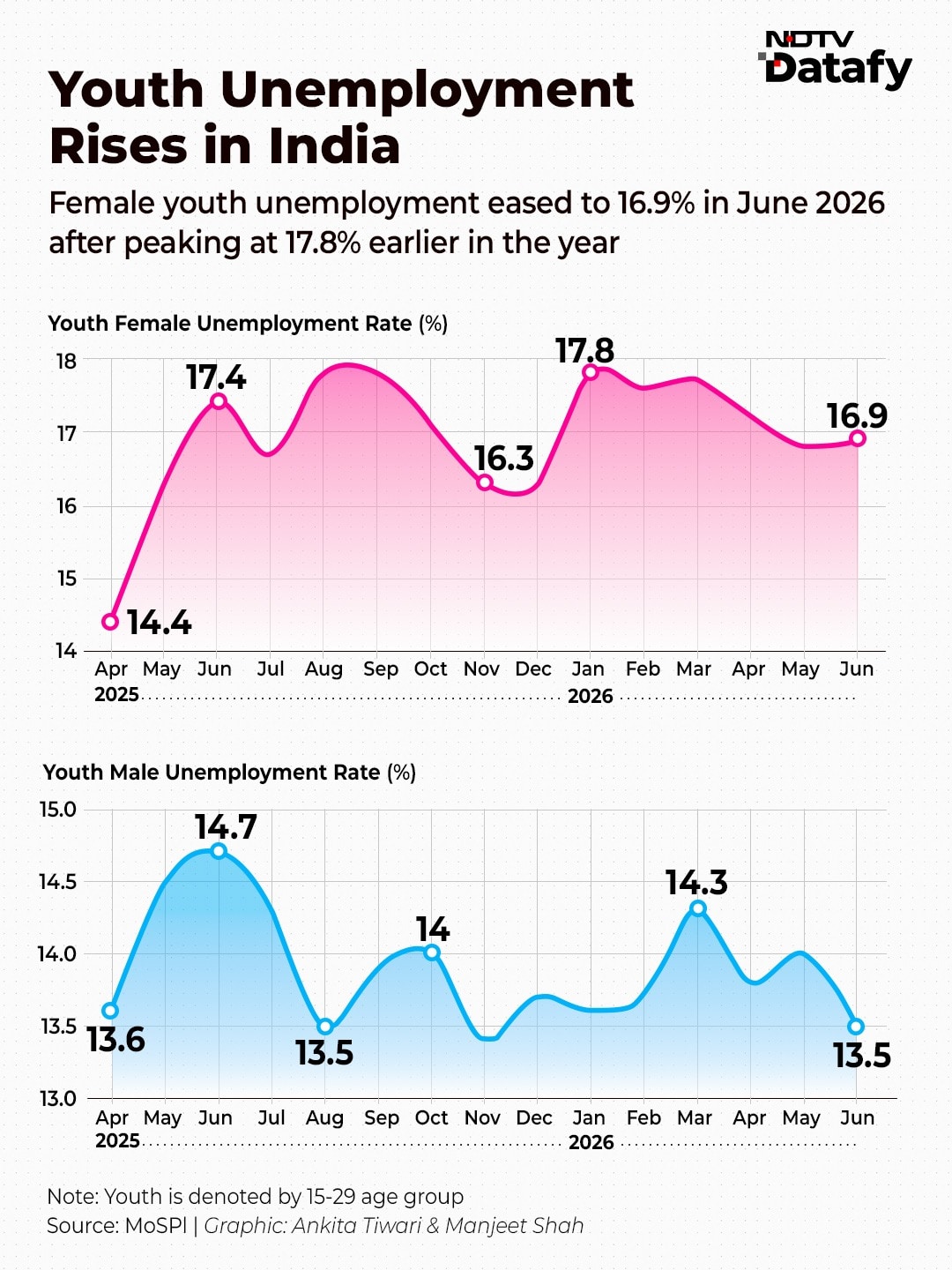
The gap between promise and performance persists. The saga of job creation has migrated from marker to marker - the number of taxpayers, number of EPF members, number of pension accounts. It is not that jobs weren't created, but they were clearly not enough. State governments hosted investment summits - verily item songs of the political economy serenading economic growth. Neither the states nor the union government have made any attempt to harness data - triangulate the value of investments, GSDP growth and volume of jobs created.
The announcements are spectacular. Memoranda worth over ₹30 lakh crore - roughly twice the state's own output - were signed at Madhya Pradesh's Global Investors Summit in February 2025. Davos has been a hot spot for Maharashtra, which signed memoranda worth ₹15.7 lakh crore in 2025 and ₹14.5 lakh crore on the opening day in 2026. Data on the conversion of memoranda into investment and jobs is sketchy. Young Indians wait like Beckett's tramps, for someone who does not come.
In February 2019, when the Periodic Labour Force Survey showed unemployment at a four-decade high, the mandarins at NITI Aayog published a two-part rebuttal that ripped into the survey. It then conjured an alternative reality of 30 lakh jobs created, using arithmetic of its own - conflating vehicle sales with job creation, on the reasoning that vehicles would need drivers. The struggle to harness the productive capacity of youth is visible in the list of job schemes at the national and state level.
Seventy-three years after Bimal Roy sent Shambhu Mahato from his two bighas to the city to pull a rickshaw, India hosts the world's largest rural employment scheme - MGNREGS now known as G-Ram G. The rural employment programme which offers 125 days of guaranteed work at a notified daily wage of Rs 327and has an allocation of ₹95,692 crore for 2026-27 has over 10 crore active workers on tis rolls. And generations after Mahato farms are yet the largest employer. The PLFS for 2025 shows 43% of India's workforce is dependent on agriculture - this is 35 years after the 1991 reforms, a decade after Make in India, a decade after the promise to shift folks from farms to factories and lift manufacturing's share to 25% from 14%.
Six years on, the launch of 14 production linked incentive schemes funded by allocations of over Rs 1.91 lakh crore attracted Rs 2.4 lakh crore in investments and 14 lakh jobs. In 2024 the government introduced a new 'employment linked incentive scheme' called the Prime Minister's Internship Scheme, with a target of one crore jobs in five years. As of March 2026, nearly a year and half after its launch, 16,060 interns joined their internship in two rounds.
The history of underperformance is recorded by the government itself. In October 2025 NITI Aayog, in a study of services employment, stated that over 40 million jobs were added in six years. The services sector, once the hope of job seekers and regimes alike, generates more than half of national output and under a third of the jobs. In the very same month, the Niti Aayog published a road map for job creation in the AI economy, guided by an expert council drawn from tech companies that have been cutting headcounts since 2024. India's tech workforce is put at 7.5 to 8 million. The roadmap states it could rise to 10 million or fall to 6 million, depending on action not yet taken. The evolution of narrative in 25 years of BRICS is notable. In 2001 the state promised 100 million jobs. In 2025 it offers a range with a downside.
There are many explanations why India has struggled to create jobs. Every major economy has dominated sectors and markets, created global brands as it climbed the global GDP ladder - Germany rode on automobiles and chemicals, Japan wired growth with electronics and cars, China dominates global manufacturing and trade. India reached the top five bracket of global economies without a significant spend on R&D which fuels innovation, brands and global footprints.
Central to the failure is the strong political consensus for weak reforms across all parties. The 1991 reforms dismantled licence raj but allowed permission raj to prevail. For years India has claimed to have improved the ease of doing business. A good test would be whether the number of permits and clearances - most of them dealing with factors of production and vested with the states - has come down at all for power projects, manufacturing plants, hotels or hospitals.
The picture worsens on regulatory compliance. Rishi Agrawal of Avantis RegTech estimated in 2021 that Indian enterprises were subject to 1,536 laws, 69,233 compliances and 6,618 filings. A pharmaceutical unit in the MSME sector needs 87 licenses and carries 992 continuing obligations, 442 of them on labour; a small non-banking finance company needs 35 licenses and carries 620 obligations, 238 of them on labour. It is more than a year since the government set up two task forces to unclog the regulatory plumbing. India awaits their findings.
The BRIC papers were right about size. India is among the largest economies. It is also stranded in the middle-income trap. The implicit assumption was that the necessary and sufficient conditions would be met - that development, as the 2003 paper put it, would proceed successfully. Twenty-five years, five governments and several hundred investment summits later, demography is waiting for politics to propel the promise. BRIC by brick, systemic apathy to outcomes stalled the arrival of the demographic dividend.
Next: Twenty-five years on, has BRICS lived up to the hope and the hype?
(Shankkar Aiyar is a political economy analyst and author)
Disclaimer: These are the personal opinions of the author
-
Opinion | Sydney Sweeney And The Obsession With Asking Sportswomen To 'Take The Clothes Off'

There is a world of difference between an athlete choosing to be sexy and an advertiser deciding that sex is the most interesting thing about her
-
Opinion | The 'AIPC' Was Once Congress' Boldest Idea. What Happened To It?
Tharoor, to Chakravarti, to Yaskhi now, the fate of a Congress 'experiment' that started in 2017 will tell you a lot
-
Woman Biker Hit, Air Force Veteran Attacked: The Lawlessness In Gurugram
What gives confidence to some elements in Gurugram to break the law again and again in full public view and on camera?
-
Opinion | When The Feed Braves The Flood
NDTV drops the 24x7 and stakes its next chapter on presence as it inaugurates a new identity
-
The Politics Of Blue: Why Akhilesh Yadav-vs-Mayawati Over A Colour Is Just One Shade Of History
A movie starring Rajinikanth tells us how colours can carry meaning beyond what meets the eye. The latest row over Akhilesh Yadav's party adopting blue, and Mayawati objecting, can be a starting point for understanding the many shades of history.
-
2 Indians Survived 9/11, Then American Justice System Became Their Nightmare
Pulled off a Texas train hours after 9/11, two Indian men were plunged into America's largest terror manhunt.
-
Opinion | Building BRICS In New Delhi
For India as the host nation, chairing the summit tests the core tenet of its modern foreign policy: strategic autonomy.
-
Can India 'Mediate' Between Iran And UAE At BRICS? Gulf Envoy Suggested It Once
At the very start of the Israel-US war on Iran, it was a UAE diplomat who had suggested as much.