





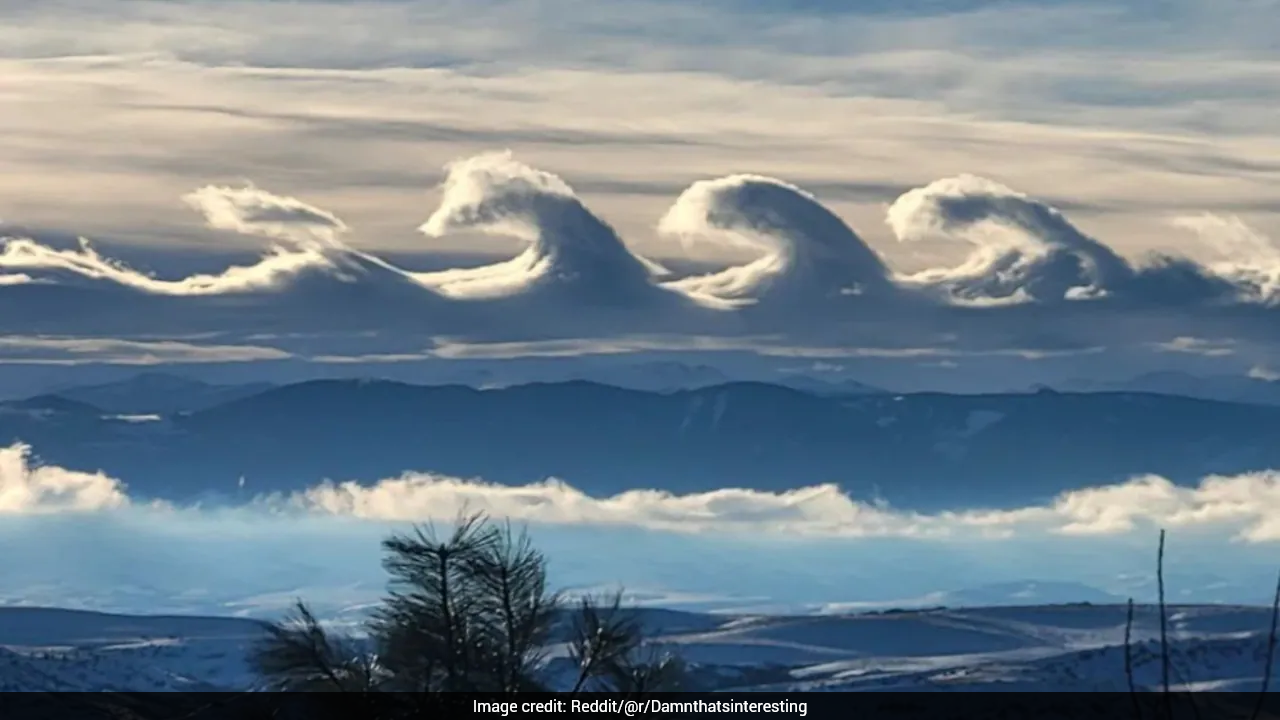
We often see shapes in the clouds, and it's not purely random. It is a psychological phenomenon called pareidolia, where the brain perceives familiar patterns, like faces or animals, in unrelated objects. But if you spot 'ocean waves' in the sky, it isn't just your imagination. Those are real formations; in fact, one of the rarest, most striking atmospheric sights on Earth. They are called Kelvin-Helmholtz clouds.
Recently, a Reddit user shared several images of Kelvin-Helmholtz clouds, and the post went viral with over 9,000 upvotes and many curious comments. One user called it "Ocean in the clouds."
These clouds are named after Lord Kelvin and Hermann von Helmholtz, who studied the physics of the instability that leads to this type of formation.
Also read | Scientists Detect Radio Signals From Planet Outside Our Solar System
What causes the wave shape?
According to EarthSky, a Kelvin-Helmholtz instability forms where there's a velocity difference across the interface between two fluids. Temperature also plays an important role. It is created when a layer of cool, dense air sits underneath a warmer, lighter layer of air, with the warmer layer moving faster than the colder layer.
The curl appears when the fast-moving top layer blows over the slower bottom layer; it drags the top edge of the cloud along with it. The media outlet further explained that this friction scoops the cloud material up and forward into a crest, creating a curling wave pattern.
These clouds are extremely rare, as a lot of this must go right for the formation, and once they do, they don't last long. Spotting them is a matter of pure luck.
Also read | Hiker Shouted For Help 10,000 Times After Getting Lost On Remote Island
These wave like clouds are called Kelvin-Helmholtz clouds.
by u/Top-Marionberry-6604 in Damnthatsinteresting
What do they signal to pilots?
As per the UK's Met Office, the clouds are more likely to occur on windy days. "They are often good indicators of aircraft turbulence," it added. Hence, the Kelvin-Helmholtz clouds carry a warning for aviation.
The intense wind that creates these patterns also produces severe, unseen clear-air turbulence. Pilots usually try to avoid flying through or near air layers exhibiting these patterns.
Social media reactions
While reacting to the photos, one user wrote, "Look like the classic cartoon waves." Meanwhile, another said, "It looks like that one kinda famous painting".
A third user added that these look similar to "The Great Wave off Kanagawa by Hokusai". "It reminded me of that one as soon as I saw the pic," the user added.
"I saw it a few months ago; there was a display of Hokusai's works and got to see the Great Wave in person! It was quite a nice experience," a fourth user shared their experience.
Track Latest News Live on NDTV.com and get news updates from India and around the world

