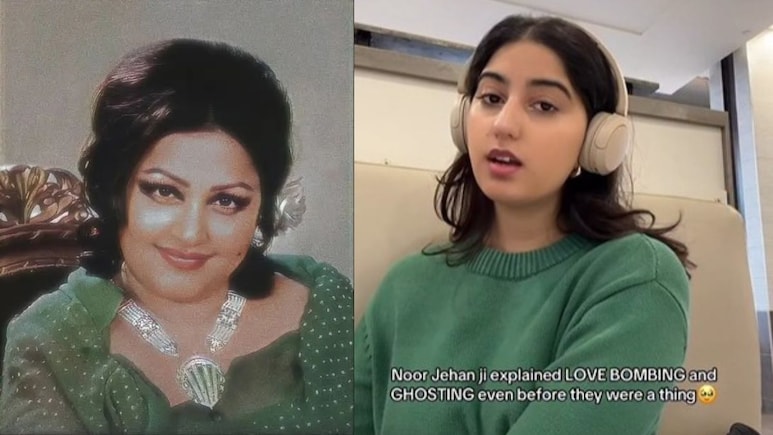
A soft, aching ghazal from the 1970s is finding an unlikely new audience, not through vinyl records or late-night radio shows, but via Instagram Reels scrolling on Indian smartphones.
Sanun Nahar Wale Pool, sung by Pakistan's legendary Noor Jehan, is currently buzzing among Indian Gen Z listeners as her voice stopped them mid-scroll (including us).
Nearly five decades after it was first recorded, Noor Jehan's voice and the song's quietly devastating lyrics are striking a chord with a generation raised on algorithms, short-form videos and modern relationship anxieties.
How A 43-Second Clip Took Over Gen Z Feeds
The renewed interest in Sanun Nahar Wale Pool has been fuelled largely by social media, especially Instagram.
A 43-second excerpt from the song, usually focusing on its most emotionally loaded lines, has become a popular background for reels on heartbreak, complicated relationships and unspoken longing.
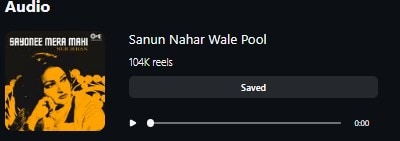
At last count, that single audio clip has been used in over 104k Reels.
Part of the buzz comes from how easily the song's themes translate into today's dating vocabulary.
One Gen Z influencer summed it up neatly in a now-viral post: "Noor Jahan Ji explained about Love Bombing and Ghosting even before they exsited".
Young listeners see their own experiences reflected in a song written long before terms like ghosting or love bombing entered everyday language.
For many Gen Z users, the song feels almost cinematic. It is not loud or dramatic, but restrained and intimate, making it ideal for reels that rely on mood rather than spectacle. The voice, textured with longing and restraint, does most of the emotional work.
The song went viral a month ago after Patiala Mehfil posted a video of themselves singing it, racking up 22.1 million views and more than 2 million likes!
Why The Lyrics Still Hit Home
Sanun Nahar Wale Pool, sometimes spelled Sanu Nehar Wale Pul, loosely translates to "call me to the bridge by the canal". On the surface, it is a simple image. Dig a little deeper, and it becomes a powerful metaphor for waiting, uncertainty and the quiet hope of reunion.
The lyrics speak of a lover who calls, then disappears, of promises that feel fragile, and of the emotional toll of loving someone who remains just out of reach.
The song patience tinged with sadness, a kind of dignified vulnerability that feels rare even today.
Here's a quick translation:
Saanu nehar wale pul te bulaake
Saanu nehar wale pul te bulaake
Te khore maahi kitthe reh gaya?
He called me at the bridge over the river
Now that I'm at this bridge
Where is that idiot?!
Saddi akkhan vicho neendra.n udaake
O saddi akkhan vicho needra.n udaake
Te khore maahi kitthe reh gaya?
Thanks to him, I can't get sleep at night
And for all those sleepless nights he's accountable for
Where'd he go!?
Ud-da dupatta mera malmal da
Dil utte zor channa naiyo chalda
Ud-da dupatta mera malmal da
Dil utte zor channa naiyo chalda
Aanvein te manaavaangi main hath jodke
Channa vey tu gussa kitta kedi gal da
My scarf tends to fly away all the time
Simply because I can't convince my heart
My dupatta, oh my pretty muslin one, runs away from my grip all the time
Because I cannot force my heart, my love
When you do come around, love, I'm going to plead and convince you
What did I say that made you so angry anyway, love?
For Indian Gen Z listeners, this emotional restraint feels refreshing. In an era of oversharing and performative vulnerability, the song's understated sorrow feels authentic. It allows listeners to project their own stories onto it, whether that is an unanswered text, a situationship that never became real, or a relationship that existed only in late-night conversations.
Where The song Came From
Although many social media posts credit Sanun Nahar Wale Pool simply to an old album, the song's roots go back much further.
The original recording was featured in a Pakistani Punjabi film Dukh Sajna De, released on September 14, 1973. In that movie, the song Sanu Nehar Wale Pul Te Bula Ke was sung by Noor Jehan, composed by Salim Iqbal, with lyrics by Rauf Sheikh and quickly became one of the standout romantic tracks of the era.
The imagery of the canal bridge is deeply rooted in Punjabi cultural landscapes, evoking rural settings, secret meetings and emotional waiting. It is this universality of place and feeling that allows the song to travel so easily across time and geography.
Later, this song was featured in her album Sayonee Mera Mahi (an album released a year after her death).
While ghazals are often associated with Urdu poetry, this song stands out for its Punjabi roots.
About The Voice Behind The Longing
To understand why the song works so powerfully, one must understand Noor Jehan herself. Often referred to as Malika-e-Tarannum, she was one of the most influential voices in South Asian music, with a career that spanned several decades and languages.
Born as Allah Rakhi Wasai in Kasur in 1926, Noor Jehan began performing at a young age. By 6, she knew she was interested in music. She was given the name Baby Noor Jehan and groomed as a child star in Kolkata, and by 19, she was already doing movies in Bombay.
She rose to fame in pre-Partition India as both a singer and actor, appearing in Hindi films; her hits included iconic films like Khandaan (1942), Zeenat (1945), and the massive blockbuster Anmol Ghadi (1946), captivating audiences with her emotive voice.
After Partition, she moved to Pakistan, where she became a cultural icon, lending her voice to film songs, ghazals, and patriotic numbers.
She however quit acting in 1959, after establishing herself as an accomplished actress with musicals, and started only composing music.
Her connection with India though never truly faded. Many of her early admirers were Indian listeners, and her music continued to circulate across borders despite political tensions.
For instance, Jehan visited India in 1982 to celebrate the Golden Jubilee of the Indian talkie movies, where she met Indian Prime Minister Indira Gandhi in New Delhi and was received by Dilip Kumar and Lata Mangeshkar in Bombay.
Bottomline
For Indian Gen Z, Sanun Nahar Wale Pool, is a song that puts words and melody to feelings they know well, even if they did not expect to find them in a 1970s Punjabi ghazal.
In the end, trends may move on, algorithms may shift, but songs like this have a way of resurfacing.
Track Latest News Live on NDTV.com and get news updates from India and around the world
