



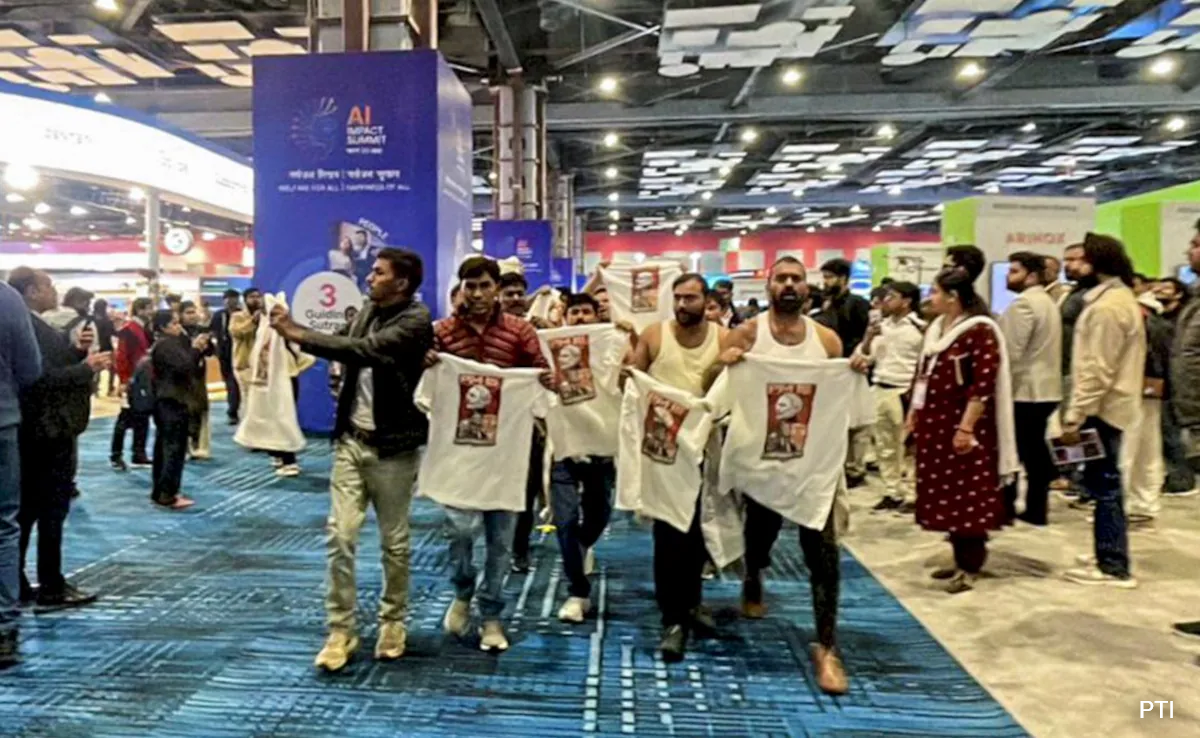
- The police sought 5-day custody of 4 Youth Congress workers arrested during the India AI Impact Summit protest
- The police said the protest was not peaceful and claimed that anti-national slogans were raised
- The Youth Congress workers' counsel argued that the protest was peaceful and constitutionally protected
Seeking five-day custody of the four Indian Youth Congress workers who were arrested during their shirtless protest at the India AI Impact Summit on Friday, the Delhi Police told a court the demonstration bore similarities to the Gen-Z protests in Nepal, and alleged it was part of a conspiracy to defame India internationally.
The four workers were produced before the Patiala House Court in Delhi on Saturday. Public Prosecutor Atul Shrivastava, representing the Delhi Police, alleged that the protest was not peaceful and claimed that anti-national slogans were raised, with references made not only to the Indian Prime Minister but also to US President Donald Trump.
The Delhi Police said three police personnel were injured while attempting to stop the protest, and medico-legal certificates would be submitted before the court.
The investigating officer said custodial interrogation was necessary to confront the accused with each other and examine electronic evidence. They also needed to be questioned, the police said, about the funds for the protest, including the procurement of printed t-shirts.
The police sought recovery of the accused's mobile phones to ascertain whether there was any external funding and claimed that individuals from different states had gathered in a coordinated manner, suggesting a "larger conspiracy."
The defence, however, strongly opposed the plea for remand, describing the case as a "malicious prosecution" and a "political witch hunt." The Youth Congress workers' counsel argued that the protest was peaceful and constitutionally protected, stating there was no video evidence showing any aggression or assault on police officials.
Emphasising that all the accused are office bearers and degree holders under the age of 35 with no prior criminal records, the defence cited the legal principle that "jail is an exception, bail is the rule", particularly in cases where the maximum punishment is below seven years. They also argued that notices could have been issued instead of arrests and questioned the imposition of stringent sections to deter political dissent.
After hearing detailed arguments from both sides, the court granted the police custody of the four men for five days.
Track Latest News Live on NDTV.com and get news updates from India and around the world

