





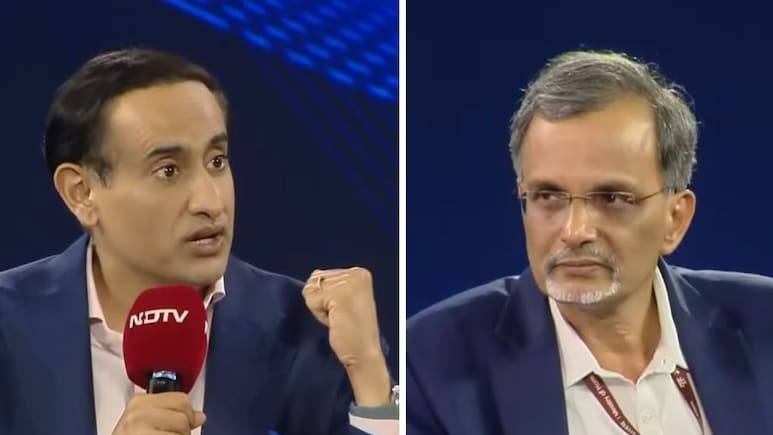
- India's domestic demand remains strong despite Middle East conflict impact, says CEA V Anantha Nageswaran
- Nominal GDP growth expected to reach 12%, surpassing the budget estimate of 10.1%
- Higher nominal GDP base may offset revenue declines from economic uncertainties
Two months of fiscal data since the war in the Middle East began indicate the "worst is behind us" and India is confidently facing the global turmoil while keeping itself safe, Chief Economic Adviser V Anantha Nageswaran said at 'NDTV Ignite: The Future India Summit'. Two factors show why India need not worry, Nageswaran told NDTV Editor-in-Chief Rahul Kanwal. They are: domestic demand has been holding up well, and nominal GDP growth is more likely to hit 12 per cent.
"I think it is still early days, given that we only have one month of fiscal data for the current financial year to talk about the corporate tax revenue or personal consumption, personal taxation. But having said that, it is encouraging - and again one more reason for my relative calmness - so to speak, we have had two months of data, March and April, after the conflict began," Nageswaran said.
"High frequency indicators have shown that domestic demand is holding up very well, and that would naturally mean better revenues for companies. You know that in the fourth quarter of the last financial year, profitability also turned up for Indian companies," he said.
"And then the other good news is that nominal GDP growth which we assumed in the budget to be around only 10.1 per cent is more likely to be 12 per cent. It is 2 per cent higher, which also means better revenue compensation than what we may have assumed," the chief economic adviser said.
He said even if the buoyancy was to go down a little because of economic uncertainty, the higher base of the nominal GDP growth will compensate for a lower buoyancy. "So that is why I think we may not have to be unduly pessimistic on the revenue front."
"I would say now in the last week or so, I'm beginning to breathe a little easier. I can see a glimpse of the possibility of India kind of having seen the worst in terms of potential impact of the ongoing conflict," Nageswaran said, adding there are many reasons behind why he feels the worst is behind us. "First, we are going to have a GDP estimate of 7.7 for last year... I am beginning to breathe a little easier."

To a question about China's policy moves amid the war in the Middle East, Nageswaran pointed out the neighbouring country's "domestic economic stagnation" may be playing a role in the reduction in their crude oil import.
"It could very well be possible that they are playing a conscious stabilising role which I can't rule out. But that said, I would probably attach greater weight to the possibility that their continued domestic economic stagnation is playing a very big role, part in bringing oil prices down and also opening up the urea market for export. But either as it may, regardless of what the underlying cause is, both are helping the Indian economy and our own external situation quite considerably at this point," Nageswaran said.
Hopes grew this morning for peace between Iran and the US after President Donald Trump said a deal could be signed as soon as this weekend, even as Tehran said it had not made a final decision on a pact. The deal, if confirmed, would be the most significant diplomatic breakthrough yet to end the three-month-old war, which has killed thousands and sent global energy prices sharply higher after Iran all but closed the Strait of Hormuz to shipping.
However, if the conflict continues and certain scenarios happen, such as oil production remaining shut and the US deciding its strategic petroleum reserve has come down to a level where they have to refill it, and if the oil price starts going to north of $100 in the second half of the financial year, then an outcome of GDP below 6 per cent is possible, the chief economic adviser said.
"But right now if you ask me, I would say a characterisation by the central bank of 6.6 per cent with a downside risk attached to it which could be somewhere between 20 and 30 basis points on the downside. I think that is more realistic to me as things stand," Nageswaran said.
On Super El Nino
There are still two big unknowns. While one is about energy price rise in the future, the other is about a Super El Nino.
"I don't have the information to say whether we are prepared or not, but I can say reservoir levels are 23 per cent higher than what they were last year. And the sowing by farmers who are aware of the projections by the IMD both in April and May have been much healthier than last year."
"So, farmers seem to be assessing that given the stock of fertilizers and given the reservoir levels, they feel they can handle the impact of Super El Nino on the Karif crop output. That much confidence we can say," the chief economic adviser said.
Track Latest News Live on NDTV.com and get news updates from India and around the world

