





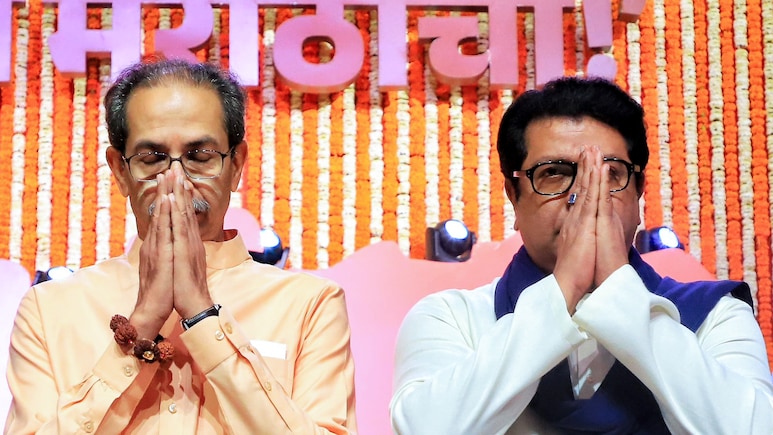
For the last 20 years, every election in Mumbai has come with a whisper - will the Thackerays unite this time? Not just elections, this question has cropped up during moments of crisis too, political or personal, and disappeared just as quietly.
This winter, though, the question hits differently, not because of any dramatic visual of a family meetup, but because of something far more unusual for the Thackerays: planning.
In the last four months, joint protest rallies, carefully curated messaging, and workers from both parties sharing the same stage have replaced last-minute hassles for political adjustment. For a family known more for appealing to emotion, the new approach is hard to miss. And it raises a larger question: have the Thackerays finally learned from their earlier mistakes?
Politics built on emotion more than planning
To understand the importance of this moment, one must go through the history of the 'Thackeray brand'.
Since the creation of the state, political power in Maharashtra has largely oscillated between national forces. The Congress dominated the early decades, with a formidable opposition in the socialists. Later, the Bharatiya Janata Party rose, given the fertile ground created by the Janata Party and the Rashtriya Swayamsevak Sangh (RSS). Besides all of these, Mumbai also produced another force, one that did not fit into any of these boxes.
In the mid-1960s, a sub-nationalist, regionalist, language-driven movement emerged under Balasaheb Thackeray, a surname best known for social reform thanks to Keshav (Prabhodankar) Thackeray.
Bal Thackeray spoke directly to the concerns of the 'timid' Marathi manoos in a rapidly changing metropolis. Supporters viewed the movement as assertive, while critics saw it as divisive, at times even xenophobic. What began as a movement soon turned into a political party, deriving its name from Chhatrapati Shivaji Maharaj - the Shiv Sena.
There were many parties within the constitutional framework, but there was only one Sena.
Emotion has always been central to Sena's politics. Bal Thackeray was among the first leaders in Maharashtra to use identity as an electoral tool. Sentiment often served as the base of the party's strategy, while for many others, it worked the other way around. The party did not lose out on political astuteness either; it was infamously referred to as 'Vasant Sena' for allegedly working at the behest of then Congress Chief Minister Vasantrao Naik to wipe out the socialists from the city.
Shiv Sena's victory in the 1985 Brihanmumbai Municipal Corporation (BMC) polls, followed by the 1987 Vile Parle by-poll win, marked a moment of reckoning, as the party formally married its Marathi-first plank with aggressive Hindutva politics.
This Shiv Sena template became so strong that it later spilt over into Raj Thackeray's Sena, left an imprint on Bal Thackeray's son and grandson, who were often seen as not 'Hindutva' enough, and eventually became one of the reasons an Eknath Shinde from Thane would split the party three decades later.
For all its glamour, the long-term electoral plan around Hindutva remained uncertain, typically so.
The split that never healed
By the mid-2000s, the Shiv Sena had successfully pushed the Congress to second place in Mumbai. But Bal Thackeray grew more wary of his nephew than of political rivals. Raj Thackeray, who walked out of the Sena to form his own party, the Maharashtra Navnirman Sena (MNS), understood the game just as well.
That apprehension soon turned into reality. Just three years after his exit, Raj Thackeray's Maharashtra Navnirman Sena clinched 13 seats in the state Assembly elections.
Attempts at reconciliation were made before the 2012 and 2017 municipal polls, but on both occasions, talks fell apart as egos clashed on every front.
In 2017, the relationship between the two cousins hit a new low. The MNS was reduced to just seven corporators, but six of them later defected to the Shiv Sena. Any residual possibility of reunion, political or personal, was effectively buried.
Raj Thackeray: movement without momentum
After the initial high of 2009, Raj Thackeray's political positioning swung sharply.
In 2014, he backed Narendra Modi for the prime ministerial post, only to be sidelined by the BJP, which chose to ally exclusively with the Shiv Sena. Raj contested that election independently and won nothing.
In the 2019 Lok Sabha elections, he did not field a single candidate but ran a sustained campaign against the BJP, indirectly backing the Congress-NCP alliance. The BJP-led NDA, however, went on to dominate the election once again.
Then came a 180-degree shift. Raj Thackeray reinvented both his party and his own image; the Marathi-first plank was replaced by a Hindu-first narrative. This time, he campaigned openly for the BJP in the Lok Sabha elections. Yet the results told a different story: for the first time in a decade, the opposition outscored the NDA in Maharashtra.
Uddhav Thackeray: power followed by erosion
Uddhav Thackeray's trajectory followed a different curve but led to a similar fate.
After breaking away from the BJP in 2019, he stitched together a unique political experiment, the Maha Vikas Aghadi, which also made him Chief Minister. The alliance with the NCP and the Congress drew criticism, with Uddhav accused of betraying Bal Thackeray's legacy. But such 'unholy' alliances were not unprecedented. Remember Vasant Sena?
The experiment was short-lived. Eknath Shinde rebelled and brought the Maha Vikas Aghadi (MVA) government down.
Uddhav Thackeray lost not just party members and the symbol but also the trust of his newly found allies. Senior opposition leader Sharad Pawar later questioned Uddhav's tenure in his book Lok Majhe Sangati.
As of December 2025, Uddhav Thackeray remains the most recognisable face of the opposition, but his party trails even the third-largest Mahayuti constituent, the NCP, in numbers.
Why this winter feels different
After the debacle faced by the opposition in the 2024 state Assembly elections, the battle for relevance became far more important than before. With the BMC polls approaching, the customary chatter began once again, but this time, the Thackerays approached it differently.
The Hindi language policy introduced by the Devendra Fadnavis-led cabinet offered an opportunity for the brothers to take a common, yet independent, stand first - reviving the tried-and-tested Marathi-first narrative.
The cousins, who had spewed venom at each other just a year earlier, reframed their fight for relevance as the Marathi people's fight for relevance, anchored in the emotive issue of language. It was followed by a show of strength when the government resolution was rolled back. While initially termed strictly apolitical, seasoned commentators could see what was coming.
There has been no rush to announce an alliance or finalise seat-sharing publicly. Instead, workers from both camps were allowed to come together first. Joint rallies in Nashik and Dombivli signalled intent.
In Mumbai, though, it is not just second-rung leaders meeting this time, not even just Raj and Uddhav, but the families too.
An official announcement is still awaited. But sources suggest that groundwork, from seat distribution and campaign themes to emotional messaging, has already been done.
The BJP has publicly dismissed the possibility. "Zero plus zero does not add up to anything," said BJP minister Nitesh Rane.
Yet on the ground, the reunion is being taken seriously. Because for once, the Thackerays seem to have a plan.
Track Latest News Live on NDTV.com and get news updates from India and around the world

