





Berhampore, in West Bengal, serves as the administrative headquarters of the Murshidabad district. Nestled on the east bank of the Bhagirathi River (the local name for the Ganges as it flows into and divides Murshidabad), it was founded and fortified by the British East India Company in 1757.
And, since the colonial era, Berhampore has been the major hub for silk weaving, oilseed milling, ivory carving, and for the gold, silver and brass industries.
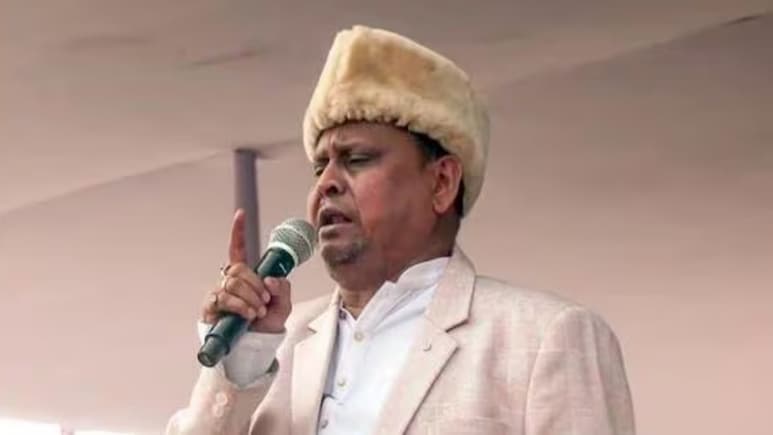
In sharp contrast, on December 6 (the day Babri Masjid was demolished in Ayodhya in 1992), Berhampore caught the national news for a political drama that unfolded, echoing the historical complexities of identity politics itself. A 12-km stretch of National Highway-12, from Rejinagar to Beldanga, remained shut for three hours as several thousand people, some carrying bricks and stone chips, gathered at suspended Trinamool MLA Humayun Kabir's foundation stone-laying for a "Babri Masjid-styled" mosque.
The 62-year-old, wily Kabir, plans to set up the Babri Masjid at the district's Beldanga area, which was rocked by communal violence in April 2025. On December 22, Kabir threatens to set up his new party despite not resigning from the Trinamool, to maintain his privileges as an MLA.
In the past, Kabir has switched parties across the spectrum. In 2015, Kabir was expelled from the Trinamool for six years for anti-party activities. Kabir contested as an independent candidate in the 2016 elections from Rejinagar but lost. He joined the BJP in the 2019 Lok Sabha elections but lost to the Trinamool. He rejoined the Trinamool in 2021 and won as MLA from Bharatpur constituency with more than 42,000 votes.
"I will form a new party that will work for Muslims. I will field candidates in 135 seats. I will become a game-changer in the Bengal election. I am in touch with AIMIM and ISF (Indian Secular Front led by Pirzada Abbas Siddiqui) and will fight the election with them. I had a word with Asaduddin Owasi,” fumes Kabir. The AIMIM officially refused to have anything to do with Kabir. Later, Kabir also claimed he had been in touch with the Congress and the CPI-M. CPI-M's State Secretary and Politburo member Mohammed Salim has maintained silence on the issue. So has the Congress Party.
Kabir dreams of becoming the new Owaisi of West Bengal
The suspension of Kabir has created ripples within the Muslim electorate. His audacious plan to rebuild the Babri Masjid and form a new political front aims to capture the discontent simmering among the Muslim electorate, a demographic that has historically leaned towards the Trinamool under Mamata Banerjee's leadership. Although Muslims are the party of choice for Bengal Muslims, ever since Mamata Banerjee turfed CPI-M, Kabir's threat to form a new party has made the rank and file of Trinamool uneasy, given that the BJP is breathing down its neck.
Kabir's actions attempt to resurrect sentiments akin to those observed in Bihar, where AIMIM's Asaduddin Owaisi challenged the RJD in the Seemanchal region and secured five seats in 2020 and 2025. Much like Owaisi's foray, Kabir's entry highlights a localised yet profound transformation, aiming to redefine the nexus between identity and representation in West Bengal.
Historical Parallels: Bihar and West Bengal
To traverse this political landscape, we must first explore the historical undercurrents that shape Muslim politics in the two neighbouring states. Bihar's Seemanchal, characterised by its significant Muslim population, witnessed Owaisi's rise as a counter-narrative to the dominant RJD hegemony. This challenge was not merely a quest for power; it was a quest for identity, a declaration of autonomy in a landscape where political representation often overshadowed communal aspirations.
The language and caste divisions among Muslims of Eastern India
One cannot help but marvel at the intricate community patterns woven through its diverse Muslim communities from Seemanchal in Bihar to North and Central Bengal. In Bihar, the three major groups—Surjapuri, Shershahbadi, and Kulhaiya—embody not only distinct cultural identities but also the complex interplay of caste-like divisions, dialects, and political affiliations. Each group carries its own story, and together they reflect the broader narrative of a community at a crossroads.
The Surjapuris, the majority Muslim community, with their dialect enriched by a heavy infusion of Urdu, dominate the landscape of Kishanganj. The Shershahbadis, primarily found in Katihar, speak a dialect that is closer to Bengali, resonating with the rhythms of the eastern states, while the Kulhaiyas, deeply rooted in their Maithili-speaking heritage, form a significant populace that grounds the region in its local traditions.
These groups, largely endogamous, navigate their social worlds with a careful adherence to cultural boundaries. Intermarriage is a rarity, a reflection of the deep-seated traditions and identities that each group cherishes. The 2020 assembly elections in Bihar marked a pivotal moment, as Owaisi's AIMIM successfully united the Surjapuri, Kulhaiya, and Shershahbadi communities under a single banner. This coalition resulted in a surprising electoral victory, with the AIMIM securing five seats in 2020 and 2025 in a historic electoral realignment of minority votes.
The divisions among the Muslim electorate in Seemanchal mirror the broader classifications of Ashraf, Ajlaf, and Arzal within Indian Muslim society. These distinctions influence not only social interactions but also the political calculus that governs electoral behaviour. The impending elections in 2026 in Bengal could very well see the fragmentation of the Muslim vote, where identities once unified under Mamata Didi's Trinamool banner in the 2021 assembly elections and the 2024 Lok Sabha, may splinter into factions that dilute their collective bargaining power.
The Muslim Mosaic in West Bengal
Muslims make up 27 per cent of West Bengal's population, according to the 2011 census. They live mostly in the north Bengal districts of Uttar Dinajpur (49.9 per cent share of population) and Malda (51.3 per cent), the central Bengal district of Murshidabad (66.3 per cent) and the south Bengal districts of Birbhum (37 per cent), South 24-Parganas (35.6 per cent), Nadia (26.8 per cent) and North 24-Parganas (25.8 per cent). Political observers point out that the Census figures are outdated; the real numbers of minorities today in these districts are much higher.
In contrast to Bihar, West Bengal's context is rich with its own numbers and nuances. In sharp contrast to Bihar, Bengali-speaking Muslims form the majority in Bengal (the Shershabadis); Urdu-speaking Muslims are a minority. The Muslim electorate here is not a monolith; it is a mosaic of various socio-economic classes, aspirations, and resentments. Bengali-speaking Muslims, largely settled in rural areas, have some commonalities with the culture and origin of Bengali Hindus, whereas Urdu-speaking Muslims, largely settled in urban areas, particularly Kolkata, have a migrant identity from Bihar and Uttar Pradesh.
For instance, in the case of the Urdu-speaking Muslims living in Rajabazar, in Kolkata, their residential segregation is drawn from factors like religion, language, and economic conditions. The majority of those living in these ghettos are engaged in informal economies such as embroidery, paper craft, leather craft, bangle-making, shoe-making, and taxi driving. The area also has six Urdu medium schools where students mostly come from the Rajabazar locality to receive education.
The Trinamool's mantra of minority upliftment has created a loyal constituency, yet this loyalty is fraying at the seams. Historically, the party has thrived on mobilising Muslim votes, particularly in districts like Murshidabad and Malda.
The Shershabadis reside along the left and right banks of the Ganges from Malda, Murshidabad, to Uttar Dinajpur and Darjeeling.
With Kabir's assertion towards forming a new party and fielding candidates across 135 constituencies, he seeks to harness the diverse voices within this constituency—a move reminiscent of Owaisi's strategy but tailored to Bengal's unique fabric.
Can Kabir dent Trinamool's vote banks?
Big question: Will Kabir's initiatives effectively dismantle Mamata's stronghold on Muslim votes?
Election analysts predict a potential shift of around 10-15 per cent of the Muslim vote towards Kabir's fledgling future party, particularly in constituencies where disenchantment towards the party is palpable.
Districts like Murshidabad and Malda, with their significant Muslim populations, could serve as hotspots for this transition, especially in constituencies like Raghunathganj (Muslim voters are 79.9 per cent although BJP won in 2021), in Jangipur parliamentary constituency, in Murshidabad district and the former constituency of Kaliachak in Malda district, which, after the Delimitation Commission orders of 2011, is now split into Mothabari (Muslim voters 67.3 per cent) and Baisabnagar (Muslim voters 48 per cent).
Such estimates at this stage amount to pure speculation. The voter turnout in the previous assembly and Lok Sabha polls in each of these Muslim-dominated constituencies was between 87 to 90 per cent. In some of such constituencies, Kabir might cut a few thousand votes, which might benefit the BJP.
Rhetorically, Kabir has recently thundered that he will be the “king-maker in 2026, given neither the BJP nor the Trinamool is likely to win a majority.”
The rebuilding of Babri Masjid holds symbolic weight in North Bengal
Regardless of Kabir's rhetoric and threats, it is essential to underscore a more qualitative perspective, one that delves into the grassroots sentiments among the populace. The rebuilding of the Babri Masjid holds symbolic weight. It is not merely about the bricks and mortar; it transcends physicality into the realm of identity politics. For many, it could resonate as an assertion of belonging—an affirmation that their concerns, faith, and cultural narratives are not relegated to the sidelines but brought to the forefront. A brilliant sociologist, from Malda, Avijit Pathak, agreed that he has noticed new cultural markers in Malda today which never existed when he was growing up: “Women wrapped in Burkhas, earlier Bengali women, even if Muslims would wear a Sari like Hindu women.”
The Political Tapestry of West Bengal: Can a single rain alter the fate of a harvest?
In the past, Mamata has maintained her grip over the Muslim vote by projecting an image of secularism, development and unity. The BJP calls it “Minority appeasement.” However, Mamata's tenure has also been marred by accusations of political patronage and a failure to address the socioeconomic challenges faced by minorities. Kabir's threat, therefore, is not just a numeric one; it is an ideological one. If he can convince voters that he articulates their concerns more credibly than Mamata, he just might cultivate a new allegiance.
Like in the fertile fields of Bengal, where a single rain can alter the fate of a harvest, the political landscape is fluid, prone to the whims of change. It is within this uncertain terrain that Kabir's challenge could either flourish into a resounding success or wither under the weight of established loyalties.
Power in Numbers: Minorities vote by identity in Muslim majority Constituencies
How do Muslims vote in India? Deep dive research suggests two main arguments.
Yale professor Harry W Blair empirically argued that Muslim voting trends are shaped more decisively by “Numbers”: where Muslims are numerous (enough to be a decisive bloc, like in Murshidabad and Malda), they vote on identity issues only for Muslim candidates. Where Muslims are thinly dispersed, their preferences mirror the majority population because local clientelism and personal ties matter more than communal identity. Where the minorities are a critical block (Between 20 and 30 per cent), they vote for a “Secular party,” like the Trinamool (earlier for the CPI-M and Congress in Bengal).
Harvard-based Feyaad Allie emphasises a different, complementary pattern from the national scene: Since 2019, Indian Muslims have shown a stronger tendency to vote against the BJP as a national choice — a defensive, consolidating move in response to perceived exclusion and insecurity — even while internal divisions (by caste, region, sect) remain important.
Power in Numbers: Sharper polarisation benefits the BJP
Owasi-Humayun Kabir's recent popularity among minorities in Muslim majority areas of Bihar and Bengal conclusively shows that Blair's hypothesis, based on numbers, is more likely to shape Bengal politics in 2026. When minorities vote on identity issues for Muslim candidates, the polarisation is sharper, thus benefiting the BJP-led NDA. The recent Bihar elections indicated in that direction. The Bengal minority voting trends in 2026 are likely to tend in that direction.
As we stand on the precipice of this political reconfiguration, the implications of Kabir's endeavours extend beyond mere electoral strategies. They open a conversation about identity, representation, and the dynamics of communal politics in West Bengal. If Kabir can successfully tap into the latent sentiments of disenfranchised voters, still unhappy with the demolition of the Babri Masjid, he may not only dent Mamata's formidable vote bank but also reshape the contours of Muslim political expression in the state.
Mamata remains a formidable force in Bengal
The formidable Mamata is no Tejashwi Yadav. She has ruled Bengal with an iron fist for 15 years. The Mamata and her nephew Abhishek Bannerjee-led Trinamool's machine politics is as well-oiled as that of the BJP. Despite fierce anti-incumbency, she controls the districts across Bengal. For the BJP, winning Bengal remains a much bigger challenge than sweeping Bihar, piggybacking on Nitish Kumar's popularity.
In this intricate dance of democracy, powered by the dreams and aspirations of millions, the coming campaign in Bengal will illuminate whether new beginnings can indeed sprout from the ashes of nostalgia and dissent. The heart of a community may well be swayed by its anger and aspirations for the future, and in that lies the quintessence of electoral politics in West Bengal.
Track Latest News Live on NDTV.com and get news updates from India and around the world

