





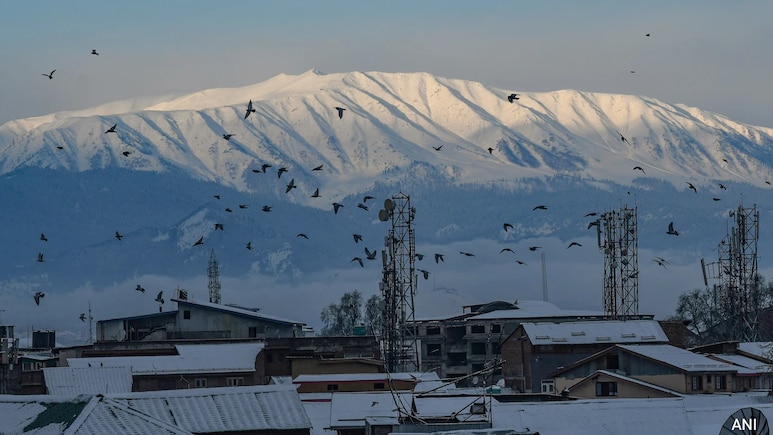
- Several high-altitude regions in Jammu and Kashmir warmed nearly 1 degree Celsius in 20 years
- Elevation-Dependent Warming causes a faster temperature rise at higher altitudes
- Snow-albedo feedback accelerates warming and glacier melting in mountainous areas
A new study by researchers at IIT Kharagpur has raised fresh concerns about climate change in the Himalayas, finding that several high-altitude regions of Jammu and Kashmir have warmed by nearly 1 degree Celsius over the past two decades.
Published in Scientific Reports, the study analyses 44 years of weather data and identifies a clear pattern of Elevation-Dependent Warming (EDW), where temperatures are rising much faster at higher elevations than in the plains. Tourist destinations such as Pahalgam and Gulmarg are among the regions experiencing the fastest warming.
Higher The Altitude, Faster The Warming
The researchers analysed observations from 10 weather stations across Jammu and Kashmir and found that the region's climate is changing unevenly.
Annual temperatures rise by around 0.18 degrees Celsius for every kilometre of elevation. During winter, the warming rate increases to 0.43 degrees Celsius per kilometre every decade, highlighting how mountain regions are heating up much faster than lower-lying areas.
The study attributes this to a phenomenon known as the snow-albedo feedback loop. As temperatures rise, seasonal snow melts earlier, exposing dark mountain rocks beneath. Unlike bright snow, which reflects sunlight, these darker surfaces absorb more heat, accelerating warming and speeding up glacier melt.
The researchers also found that nighttime minimum temperatures are increasing faster than daytime maximum temperatures, particularly at mid-altitude locations such as Bhaderwah. Increased atmospheric moisture acts like an insulating blanket, preventing mountains from cooling efficiently after sunset.
Why Are Jammu's Plains Cooling Slightly?
In contrast to the warming mountains, the plains of Jammu recorded a slight cooling trend.
The study says these areas lack seasonal snow cover, preventing the snow-albedo feedback from taking effect. Researchers also attribute the cooling partly to the expansion of irrigated agriculture. Increased soil moisture boosts evaporation, which removes heat from the surrounding air and creates a natural cooling effect.
Unique Geography
Professor Anuradha Sharma from the Department of Geography at the University of Jammu says the Union Territory's geography makes it especially vulnerable to uneven warming.
Stretching from subtropical plains to Himalayan peaks above 5,500 metres, Jammu and Kashmir spans three distinct climatic zones.
"The IMD data from 10 stations across Jammu and Kashmir shows that warming has remained steady over the past four decades. High-altitude regions have warmed by nearly 1 degree in just 20 years, while some mid-elevation stations are warming by around 0.3 degrees per decade. Even nighttime minimum temperatures are increasing faster than daytime maximum temperatures," she said.
Dr Sharma warned that the changing climate is already affecting the region.
"July 2025 recorded the three hottest days ever observed in the Kashmir Valley, placing additional stress on water resources, especially as the Himalayas serve as India's water tower," she said.
She added that shrinking glaciers and declining winter snowfall could affect agriculture, horticulture, winter tourism, alpine ecosystems, forests, meadows and biodiversity, while also threatening drinking water, irrigation and hydropower supplies across northern India.
"Reduced winter will impact agriculture, horticulture, tourism based on winter sports, increased vulnerability of the Alpine ecosystem, forest, meadows, biodiversity, etc."
Experts say global climate change is being compounded by rapid local development.
Professor BW Pandey, Director of the Centre for Himalayan Studies at the University of Delhi, said the growing number of vehicles entering mountain regions is adding to the problem.
"One of the major reasons is the increasing number of vehicles entering the valley. Tourism, whether leisure, eco-tourism or religious tourism, has expanded rapidly without adequate planning," he said.
He criticised both authorities and the public for prioritising economic gains over environmental protection.
"Whether it is the government or the public and local people, they are looking only for money, not for the environment, and not for the ecology. As a result, there is no ban on the number of vehicles. You can see 5 to 10-kilometre traffic jams on the way to Jammu, Manali, Shimla, and Mussoorie," he added.
This immense traffic logjam traps highly destructive emissions in narrow mountain valleys. "All these vehicles are causing a crisis with the emission of carbon monoxide. This carbon monoxide spreads as black carbon, which is not only increasing the temperature of the Lower Himalayas, but is actually the factor most responsible for glacier melting in the Himalayas and the changing micro-climate," Pandey explains.
Concrete Expansion And Forest Fires
Experts point to compounding vehicular exhaust alongside a massive wave of unregulated construction on mountain slopes. Earlier, a single-story structure was a rare sight, but now heavy four- and five-story concrete buildings can be seen.
"Earlier there were one or two dhabas all the way. Now you can see regular shops all along the road and heavy buildings coming up," Professor Pandey said.
At the same time, prolonged dry spells during both winter and summer have increased the frequency and intensity of forest fires across the Western Himalayas, including Jammu and Kashmir, Himachal Pradesh and Uttarakhand.
Prof. Pandey explains that "because of continuous dryness even during the winter season and extreme dryness in the summer season, there is a greater frequency and magnitude of forest fire." He warns that across these regions, particularly in the Western Himalayas, "the forest fire has increased at multiple levels."
These blazes release massive blankets of carbon directly into the mountain air, trapping even more heat. Ultimately, this feedback loop acts as the final blow to the local environment, serving as the "addition of the release of the carbon in the air of the mountain," which remains a critical "additional factor for rising the temperature in the Himalaya."
A Warning Beyond Kashmir
The findings add to growing evidence that climate change in the Himalayas is no longer a distant concern.
Faster warming at higher elevations threatens glaciers, water security, agriculture, hydropower, biodiversity and tourism across northern India. The researchers and experts say the study underscores the need for stronger conservation measures and climate adaptation strategies before these changes become irreversible.
Track Latest News Live on NDTV.com and get news updates from India and around the world

