





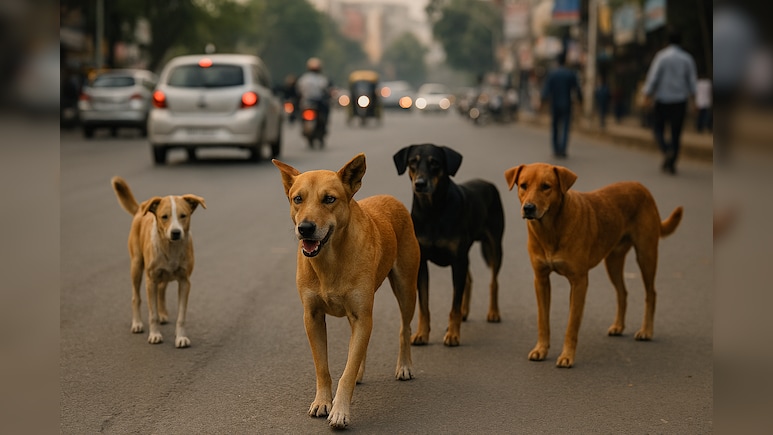
Removing stray dogs from public spaces can cost the government up to Rs 26,800 crore, the Supreme Court was told today. Senior lawyer Krishnan Venugopal, appearing for the country's leading expert Gauri Mulekhi -- who has worked with four states including Uttar Pradesh -- took the top court through the estimates arrived from government data. Informing the top court about successful "Lucknow Model" which has brought down the dog population, the advocate urged the top court to revisit its earlier November 7 order.
Implementing the November 7 order will lay a vast burden on the government, he told the court.
The Dog Population in the country is estimated at 5.25 crore and to shrink the number, at least 1.84 crore dogs will have to be captured and confined to shelters. The cost of feeding them - at Rs 40 each dog each day -- will add up to Rs 73.6 crore a day and Rs 26.8 thousand crore annually. To house them, 91,800 new shelters will have to be built, which would require approximately 16,863 acres across the country.
Besides, provisions must be made for infrastructure construction, manpower training, staff salaries, and other operational costs.
Given the enormity of the burden, the first step to implement the November 7 court order - capturing, sterilization and vaccination of strays -- has not started, he added.
The court was told that while states are taking some steps, these are usually haphazard and so there is no perceptible difference in the outcome.
Mulekhi, who has worked with the Uttar Pradesh government to help bring down the dog population to almost zero, offered some solution, which include a performance linked scheme for budgetary allocation by the Central and state governments.
Given the multi-dimensional nature of the problem, such a scheme should involve multiple ministries, including fisheries, animal husbandry and dairy, housing and urban affairs, panchayati raj, health and family welfare.
It was suggested that the share of expenses be fixed at 60:40 between the Union and the States, and 90:10 for Special Category States.
The expert also suggested the adoption of the "Lucknow Model" which proved a successful pilot project with a facility that includes a dedicated training center for the personnel.
The top court will hear the matter again tomorrow.
Track Latest News Live on NDTV.com and get news updates from India and around the world

