





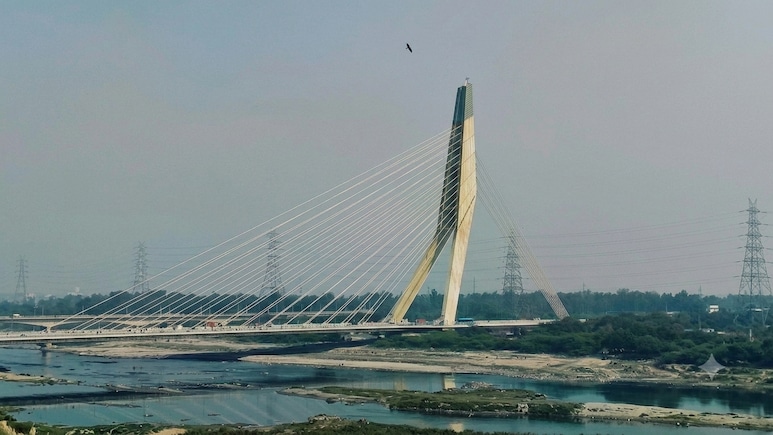
- Audit finds rusting steel and sensor damage on Delhi's Signature Bridge
- Public Works Department plans maintenance and rehabilitation for the cable-stayed bridge
- Bridge Health Monitoring System largely non-functional with many sensors damaged or missing
Rusting steel, damaged and missing sensors, and deterioration of protection around parts of the foundation have been flagged in an audit of Delhi's Signature Bridge, one of the capital's most recognisable landmarks.
The findings have prompted the Public Works Department (PWD) to draw up a maintenance and rehabilitation plan for the cable-stayed bridge, which opened in 2018.
The audit, carried out in July 2026, examined major parts of the structure, including the foundations, steel deck, 154-metre pylon, stay cables, bearings, expansion joints, approach structures, skywalk ramp and the Bridge Health Monitoring System, or BHMS.
One of the key concerns is the BHMS, a network of sensors and software meant to continuously track the bridge's structural condition.
According to a senior Delhi government official, the system was found to be largely non-functional, with several sensors damaged, missing or operating in passive mode.
The proposed overhaul includes sensors to monitor temperature, strain, wind, displacement, acceleration, inclination, corrosion, traffic and force. A new data-acquisition system and control room have also been proposed.
Foundation Concerns, Rusting Steel
The audit has also flagged erosion and deterioration of foundation protection, particularly around the river-side foundations.
But parts of the structure below the water and underground could not be fully inspected because of water flow and safety conditions. The report has recommended a detailed investigation before major work is taken up in these areas.
The proposed measures include removing debris and silt, restoring damaged protective concrete and adding scour protection where required.
The skywalk ramp has emerged as another area of concern.
Its steelwork showed severe corrosion, rust scaling and coating failure, the audit found. Corrosion was also noticed at joints, splices and fasteners. A detailed assessment and rehabilitation of the affected steelwork have been recommended.
The report has also flagged corrosion of the steel deck, deterioration of the pylon coating, issues requiring attention around stay-cable anchorages and wax leakage, as well as the need for cleaning of expansion joints and drainage maintenance.
Deficiencies were also identified in some pendulum-bearing components.
Hidden Defects Cannot Be Ruled Out
The report, however, makes an important point: the assessment was primarily based on a visual inspection.
That means concealed or inaccessible defects cannot be ruled out without specialised testing. Such tests have been recommended before major structural interventions are carried out wherever required.
PWD Minister Parvesh Verma said the bridge had been handed over to the department only a few months ago and its maintenance requirements were now being assessed.
"Every component of the bridge must remain safe, strong and properly maintained. We will not allow past gaps in maintenance to become future risks," he said.
The audit has recommended monthly routine inspections and detailed inspections every six months. Specialised inspections have also been proposed after extreme weather, flooding, accidents or other incidents that could affect the bridge's structural condition.
A five-year preventive and corrective maintenance programme has also been proposed as the PWD prepares to address the issues flagged in the audit.
Track Latest News Live on NDTV.com and get news updates from India and around the world

