





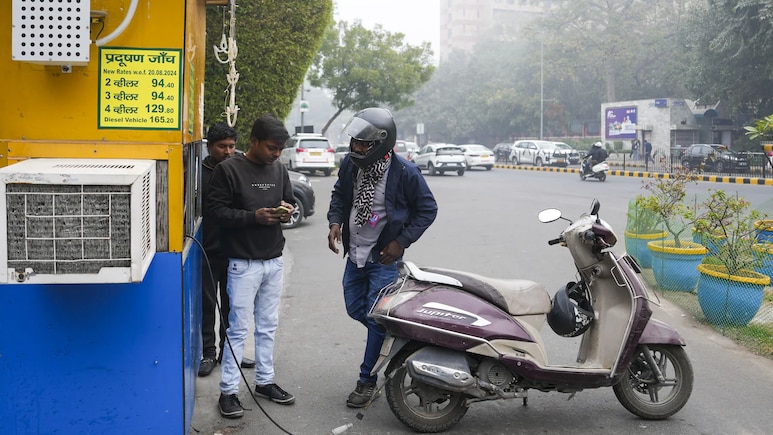
Even as GRAP-IV restrictions are rolled back, Delhi's toughest check on vehicle pollution is here to stay.
The Delhi government announced on Tuesday that vehicles without a valid Pollution Under Control Certificate (PUCC) will be permanently barred from refuelling in the capital. The move signals a shift toward year-round enforcement of emission norms rather than just temporary emergency measures.
Following a Cabinet meeting, Environment Minister Manjinder Singh Sirsa confirmed the "No PUCC, No Fuel" policy is now a standing rule.
"A vehicle running without a valid PUCC is committing a crime against Delhi's air. There will be zero tolerance," Sirsa said.
Rs 10,000 Fine, Rising Checks
Vehicles found operating without a valid PUC certificate will continue to face a Rs 10,000 penalty, as per existing provisions. Officials said intensified checks across the city have already revealed a growing number of violators, prompting the government to keep enforcement tight even beyond GRAP.
The impact of the crackdown is already visible. According to official data, 47,600 PUC certificates were issued on December 19 alone, while over one lakh certificates were generated during the three-day enforcement drive between December 17 and 19.
Since the implementation of GRAP-IV, more than 10,000 vehicles have failed emission tests, while over two lakh vehicles have obtained valid PUC certificates.
PUC Centres Under Scanner
The enforcement drive has also turned the spotlight on PUC centres themselves. Recent inspections found serious irregularities at several PUCC centres, including defective equipment and non-functional systems.
As many as 12 centres were suspended and issued notices, officials said, adding that surprise inspections and continuous verification will continue to prevent manipulation and protect the credibility of emission certification.
Big Shift In City Bus Operations
Alongside pollution control measures, the Cabinet cleared a major transport reform, the transfer of operational control of city bus services from DIMTS to DTC, effective from the next financial year.
The move aims to bring all bus operations under a single authority to improve efficiency, accountability and service delivery.
Transport Minister Pankaj Singh said the shift will help streamline route planning, reduce overlaps and improve monitoring.
DIMTS currently manages around 2,500 of DTC's 5,200 buses, handling route planning, scheduling and monitoring.
Officials said the transition is also expected to provide greater employment stability to drivers and conductors working under outsourced arrangements, with a unified command structure allowing quicker decision-making.
New Automated Testing Stations Cleared
The Cabinet also approved the operationalisation of four new Automated Vehicle Testing Stations (ATS) in the coming days. These technology-driven centres will conduct fitness and emission tests for commercial vehicles, reducing human intervention and improving transparency.
Permission has also been granted to set up additional commercial vehicle testing facilities to meet rising demand.
With fuel stations, emission certificates, bus operations and fitness tests now under tighter scrutiny, the Delhi government has made it clear that transport will remain at the heart of its clean air push. "From fuel stations to fitness tests, every link in the transport chain is being monitored. No polluting vehicle will be allowed to operate unchecked," Sirsa said.
As GRAP restrictions ease but enforcement stays firm, the message to vehicle owners is unambiguous: compliance is no longer seasonal. The question now is whether sustained checks and tougher penalties will finally translate into cleaner air for Delhi year-round.
Track Latest News Live on NDTV.com and get news updates from India and around the world

