






In the Indian Constitution, few provisions are as politically consequential and as frequently contested as the anti-defection law contained in the Tenth Schedule. Today, that framework was tested when a significant bloc of Rajya Sabha members from the Aam Aadmi Party (AAP), led by Raghav Chadha, announced their exit from the party, and put the spotlight on a constitutional safeguard that hinges on a precise numerical threshold -- two-thirds.
The anti-defection law, introduced through the 52nd Constitutional Amendment in 1985, was designed to curb political defections motivated by office or power. It sets out conditions under which legislators can be disqualified for switching parties.
However, the law also provides specific exemptions that deal with mergers.
READ | Swati Maliwal, Harbhajan Singh: Raghav Chadha Names 7 AAP MPs Joining BJP
Under this provision, a Rajya Sabha member is not disqualified if their original political party merges with another party, and they either join the new party formed after the merger or choose to function as a separate group.
Crucially, such a merger is legally recognised only if at least two-thirds of the members of the legislature party agree to it.
READ | Raghav Chadha's BJP Shocker For Arvind Kejriwal. 6 Other MPs To Switch Too
The Tenth Schedule of the Constitution states explicitly that a merger is deemed valid "if, and only if, not less than two-thirds of the members of the legislature party concerned have agreed to such merger."
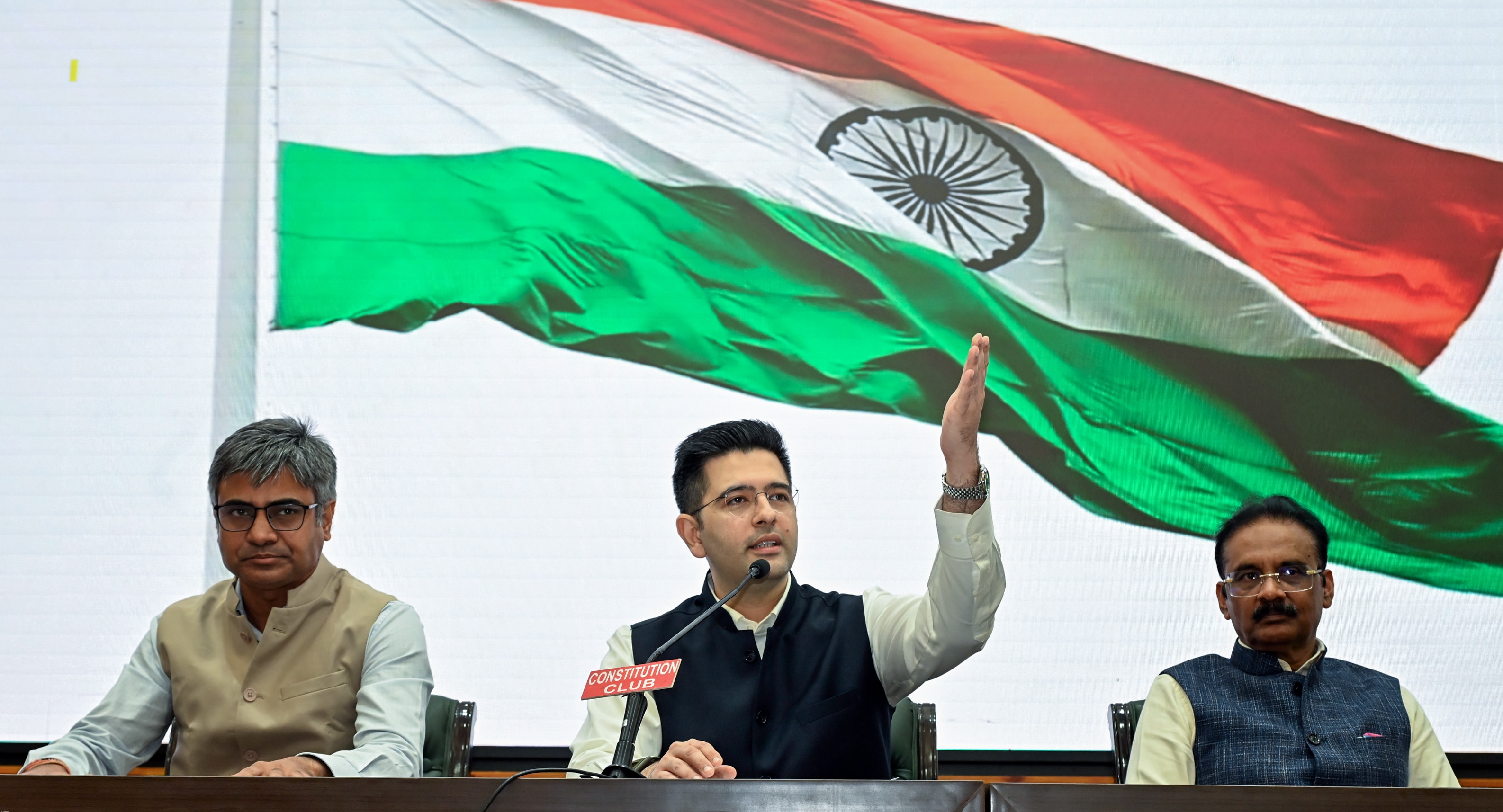
AAP MPs Raghav Chadha, Sandeep Pathak, and Ashok Mittal during a press conference, at Constitution Club, in New Delhi on Friday.
Photo Credit: ANI
Why "Two-Thirds" Matters
Had Chadha, 37, resigned alone -- or even as part of a small group -- he would have been immediately liable for disqualification under the anti-defection law. His Rajya Sabha membership would have been at risk.
READ | Arvind Kejriwal's First Reaction On Raghav Chadha's Switch To BJP
Instead, by ensuring that at least two-thirds of AAP's Rajya Sabha MPs acted in cohesion, the group effectively shielded itself from disqualification. In constitutional terms, their move qualifies not as defection, but as a merger or split recognised under the Tenth Schedule.
Why Raghav Chadha Quit AAP
In what Chadha described as a difficult but necessary decision, seven of AAP's ten Rajya Sabha MPs announced their departure from the party.
The group includes Chadha, Swati Maliwal, Harbhajan Singh, Sandeep Pathak, Ashok Mittal, Rajinder Gupta and Vikram Sahney.
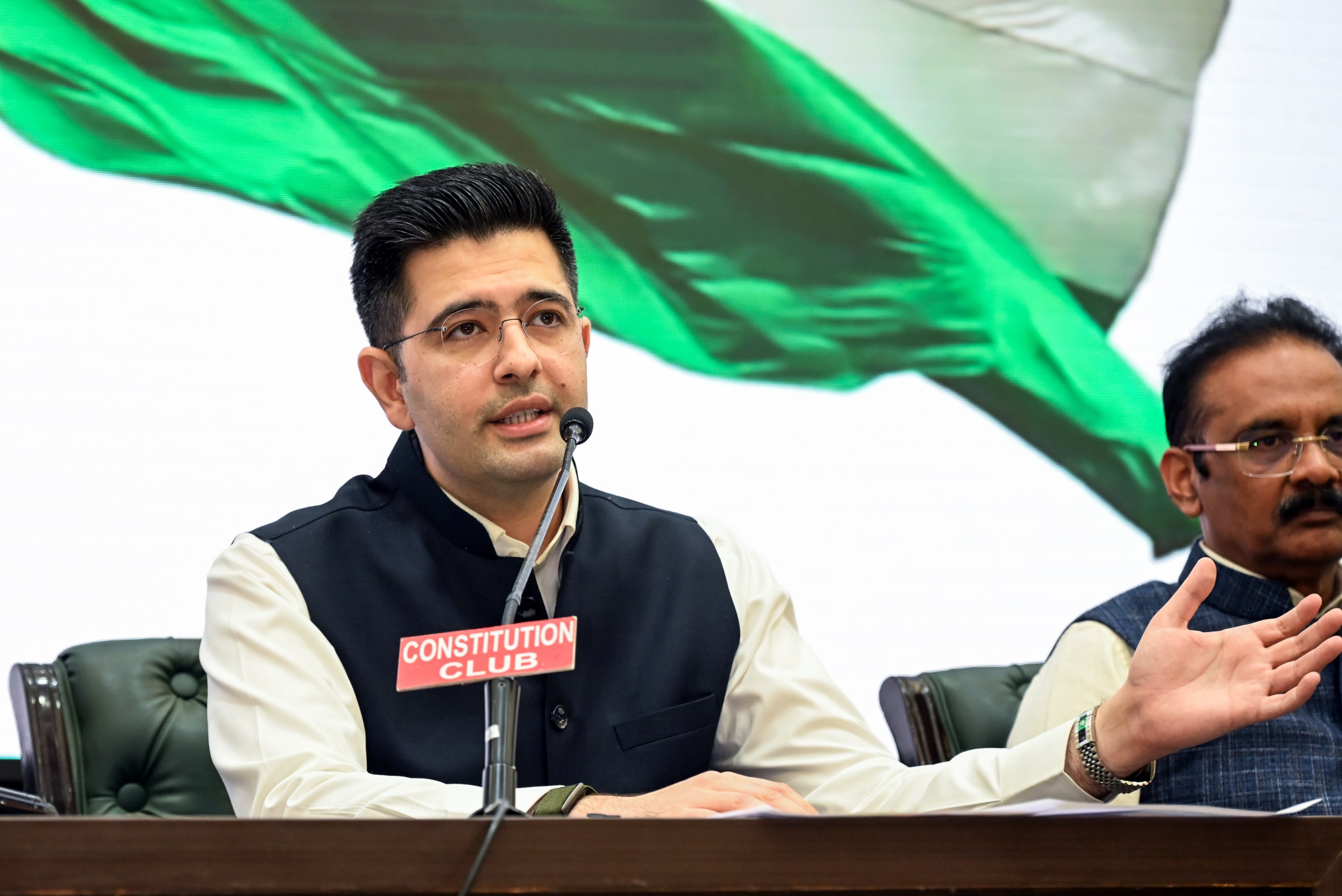
AAP MP Raghav Chadha addresses during a press conference, at Constitution Club, in New Delhi on Friday.
Photo Credit: ANI
"In the Rajya Sabha, the Aam Aadmi Party has 10 MPs. More than two-thirds of them are with us in this initiative," Chadha said at a press conference today. "They have already signed, and this morning we submitted all the required documentation, including signed letters and other formal paperwork, to the chairman of the Rajya Sabha."
Once among AAP's most prominent national faces, Chadha framed his exit as a response to what he described as the party's deviation from its founding principles.
READ | Raghav Chadha Reveals "Real Reason" Why He, 6 AAP MPs Are Joining BJP
"AAP, that I nurtured with my blood and sweat and to which I gave 15 years of my youth, has completely strayed from its principles, values and core morals," he said. "Over the past few years, I have increasingly felt that I am the right person in the wrong party."
Without naming individuals directly, the remarks were widely interpreted as criticism of the leadership under AAP chief Arvind Kejriwal.
"Today, I announce my decision to move away from AAP and work more closely with the 'janata' (public)," he said.
The move comes shortly after Chadha's removal as deputy leader of AAP in the Rajya Sabha. He was replaced in that role by Ashok Mittal, who is now among those leaving the party.
Track Latest News Live on NDTV.com and get news updates from India and around the world

