





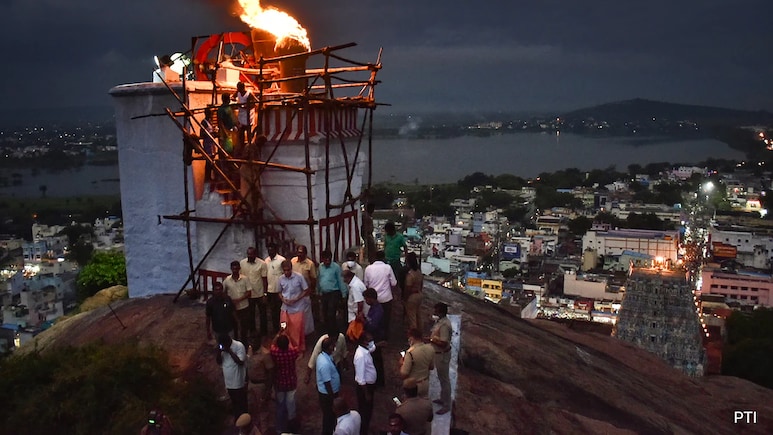
Arguments concluded on Thursday in the writ appeal related to the long-running dispute over lighting of a lamp at Thiruparankundram hill, with the Tamil Nadu government strongly contesting a single judge's earlier order permitting the petitioner to light a deepam on an ancient stone pillar near the dargah at the hilltop. The Division Bench of the Madurai Bench of the Madras High Court has reserved its judgment, without indicating a date.
During its submissions, the state government argued that there is no historical, documentary or archaeological evidence to establish that the pillar located near the dargah is a "deepathoon" — a designated pillar meant for lighting lamps. The government maintained that there is also no proof to show that deepam lighting was ever carried out at that location in the past, despite the single judge directing that lamps be lit there.
The state contended that the single judge had passed the order without clear and strong evidence, and without the authority to alter long-standing temple traditions. Referring to a 1929 order, the government pointed out that there was no mention of any deepathoon near the dargah, adding that had such a structure existed, it would have been recorded at that time.
The government further argued that the petitioner's plea itself was not maintainable under writ jurisdiction and should have been adjudicated only by a civil court, especially as the issue touches upon questions of ownership, trusteeship and administration of temple property. The counsel warned that the impugned order shakes the very fundamentals of temple management.
Raising a broader legal question, the state asked whether an individual could stake a claim to light a lamp at a particular spot within temple or government property, stressing that the pillar is not private property for any individual to assert exclusive rights.
Multiple parties echoed similar concerns. The Wakf Board and representatives of the dargah argued that the pillar belongs to the dargah and that any ownership dispute must be settled in a civil court. The police submitted that enforcing the single judge's order could disturb public peace and order, and that courts should exercise restraint in religious matters.
The Devaswom Board told the court that temple administration cannot be compelled, noting that deepam lighting has been carried out for over a century strictly in accordance with Agama rules at designated locations. The HR&CE Department argued that the hilltop pillar bears no Nayak-era symbols and is not a deepathoon, though it added that Jain (Samanar) saints may have used similar pillars for lighting lamps in ancient times.
On the other hand, the petitioner countered that claims of potential law and order problems by the district administration and police were merely a ploy to delay implementation of the single judge's order.
With arguments from all sides concluded, the court has reserved its verdict.
Track Latest News Live on NDTV.com and get news updates from India and around the world

