





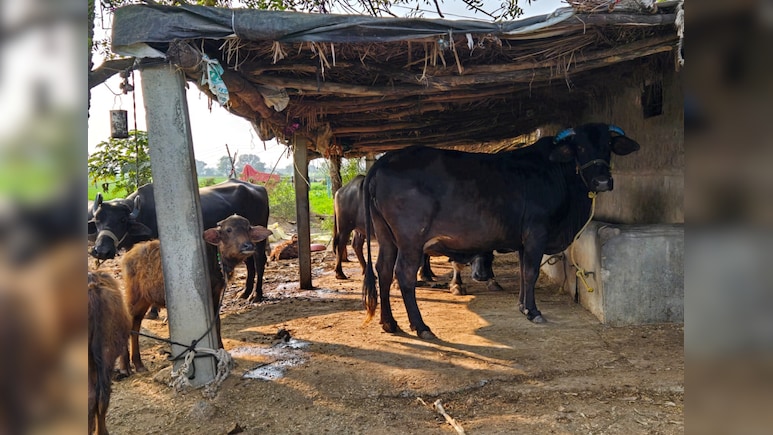
In a major step aimed at tackling the growing menace of stray cattle on roads and farms, the Madhya Pradesh government's proposal to tag nearly 40 lakh stray cattle with unique 12-digit saffron identification tags has received in-principle approval from the Centre.
The plan seeks to introduce distinct colour-coded tags, including saffron and red, to clearly differentiate stray cattle from domesticated animals, enabling authorities to identify and manage them more efficiently.
Additional Chief Secretary (Animal Husbandry) Umakant Umrao said the state had formally requested the Centre for colour distinction in cattle tags after authorities faced repeated challenges identifying stray animals under the current system.
“All cattle are currently tagged in yellow, which makes it difficult to distinguish between owned animals and homeless cattle. The state proposed using different colours such as saffron or red for stray cattle. The proposal has received in-principle approval from the Government of India,” Umrao said.
Under the plan, every stray or abandoned cow living in shelters or roaming outside will be assigned a unique 12-digit identification tag under the Bharat Pashudhan project, part of the National Digital Livestock Mission, which aims to digitise livestock data across the country.
Officials say the colour-coded tags will allow municipal teams and cattle-catching squads to visually identify stray cattle instantly, without needing to scan the tags, a step expected to make cattle management more efficient.
The tagging move comes as the state continues to struggle with the rising problem of stray cattle affecting both public safety and agriculture.
According to data presented in the Madhya Pradesh Assembly, 237 road accidents linked to cattle were recorded in the past two years, resulting in 94 deaths and 133 injuries. The figures suggest that, on average, one person dies every third day in the state due to accidents involving cattle on roads.
Farmers across several districts have also complained about stray cattle destroying standing crops, especially during the Kharif season, forcing many to guard their fields through the night.
Despite widespread crop damage, the government has acknowledged that no compensation system currently exists for farmers affected by stray cattle. During the winter session, Animal Husbandry Minister Lakhan Patel told the Assembly that the department does not maintain data on crop losses caused by cattle and that no proposal for financial assistance is under consideration.
The scale of the issue is reflected in enforcement data as well. In 2025 alone, authorities seized 78,153 stray cattle, while owners who reclaimed their animals paid over Rs 25.58 lakh in penalties.
Abandoning cattle is punishable under the Madhya Pradesh Cow Slaughter Prohibition Act, 2004, while amendments to the Madhya Pradesh Municipal Corporations Act, 1956 allow authorities to detain cattle and impose fines of Rs 200 for the first offence, Rs 500 for the second and Rs 1,000 for the third. Owners must also pay Rs 150 per day towards feeding expenses while the animals remain in custody.
Meanwhile, the state's shelter infrastructure is already under pressure. Under the Mukhyamantri Gauseva Yojana, along with NGOs and local bodies, nearly 4.5 lakh cattle are currently housed in registered gaushalas, with the state allocating Rs 296.20 crore in the 2025-26 budget for their maintenance.
Officials say the deeper cause of the crisis lies in cattle productivity. According to livestock census estimates, nearly 70 percent of cows in the state belong to low-yield nondescript breeds, many producing less than half a litre of milk per day.
Once such cattle stop producing milk, they are often abandoned, eventually ending up on roads or in fields.
To address this, the state government is pushing breed improvement programmes under the Ksheerdhara Gram Yojana, targeting around 5,000 villages to improve cattle productivity and reduce abandonment.
Authorities are also exploring linking livestock records with digital databases through the Pashudhan App, which would store ownership and breed data for better monitoring.
For now, however, the most visible symbol of the new strategy may soon appear across highways and villages in Madhya Pradesh, a saffron tag on the ear of a stray cow, marking both its identity and the state's attempt to bring order to a growing cattle crisis.
Track Latest News Live on NDTV.com and get news updates from India and around the world

