



India and the United Arab Emirates (UAE) have deepened their strategic partnership by signing a $3 billion LNG supply agreement between ADNOC Gas and HPCL (0.5 mtpa for 10 years starting 2028), along with a Letter of Intent (LoI) to work toward a Strategic Defence Partnership/Framework and other cooperation instruments. Far beyond a transactional buyer-seller relationship, the LoI signals a long-term vision: India and the UAE intend to work together as security and technology partners, not just economic allies.
This development comes at a time when India has been rapidly expanding its defence relationships across the world. The United States remains one of India's most consequential defence partners, with agreements enabling logistics access, secure communications, joint military exercises, and growing cooperation on defence technology and manufacturing. France, best known for the Rafale fighters, is another key supplier and codevelopment partner, while Russia, India's longtime strategic ally, continues to collaborate on missiles, aircraft, submarines and joint projects such as the BrahMos.
India has also strengthened defence ties with Israel (drones, air defence, surveillance), Japan and Australia (Indo-Pacific security architecture), and South Korea (artillery systems and industrial partnerships). These relationships indicate a structural shift: India is diversifying its defence partners and becoming a participant in technology sharing and joint development, not merely an importer.
But how dramatically is India's own defence sector growing?
A Decade of Rising Defence Production
According to the Ministry of Defence, India's defence production has grown sharply, from Rs 53,000 crore in 2015-16 to Rs 1,50,600 crore in 2024-25, nearly tripling in less than a decade. This rise reflects stronger domestic manufacturing, private-sector participation, and major procurement from Indian industry.
Defence exports have risen even more spectacularly. From Rs 2,100 crore in 2015-16, exports reached Rs 26,000 crore in 2025-26, a jump of more than 1,100%.
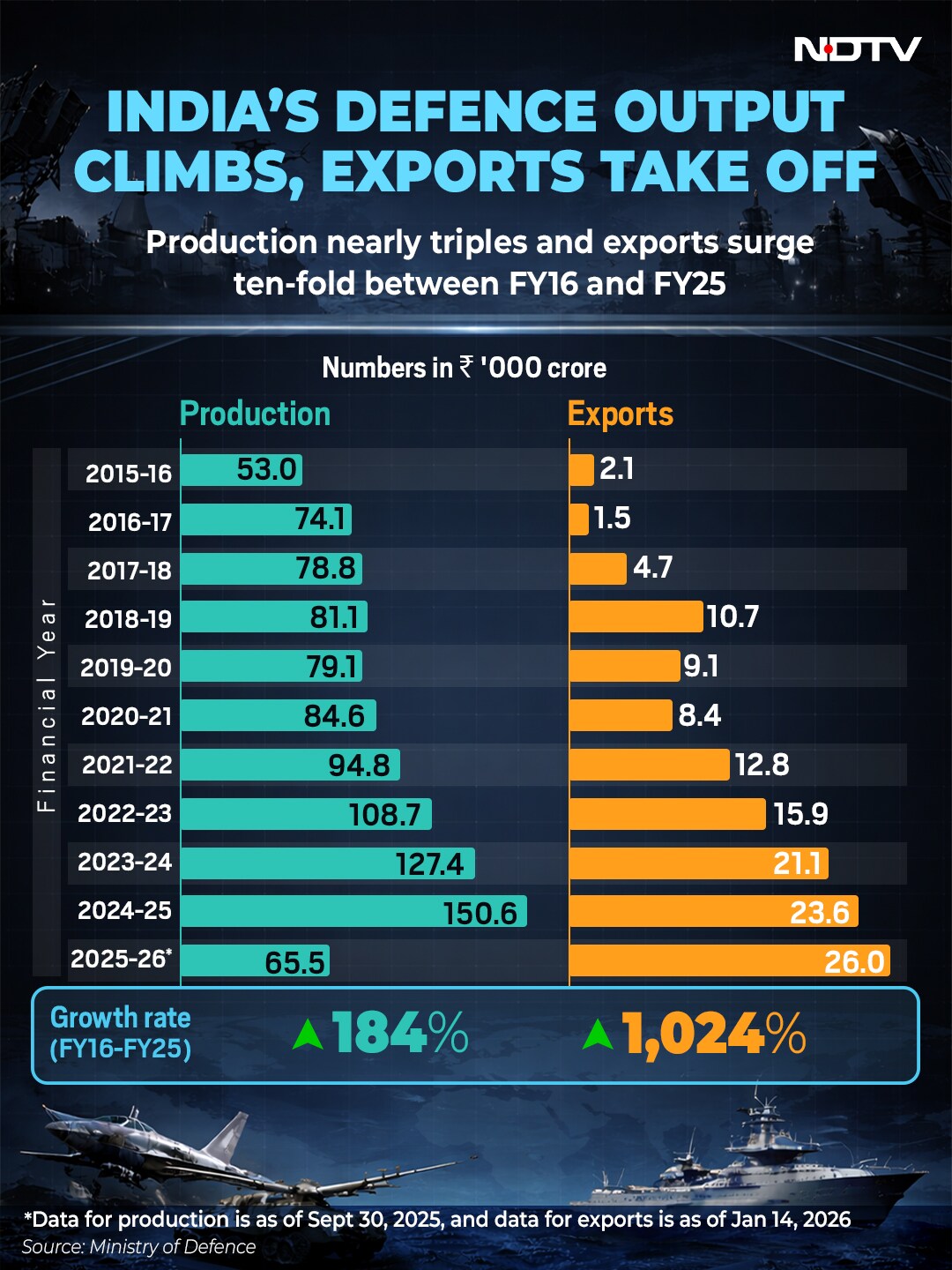
Long-term figures reinforce this trajectory. Data from Ministry of Defence reveals that between FY16 and FY25, India's defence production grew by 184%, while exports surged by 1,024%, underscoring India's transformation into an emerging global defence player.
Where and What India is Exporting
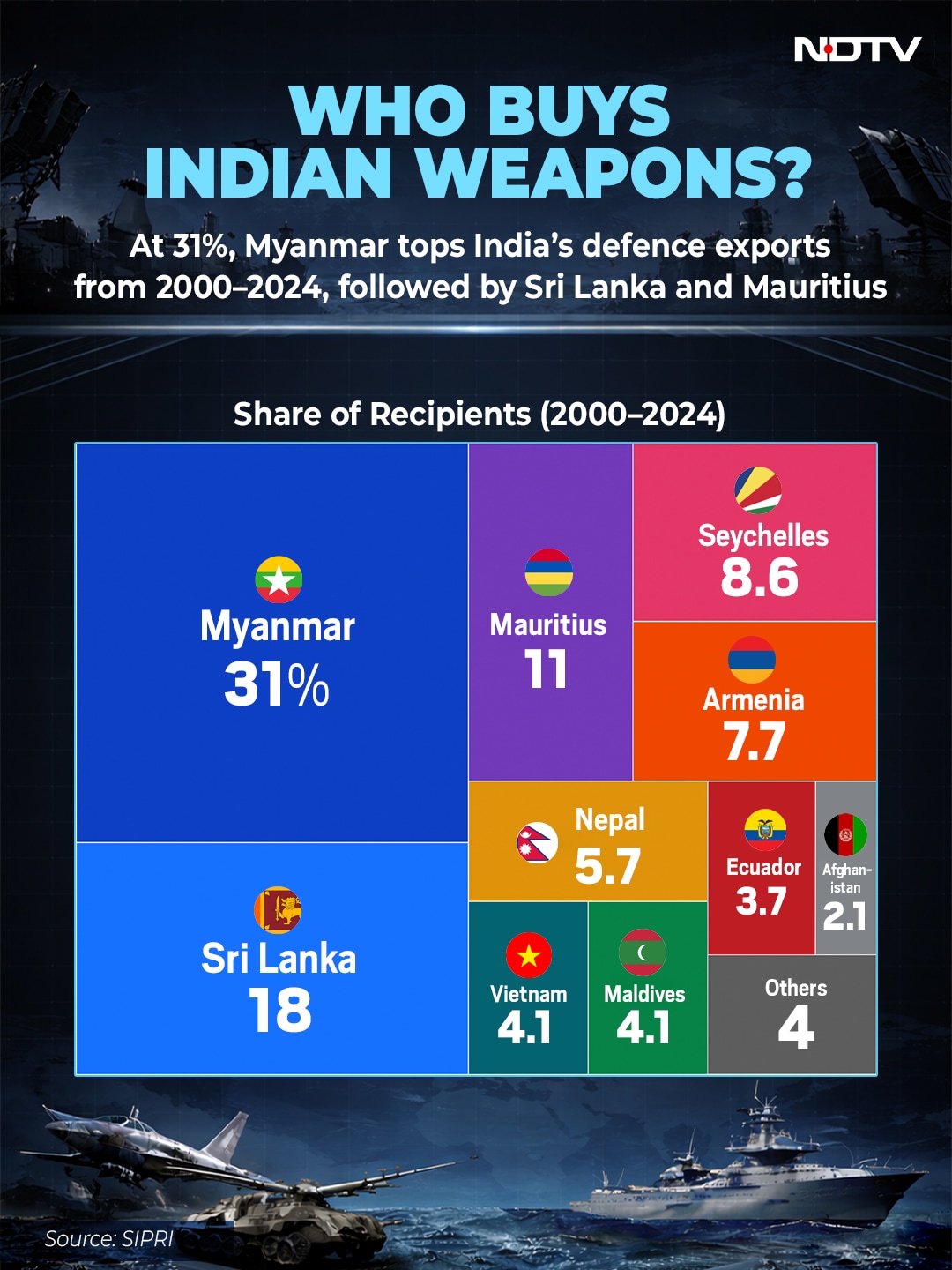
SIPRI data for 2000-2024 shows that India's exports are still concentrated in its neighbourhood and the Indian Ocean Region.
Myanmar accounts for 31% of India's defence exports.
Sri Lanka follows with 18%.
Mauritius accounts for 11%.
Together, these three nations represent about 60% of India's total defence exports. Other recipients include Seychelles and Armenia, marking India's expanding reach into the Eurasian region as well.
During the same period, India's defence exports were dominated by naval platforms. Ships made up 429 transfers, or 58.4% of all exports. They were followed by aircraft, which accounted for 19.5%, and sensors at 14.4%.
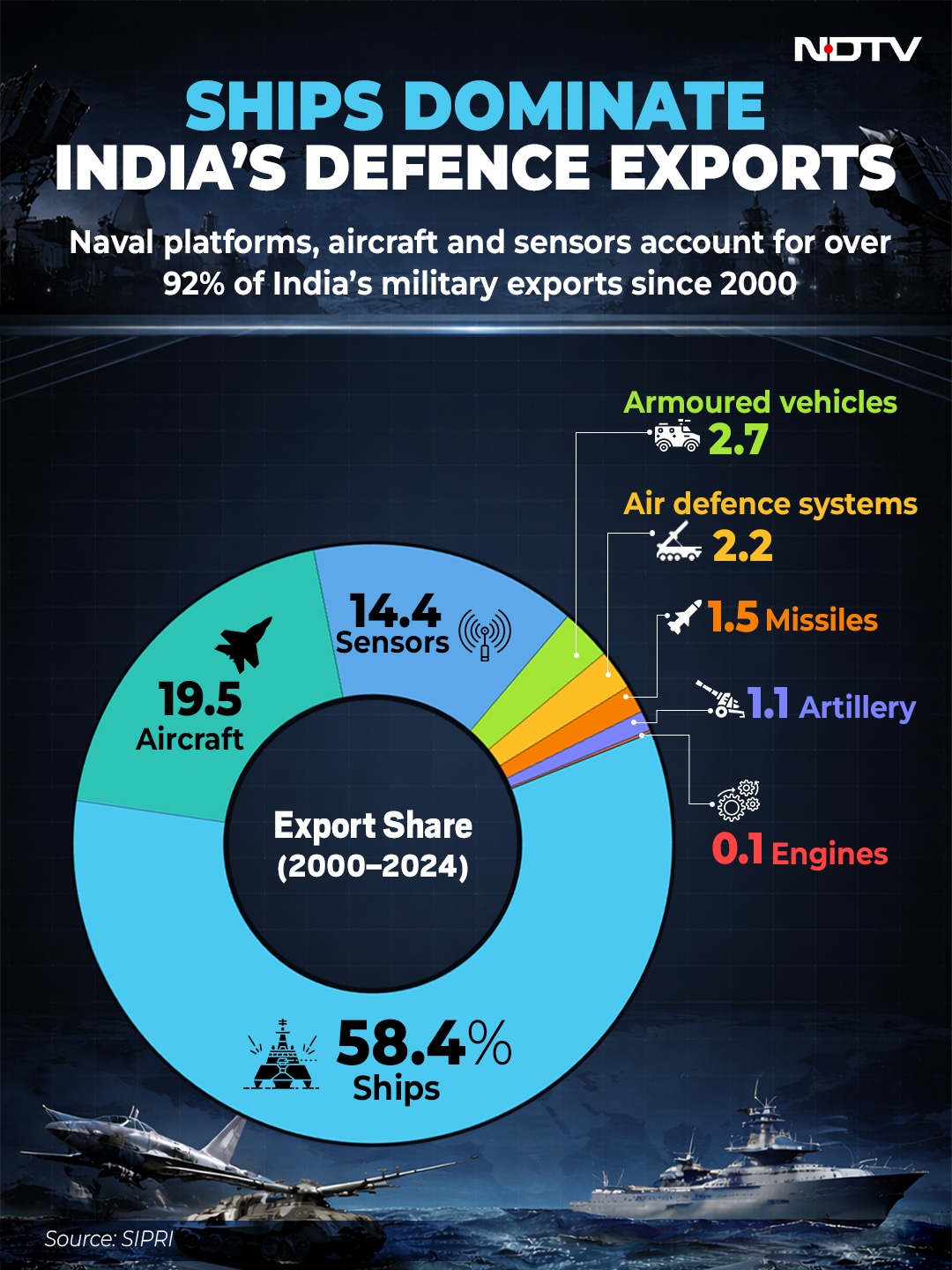
These three categories alone represent over 90% of India's defence exports. Beyond these, India has also exported armoured vehicles, air defence systems, missiles, and artillery across 734 recorded transfers.
Post-Operation Sindoor: The BrahMos Effect
After the success of Operation Sindoor, India's defence capabilities, especially the BrahMos supersonic cruise missile, gained unprecedented global attention. Several countries initiated discussions or signed contracts to procure the system.
The Philippines became the first to finalise a BrahMos deal, receiving multiple batteries across 2024 and 2025. Countries like Vietnam, Indonesia, and Malaysia entered advanced negotiations, attracted by the missile's battlefield credibility. Interest also surged in Brazil, the UAE, and Saudi Arabia, with all three expressing willingness to procure BrahMos following its reported deployment.
This wave of interest marks one of the most significant expansions in India's global defence footprint-a sign that the country's indigenous military technology is entering a new era of international demand.
Track Latest News Live on NDTV.com and get news updates from India and around the world

