





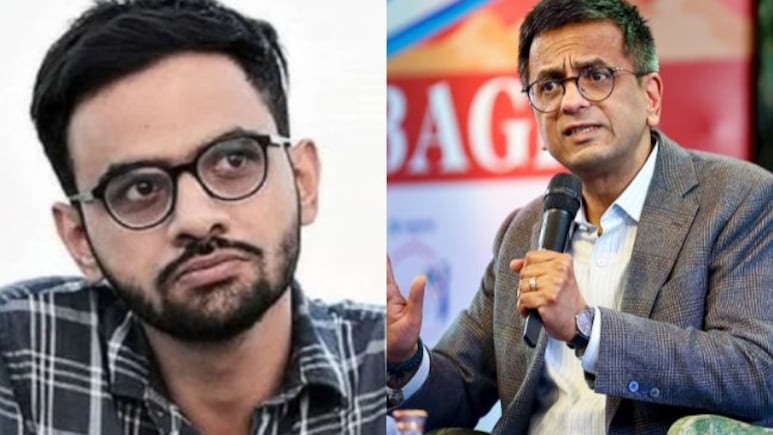
Former Chief Justice of India DY Chandrachud on Sunday said bail before conviction should be a matter of right, but asserted that it is a court's duty to examine a case in depth where national security is involved before granting such a relief.
He made the remarks at the Jaipur Literature Festival in response to a question from journalist Vir Sanghvi, who raised the issue of the Supreme Court recently denying the bail plea of activist Umar Khalid in the 2020 Delhi riots conspiracy case.
"I'm speaking now not as a judge but as a citizen," he said. "It's about the right to bail before conviction. Our law is based on the presumption of innocence - every accused is innocent until proven guilty in trial. Pre-trial bail cannot be punishment. If someone spends five-seven years as an undertrial and then gets acquitted, how do you compensate for the lost time?"
Chief Justice Chandrachud explained it with an example: a serial rapist-murderer arrested for seven murders could repeat the crimes in society, and that's a classic case for denying bail. Second, after bail, if the person doesn't appear for trial and flees. Third, if they tamper with evidence.
"If none of these three exceptions apply, bail is the rule. The problem today is that national security laws replace innocence with guilt," the former Chief Justice of India said.
"Courts must check if national security is truly involved and if detention is proportional. Otherwise, people rot in jail for years."
He said the criminal justice system's issue is that trials don't conclude in a reasonable time. If so, it violates Article 21's right to speedy trial. Even if a law denies bail, the Constitution is supreme. So, absent exceptions, bail should be granted, he added.
Umar Khalid has been in jail for five years.
"I'm hesitant to criticise my own court because I led the institution just a year ago. But these principles say you can impose conditions, but must ensure an expeditious trial. If an expeditious trial isn't possible, bail should be the rule and not an exception," Chief Justice Chandrachud said.
He said high courts and district courts have a habit of denying bail - a worrying trend. District courts are the first interface.
The reason is a culture of distrust toward authority in the country, he said.
"Judges think, 'if I grant bail, my motive will be questioned'. In financial fraud cases, the judge's integrity comes under suspicion. Better to let them go to high court. The result: 70,000 cases pile up in the Supreme Court annually."
"If a district judge grants wrong bail, like in a dowry murder case, reverse it. But don't apply moral pressure. This creates an ecosystem where judges fear. A high court's small observation can destroy a career, affect promotions. This is an assessment issue for trial judges."
On corruption, Chief Justice Chandrachud said, "I'm not justifying it, judges come from society. Society has corruption. But higher standards are expected from judges. Yes, corruption exists. To stop it, we need an efficient accountability system. Calling a wrong judgment corrupt is easy, but we must see the truth."
On the personal front, the former Chief Justice of India said he belongs to the Baby Boomer generation. "But I have two daughters with special needs who are Gen Z. To stay connected to their lives, I have to follow the Gen Z way of working."
Referring to his book, he added that it's a collection of speeches, not a strict legal book.
"I was reading it and checked the references - they include the US Supreme Court, Indian Supreme Court, and philosophers like John Stuart Mill and Kant, as expected."
While drafting the judgment decriminalizing homosexuality, he recalled a quote from Leonard Cohen about "democracy in some danger." He said the judgment should have flourish.
"Some judgments are written on the middle road; others include a bit of flourish."
Track Latest News Live on NDTV.com and get news updates from India and around the world

