





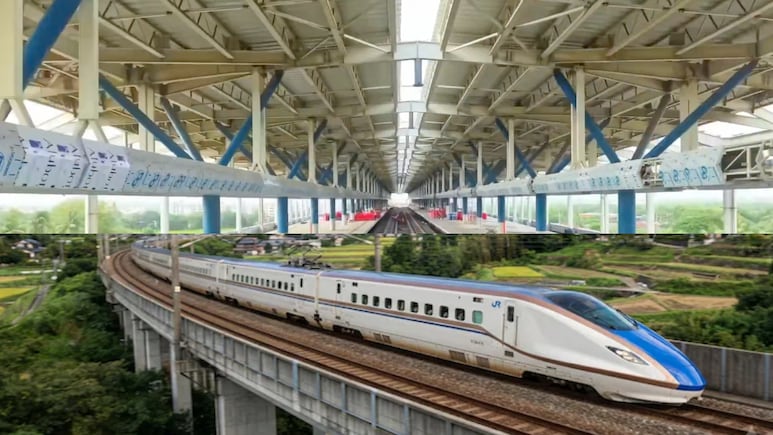
India's first bullet train is taking shape, with the Mumbai-Ahmedabad corridor introducing several technologies that are new to the country's railway network. The train will be capable of speeds of up to 320 kmph, making even a routine operation such as changing tracks a complex engineering challenge. The National High-Speed Rail Corporation Ltd (NHSRCL), which is building the 508-km corridor, is using canted turnouts to allow trains to switch tracks smoothly while maintaining the track's banking. The technology is designed to reduce sudden forces, vibration and discomfort when the train changes tracks at high speed.
What Happens When A Train Changes Tracks?
On conventional railway networks, the point where one track branches into another is generally laid without the same banking used on a curved section of track.
When a train passes through such a turnout, the wheels encounter a sudden change in the geometry of the track. At higher speeds, this can result in increased forces, vibration and passenger discomfort.
As a result, conventional trains have to slow down considerably when negotiating certain track changes. But for a high-speed rail corridor, like the Mumbai-Ahmedabad bullet train track, a different technology is applied.
What Is A Canted Turnout?
A canted turnout keeps the cant, or banking, of the track through the track-switching section.
On a normal curve, the outer rail is raised relative to the inner rail. This banking helps counter the forces generated when a train travels around a curve. With a canted turnout, the geometry of the track is designed so that the train can negotiate the transition between tracks while retaining appropriate cant.
This helps reduce sudden changes in forces acting on the train and its wheels.
For passengers, this means a smoother track change at high speed.
Point Machines And Turnouts: What Do They Do?
A turnout is the section of railway track that allows a train to move from one track to another. The movable components within the turnout direct the train towards the selected route.
Point machines are the mechanisms that move and lock these components into position. Together, they form a crucial part of the signalling and track system that allows trains to change tracks safely.
On a high-speed railway, these components have to meet much tighter engineering requirements because trains operate at far higher speeds than conventional services.
Why Is This Important For India's Bullet Train?
The Mumbai-Ahmedabad corridor will operate at speeds of up to 320 kmph, making track geometry and switching systems particularly important. Apart from the vibrations and reduced forces, it can also reduce wear on wheels and rails, potentially lowering maintenance requirements over the life of the railway.
The technology is among several specialised engineering systems being introduced as part of India's first high-speed rail project.
All About India's Bullet Train Project
The 508-km corridor is being constructed by the National High-Speed Rail Corporation Ltd (NHSRCL). The project will connect Mumbai with Ahmedabad through Maharashtra and Gujarat.
It includes eight mountain tunnels - seven in Maharashtra and one in Gujarat - along with bridges, viaducts, stations and other high-speed rail infrastructure.
Another unusual feature of the project is the construction of 16 ventilated hoods at the entrances and exits of eight mountain tunnels. These structures are designed to manage the pressure and sound generated when a high-speed train enters or exits a tunnel, thereby regulating the booming sound generated by train operations.
A train travelling at very high speed pushes a large volume of air ahead of it as it enters a confined tunnel. The effect is similar to a piston moving through a cylinder.
Conventional Indian railway tunnels generally do not need such systems because trains operate at much lower speeds.
Bullet Train Timeline
The train is currently undergoing a squeeze test, which is intended to assess the strength of its body structure. NHSRCL has said that components including the car body, bogies, propulsion system, vehicle electronics, wheels and pantograph are being tested.
The first section of the corridor is expected to be completed by December 2026, according to the project's latest timeline.
The government has said that the first operational section is planned between Surat and Vapi, covering around 100 km, with services targeted for August 15, 2027. The train is expected to cover this distance in around 20 minutes.
The full Mumbai-Ahmedabad corridor, from Bandra-Kurla Complex (BKC) in Mumbai to Sabarmati in Ahmedabad, is expected to be completed by December 2029.
The project was formally launched on September 14, 2017, when Prime Minister Narendra Modi and then Japanese Prime Minister Shinzo Abe jointly laid its foundation stone.
Track Latest News Live on NDTV.com and get news updates from India and around the world

