





- Fuel price volatility from Iran conflict drives Indian consumers toward electric vehicles
- March 2026 EV registrations rose 49% for cars and 36% for two-wheelers year-on-year
- Enterprise clients and ride-hail fleets accelerate EV adoption to hedge against fuel cost swings
Uncertainty over fuel prices is doing what environmental campaigns couldn't.
As the Iran conflict disrupts oil supply chains, petrol and diesel prices have turned unpredictable. Thus, for many Indians, planning their next vehicle, electric vehicles are emerging as a hedge against fuel shocks.
Over the last month, multiple EV makers and industry players have reported higher enquiries, stronger bookings and in some cases accelerated registrations.
Broader EV registration data for March, across all Original Equipment Manufacturers (OEMs), shows strong annual growth. Electric cars are up nearly 49 per cent and electric two-wheelers up about 36 per cent on March registrations year-on-year, per Vahan portal data.
In absolute terms, 19,711 electric cars were sold in March 2026, as compared to 13,733 units in February 2026 -- a growth of 43.5 per cent. Meanwhile, 1,77,485 EV two-wheelers were sold in March, against 1,11,680 units a month before -- a 58.9 per cent rise.
Industry insiders say a significant portion of the recent demand acceleration is due to the prevailing global uncertainty over crude oil. But the story is not uniform -- it varies by company and segment.
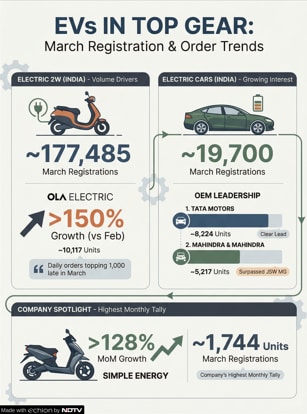
Broad registry numbers confirm that India's EV market is peaking at year-end as buyers accelerate decisions, partly on fears of fuel price hikes and possible policy changes.
EVs Riding High: Industry View
Fuel price volatility is accelerating decisions, especially among enterprise clients, says Hari Krishna, Founder & CEO, Green Drive Mobility.
"Fuel price instability accelerates conversion. Within 10-15 days of recent fuel fluctuations, we observed a sharp rise in enterprise enquiries, resulting in a backlog of 200-250 EVs," Krishna explains. He notes that while EV interest already existed, volatile petrol and diesel prices -- a direct outcome of imports and geopolitical risks -- are prompting quicker action.
At a market level, Krishna estimates India's EV penetration around 6-7 per cent, with monthly registrations crossing 1.5 lakh units in recent months, led by two- and three-wheelers. Infrastructure, however, remains a bottleneck for long-term scaling.
In a similar vein, Sahil Jindal, Co-founder, Trevel, points out that for ride-hail fleets, fuel costs directly affect earnings. "Interest in EVs is rising 15-20 per cent monthly. Drivers see EVs as a way to avoid fuel price fluctuation," he says, noting that operating cost stability is a key driver behind stronger enquiries.
Adding to this, Gunjan Malhotra, Co-founder, Komaki Electric Vehicles, says: "Fuel price volatility following the Iran conflict is beginning to reflect in consumer choices, with more people looking at EVs as a more predictable and cost-efficient option. In March, we saw enquiries and bookings double compared to February."
'Cost of Ownership Driving Mainstream Shift'
Mohal Lalbhai, Founder & CEO, MATTER, also agrees that fuel uncertainty is an accelerant. "Fuel price volatility linked to Middle East tensions has added to interest. But our internal data shows this is an accelerant, not the main driver. We are seeing a clear shift toward total cost of ownership and cost predictability."
Across its 25 retail touchpoints, MATTER saw nearly a three-fold rise in enquiries and a doubling of bookings in the last 4-6 weeks. Delivery timelines have extended as demand outpaced supply.
Echoing Lalbhai, Bharat Bala, Builder & CEO, AMP EV, calls EV adoption a strategic cost hedge, not a knee-jerk reaction. "EVs can offer far greater cost predictability, typically 60-70 per cent lower per-km cost than internal combustion engines -- making them attractive as buyers seek stability amid fuel swings."
He, however, cautions that structural enablers -- leasing options, secondary markets, charging expansion -- must align to transform EV interest into long-term adoption.
Himanshu Arya, Founder, Luxury Cart, adds a retail lens: "Fuel price swings are changing how buyers look at EVs. Overall EV sales moved up in March, and enquiries alongside bookings are rising."
Data Meets Buyer Behaviour
Industry data shows that India's EV market is growing strongly -- register totals up year-on-year and MoM -- but it's important to see nuance:
- Not all growth is due to fuel volatility alone. Discounts, operational improvements and GST shifts also play roles.
- OEM performance varies by segment and brand. Two-wheelers remain dominant in volumes; passenger cars are growing fast from a lower base.
- Fuel cost anxiety is a real behavioural factor enhancing urgency, especially among fleets and high-usage buyers.
Roadblocks In The Way
Despite rising interest:
- Charging infrastructure outside metro clusters is still patchy.
- Charging speed and reliability issues persist.
- High upfront costs and limited financing options constrain some buyers.
These structural factors must be addressed for sustained conversion from intent to long-term ownership, say industry insiders.
Track Latest News Live on NDTV.com and get news updates from India and around the world

