





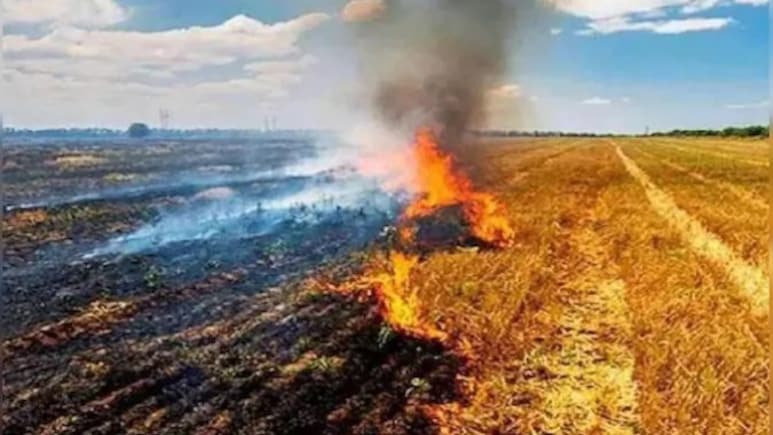
Claims of a nearly 90% drop in stubble burning in Punjab and Haryana - a key contributor to pollution in Delhi-NCR - have been challenged by a new multi-satellite analysis, revealing that the reported decline is a result of a gap in India's monitoring system, not a true reduction in farm fires.
The Stubble Burning Status Report 2025 by the International Forum for Environment, Sustainability and Technology (iFOREST) indicates that farmers are strategically shifting their burning to the late afternoon and evening, a time window routinely missed by the standard monitoring satellites, leading to a significant undercount.
Monitoring Blind Spot
The government's official monitoring protocol, run by Indian Agricultural Research Institute's CREAMS (Consortium for Research on Agroecosystem Monitoring and Modeling from Space) relies on polar-orbiting satellites like MODIS/VIIRS (Moderate Resolution Imaging Spectroradiometer/ Visible Infrared Imaging Radiometer Suite) that only pass over the region between 10:30 AM and 1:30 PM.
iFOREST's report used high-frequency observations from the geostationary SEVIRI ( Spinning Enhanced Visible and InfraRed Imager) satellite to confirm a dramatic shift in burning times. In Punjab, over 90% of large fires in 2024 and 2025 occurred after 3 pm, compared to just 3% in 2021. In Haryana, most large fires have consistently occurred after 3 pm since 2019, confirming that a massive undercount has persisted for years.
"Our analysis provides incontrovertible evidence that India's current stubble-burning monitoring system is structurally misaligned with ground realities," said Chandra Bhushan, CEO, iFOREST. "The result is a massive underestimation of fires, emissions, and their contribution to air pollution in Delhi."
Genuine Progress Too
While contesting the 90% decline, the iFOREST report, using Sentinel-2 satellite's burnt-area mapping, confirms genuine progress in reducing the total area set on fire. Burnt-area analysis is considered a more reliable measure than active fire counts, which are skewed by timing.
In Punjab, the area in which stubble was burnt reduced by 37% since its 2022 peak - from 31,447 square km to about 20,000 square km in 2025. In Haryana, the figure went down by 25% since its 2019 peak, going down to 8,812 square km in 2025.
"Burnt area provides a more reliable picture of stubble burning... a 25-35% reduction is good news and indicates that in-situ and ex-situ stubble-management practices are being adopted," Bhushan noted.
However, he warned against complacency, as close to 30,000 square km of paddy fields were still burnt in the two states in 2025.
Call For Overhaul
The report warns that the flawed data is weakening the evidence base for air-quality policymaking, leading to an underestimation of stubble burning's impact on Delhi's pollution.
Among the corrective measures, iFOREST has suggested that CREAMS must start publishing burnt-area data in addition to active fire counts for an accurate picture.
The forum also called for air-quality forecasting models for Delhi being revised to correctly quantify the contribution of stubble burning, and for policy efforts to be expanded beyond Punjab and Haryana to address emerging hotspots in states like Uttar Pradesh and Madhya Pradesh.
"We cannot manage what we do not measure accurately," stressed Ishaan Kochhar, Programme Lead, iFOREST. "To solve the stubble-burning problem, the government must urgently reform the monitoring protocol to integrate burnt-area mapping and geostationary data."
A similar analysis last year had also revealed that farmers were timing stubble burning in a way that it would not be captured by NASA satellites. Satellite images accessed exclusively by NDTV appeared to confirm this.
Track Latest News Live on NDTV.com and get news updates from India and around the world

