





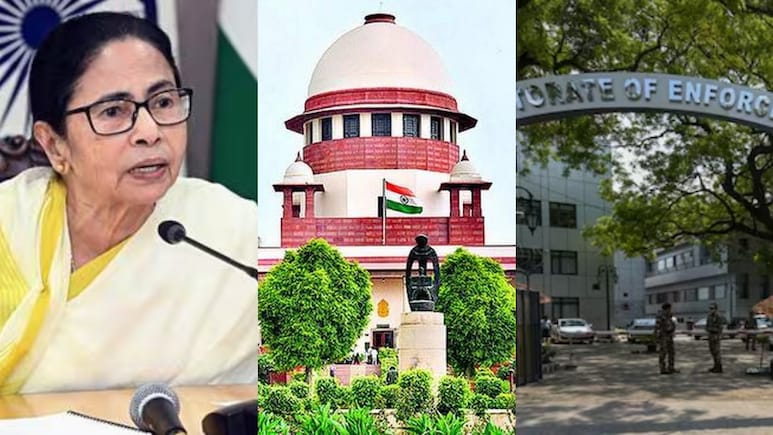
West Bengal Chief Minister Mamata Banerjee's presence at the I-PAC offices during the raid by the Enforcement Directorate was not a "happy situation", the Supreme Court said today, questioning if the Central agency can be left without a remedy in such "unusual" events. "What if tomorrow some other Chief Minister barges into such a raid? Can the ED be left without remedy?" said the bench comprising Justices Prashant Kumar Mishra and NV Anjaria, which was hearing a petition by the Enforcement Directorate.
The agency, which has knocked at the doors of the top court, has called Banerjee's move -- allegedly walking out with a laptop, phone and multiple documents from the house of Pratik Jain, the chief of election consultant I-PAC and their offices -- a "gross abuse of power". It has also demanded that a police case be filed against the Chief Minister and officials who had accompanied her.
Read: "Mamata Banerjee Obstructed Probe": Central Agency ED Approaches High Court
Representing the state, senior Advocate Shyam Divan contended that allowing a department of the Central Government to file a petition against a state government will be "dangerous to the federal structure".
Probe agencies like the CBI, Narcotics Control Bureau, Directorate of Revenue Intelligence, and Serious Fraud Investigation Office do not have the right to sue a state government, he added. Even State-level agencies like CID, Vigilance Commissions, and Anti-Corruption Bureaus do not have that power.
Justice Mishra questioned what if "unusual" situations -- such as a Chief Minister obstructing a Central Agency -- comes up.
"Because in this case, according to them, the Chief Minister barged into some government office controlled by the Central Government... if (Articles) 226 is also not maintainable 32 is also not maintainable, then who will decide? Someday some other Chief Minister may enter some other office..." he said. "There should not be a vacuum," he added.
Read: "Can't Dictate When A Hearing Should Happen": Top Court To Bengal In I-PAC Raid Case
Divan said the Constitution does provide a remedy, and suggested that the Centre could initiate appropriate proceedings rather than a department acting independently.
Divan responded that the perceived vacuum is precisely why the issue requires authoritative determination by a larger Bench. Allowing departments to invoke writ jurisdiction -- which compels courts to take action -- could pose "a danger to the federal structure" and lead to unchecked inter-governmental litigation, he said.
The case will be heard next on March 24.
Track Latest News Live on NDTV.com and get news updates from India and around the world

