






- The Indian rupee hit record lows due to global factors like rising oil prices amid the Iran conflict
- RBI used targeted measures to curb rupee’s slide, leading to its biggest gain in over 12 years
- Measures included capping bank forex positions, banning rupee NDFs, and stopping forward contract re-booking
The Indian rupee was under heavy pressure in recent weeks. Even as the macro-economic fundamentals remained stable, the rupee hit record lows against the US dollar due to global factors such as rising oil prices amid the Iran conflict. FOLLOW LIVE UPDATES
To stop rupee's slide, the Reserve Bank of India (RBI) have been using a series of targeted measures. The outcome of RBI's interventions became evident when the currency market opened on Thursday, and the Indian rupee posted its biggest ever gain in over 12 years. The rupee jumped 1.3 per cent to around Rs 93.53 per dollar -- the most since September 2013.
This comes after the currency fell below the 95-mark against the dollar.
| RBI's Measures | Objective |
| Capped banks' open forex (FX) positions at $100m | Reduce excessive speculative bets |
| Banned banks from providing rupee NDFs | Stop offshore-onshore arbitrage |
| Banned re-booking of cancelled forward contracts | Prevent repeated speculative hedges |
| Stopped FX deals with related parties | Reduce circular trading and risk |
| Allowed only genuine hedging with proof | Focus on real business needs |
RBI's initial steps helped but did not stop volatility. While the banks were complying, corporates and traders kept pressure through arbitrage. Therefore, RBI needed to close multiple entry points for speculators.
Impact Of RBI's Measures
1) Bank Position Limit
- Banks had big dollar-rupee positions.
- RBI capped them at $100m to rein in risk.
- But banks shifted some exposure to corporates -- so impact was limited.
2) NDF Ban Stops Arbitrage
- Non-Deliverable Forwards (NDFs) are offshore contracts.
- Traders were using the price gap between onshore & offshore for profit.
- RBI blocked banks from offering them, cutting that arbitrage route.
3) No Re-booking of Cancelled Forwards
- Earlier, firms could cancel forward contracts if rates moved favourably, then re-book and book gains repeatedly.
- RBI banned this, removing a major speculative loop.
4) No FX Trades with Related Parties
- Banks often traded with affiliates to reduce losses.
- RBI closed this loophole.
5) Trading Curbs
- New rules require proof that contracts are for real business needs, not trading.
Speaking on RBI's intervention, Siddharth Maurya, Managing Director, Vibhavangal Anukulkara, said, "The RBI has taken steps to stabilise the rupee, which exemplifies global uncertainties with the use of multiple methods, providing evidence of a thorough, multi-faceted approach. The rupee's multi-faceted approach includes several elements, including the flexible use of foreign exchange reserves, active use of foreign exchange reserves, disorderly movements, depletion of foreign exchange reserves, investor confidence, depreciation, and the use of foreign exchange reserves."
He added, "In the future, control of inflation, maintenance of a disciplined fiscal policy, and the regulation of capital inflows will be of the utmost importance."
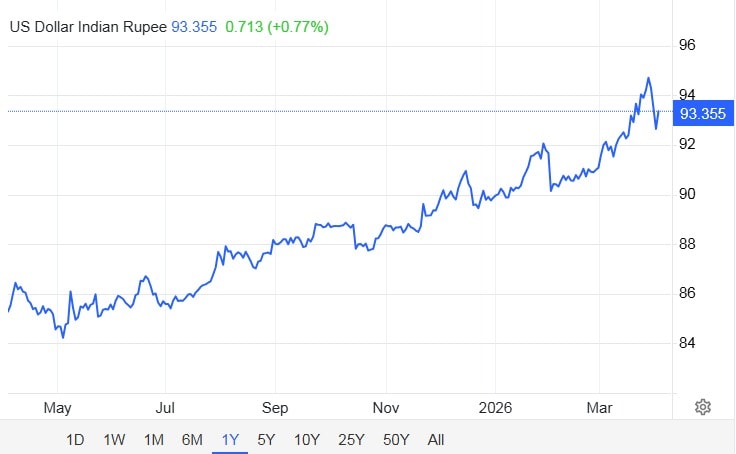
Photo Credit: Trading Economics
Could Rupee Fall Below 100?
If the ongoing Iran war prolongs, rupee could weaken further and may even touch the 100 mark against the US dollar, said a Bloomberg report citing global analysts and market data.
The report added that the rupee has declined by around 10 per cent over the past year and is among the worst-performing currencies in Asia this year. According to analysts, RBI interventions may provide temporary relief, but not long-term stabilisation.
Track Latest News Live on NDTV.com and get news updates from India and around the world

