





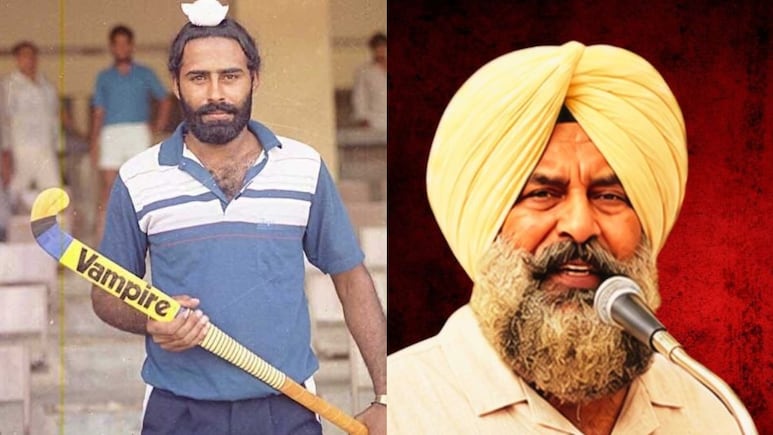
The appointment of former Indian hockey captain Pargat Singh, a Jat Sikh, as the president of the Punjab Pradesh Congress Committee has raised two pertinent questions. When Punjab's political parties search for their most visible Sikh leadership, why do they zero in on candidates from the same social profile? And where within these leadership structures are the many other Sikh communities that form a substantial part of the state's society?
Punjab's major political formations ahead of the 2027 assembly indicate this trend. The BJP is headed in Punjab by Kewal Singh Dhillon, a Jat Sikh. Congress is headed by Pargat Singh. Shiromani Akali Dal is headed by Sukhbir Singh Badal, a Jat Sikh. And the Aam Aadmi Party government is led by Chief Minister Bhagwant Mann, a Jat Sikh. All top leaders of major political parties belong to the same social background.
Also read: Analysis: Harsimrat Kaur's Big Political Moment Test Of Badal Family Legacy
The Numbers Are More Complex Than The Political Template
According to the 2011 Census, still India's latest completed Census, Sikhs constitute 57.69 per cent of Punjab's population and Hindus roughly 38.5 per cent. Scheduled Castes constitute 31.94 per cent of the state's population.
Within this Sikh majority, Jat Sikhs are commonly estimated to constitute around 21 per cent of Punjab's total population. There is, however, no contemporary official caste census giving precise population shares for Jat Sikhs, Khatri Sikhs, Ramgarhias, Kambojs, Sainis and several other Sikh communities.
Various political and survey-based estimates place Jat Sikhs among Punjab's largest and most politically influential communities. The more important point, however, does not require an exact percentage.
Punjab's Sikh society is much wider than one social group. It includes Mazhabi Sikhs, Ramdasias and Ravidasias, Ramgarhias, Khatri-Arora Sikhs, Kambojs, Sainis, Rai Sikhs, Labanas and others.
These communities cannot be combined into some imaginary "non-Jat Sikh vote". Their economic positions, histories, geographical concentrations and political concerns vary considerably.
A Mazhabi Sikh agricultural worker in Majha may have very different concerns from a Khatri Sikh businessman in Amritsar, a Ramgarhia professional in Jalandhar or a Kamboj farmer in the border belt. But diversity should not become political invisibility.
The Dalit Sikh Dimension
This becomes especially relevant when Punjab's Scheduled Caste population is examined. "Dalit" and "Sikh" are not separate demographic categories. Punjab's Scheduled Caste population contains both Sikhs and Hindus, and Census 2011 provides Scheduled Caste data by religion. Mazhabi Sikhs, for instance, constitute one of Punjab's largest individual Sikh social communities. This makes the politics of representation more complicated than the familiar Sikh-Hindu or Jat-non-Jat binaries.
The question for Punjab's parties is therefore not whether another community should replace Jat Sikhs at the top. It is whether the pathway to leadership is sufficiently wide for people emerging from Punjab's many different Sikh social backgrounds.
Also read: Analysis: Punjab Congress At Crossroads: Who Could Lead Team Rahul Into 2027
What The Electoral Numbers Show
The debate also needs to be understood through Punjab's changing electorate. In the 2024 Lok Sabha election, Punjab had 2,15,67,196 electors, of whom 1,35,42,849 voted, producing a turnout of about 62.8%. The electorate included approximately 1.14 crore men and 1.02 crore women.
The 2022 Punjab Assembly election recorded a significantly higher turnout of 71.95%, with more than 1.54 crore people voting. There was also an interesting urban-rural dimension.
The Election Commission does not publish a single statewide figure dividing Punjab's turnout neatly into "urban" and "rural" categories. Constituency data nevertheless reveal important variations.
In the 2022 election, for example, Amritsar West recorded turnout of roughly 55%, Amritsar Central about 59% and Ludhiana South about 59%. Many rural and semi-urban constituencies, particularly in Malwa, crossed 80%.
These figures do not prove any particular caste voting pattern, nor can turnout alone explain political representation. But they do raise another important question for parties preparing for 2027: Can Punjab's urban electorate remain secondary in a political system whose leadership structures were historically shaped overwhelmingly by the countryside?
Why Rural Political Power Became So Strong
Jat Sikh influence in Punjab politics has a historical and economic explanation. Post-Independence Punjab's political economy developed heavily around agriculture, landownership, village institutions, farmer networks and cooperatives. The Green Revolution further increased the economic and political importance of the countryside.
Political organisations naturally grew around those structures, helping produce a powerful rural leadership class. That history explains influence. But Punjab itself has changed.
Today's Punjab is simultaneously agricultural and urban. It includes industry, trade, education, services, technology, migration and a vast overseas Punjabi economy. The structure of political leadership may therefore need to evolve with the society it seeks to represent.
History Offers A Broader Definition Of Sikh Leadership
Punjab does not have to look very far for examples. Dr Manmohan Singh, a Sikh from a Khatri background, served as Prime Minister of India from 2004 to 2014. His political rise was not primarily about caste. Economics, administration, credibility and political circumstances defined his career. But symbolically, his elevation demonstrated that Sikh political leadership could emerge from outside Punjab's dominant agrarian political structure.
Congress had demonstrated something similar earlier with Giani Zail Singh, who came from a non-Jat Sikh artisan background and rose from Punjab Chief Minister to Union Home Minister and ultimately President of India.
The story extends beyond Congress. Master Tara Singh, one of the most influential Sikh political leaders of the twentieth century, emerged through education, the Gurdwara Reform Movement and Sikh institutional politics. His career is a reminder that Sikh political authority historically came from several worlds- religious reform, education, institutions, professions and urban society - not agriculture alone.
The Urban Sikh Question
Urban Sikhs never disappeared from Punjab's economic or social life. They remained deeply involved in business, industry, education, medicine, law, religious institutions and philanthropy. Yet this presence has not always translated proportionately into sustained political leadership. That is why the issue is larger than Assembly tickets.
"Punjab's politics should not become a contest between one community and another. Every section of society deserves equal political space and representation. Urban Sikhs are not merely a vote bank; they are an important part of Punjab's economic, social, educational and political strength. The real question is how sincerely political parties recognise them, represent them and give them a meaningful role in decision-making," said Bhagwant Pal Singh Sachar, senior Congress leader and Majitha halqa in-charge. Sachar's argument captures the distinction at the heart of this debate. Representation should mean expanding political opportunity, not transferring political dominance from one community to another.
The Real Test Lies Below The Top Leadership
That is why the most revealing test before 2027 may not be the caste identity of any single party president. Look instead at the second-line leadership in the state. How many professionals, entrepreneurs, academics, women and young leaders from different Sikh social backgrounds are being prepared for senior political responsibilities?
Punjab's parties have become skilled at electoral arithmetic - balancing Majha, Malwa and Doaba, Sikh and Hindu, rural and urban, Scheduled Castes and other communities. But electoral arithmetic is not necessarily the same as political empowerment.
A community can be carefully counted while tickets are distributed and remain inadequately represented where long-term political authority is created. That may be the more consequential question as Punjab approaches 2027.
The argument is therefore not that Jat Sikh leaders have too much space. Jat Sikhs have played an important role in Punjab's agricultural, political and social history and will continue to be an important part of its leadership. The question is whether more doors can be opened without closing existing ones.
Dr Manmohan Singh's career remains relevant precisely for that reason. It demonstrated that Sikh identity and political leadership need not be confined to one social template. So perhaps Punjab's political conversation before 2027 needs to move beyond asking:
Who is the next Jat Sikh face? Towards a broader question: When Punjab's political parties speak of Sikh leadership, how wide is their definition of a Sikh leader? And ultimately: Does the leadership being built for tomorrow reflect the social diversity of the Punjab whose votes these parties seek today? That question belongs not to Congress, BJP, AAP or the Akali Dal alone. It belongs to all of them.
Track Latest News Live on NDTV.com and get news updates from India and around the world

