





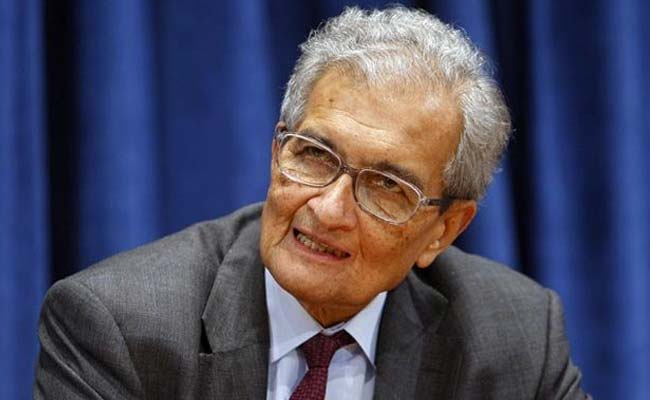
Nobel laureate economist Amartya Sen Wednesday described the proposed 10 per cent reservation for economically backward people in the general category as a "muddled thinking" that raises serious question about its political and economic impact.
He also said the Modi government sustained the "high economic growth" achieved during the UPA regime, but that did not translate into jobs, poverty elimination and better healthcare and education for all.
-

-
 World-Class Chefs, Food And Music: The Fun Side Of NDTV World Summit 2026
-
 AI, Consciousness And Dharma: Why Ancient Indian Wisdom Matters Now
-
 NDTV World Summit: What To Expect From PM Modi's Keynote Address
-
 NDTV World Summit 2026: What To Watch Out For | PM Modi, Jaishankar, AI And Global Power Shifts
-
 A World Between Orders: What To Expect At NDTV World Summit 2026
-
 Who Is Rajiv Mehta? Lilavati Hospital Trustee To Speak At NDTV World Summit 2026
-
 Alain Ebobisse, Africa50 CEO, To Attend NDTV World Summit 2026. All About Him
-
 Kriti Sanon At NDTV World Summit: A Look At Her Career And Business Ventures
-
 Ex-CIA Director To Decode 'War In Times Of AI' At NDTV World Summit
-
 Who Is Vikram Rai, CEO, South Asia GE Aerospace, Set To Attend The NDTV World Summit 2026
On the government's move to provide 10 per cent reservation in jobs and educational institutions to economically weaker sections in the general category, Mr Sen said, "The reservation for the low income upper caste is a different problem."
"If the whole of the population is covered by reservation then that would be removal of reservation," he told PTI in an exclusive interview.
"Ultimately this is a muddled thinking. But the muddled thinking may have serious political and economic effects which are seriously questionable."
The economist said the Modi government was successful in maintaining the economic growth India achieved before they came to power.
"(Prime Minister Narendra) Modi can say ''yes we have continued that''. There has not been a big reduction in the economic growth of India," he said.
But the benefits of economic growth in terms of generation of employment, inequality reduction, poverty elimination, better healthcare and education for all cannot be seen on the ground though the economic growth has continued at a high rate, he said.
The economist was also critical of demonetisation and the way the Goods and Services Tax (GST) was implemented.
"We don't have to bring in the electoral success and failure in order to be able to say that demonetisation was a pretty negative and pretty bad economic policy and the way the GST has been imposed was also very defective," Mr Sen said.
Asked if these two led to the BJP's defeat in the recently-held assembly elections in five states, he said that requires an electoral study which he had not done.
Track Latest News Live on NDTV.com and get news updates from India and around the world

