





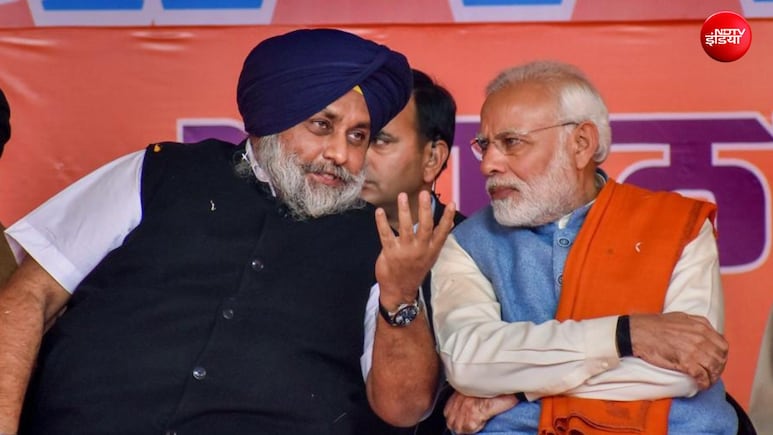
- Shiromani Akali Dal plans 15 new rallies after holding 40, signalling active campaign phase
- Possible BJP-SAD alliance energises SAD's rural cadre and boosts party morale
- BJP's urban strength and SAD's rural base can complement each other in Punjab
For a party that has spent the past few years battling electoral decline, internal turbulence and questions over its relevance, the Shiromani Akali Dal suddenly appears to have found a new source of political energy; the buzz around a possible alliance with the BJP. The alliance has not yet been formally announced, but politically, the anticipation itself appears to be doing the job.
The SAD has announced 15 more rallies across Punjab in August and September, following 40 rallies already held across the state.
Three are its traditional annual conferences: Issru on August 15, Longowal on August 20 and Baba Bakala on August 28, while the remaining 12 will be constituency-level rallies. SAD president Sukhbir Singh Badal and senior party leaders will participate.
For the Akalis, this is not merely a rally timetable. It is an attempt to signal that the party's organisational machinery is back in motion and that the 2027 election campaign may effectively have begun.
A senior Akali Dal leader privately claimed that the alliance talks are "almost finalised", arguing that even the possibility of a BJP tie-up has energised the party's rural cadre. "BJP can't survive without Akali Dal in Punjab. Our rural cadre is very energised with just the buzz of alliance talks," the leader said, adding that the SAD believes it is already ahead of the BJP in some urban pockets. The boast is significant because it captures the political logic behind the proposed alliance.
The BJP has spent the past few years trying to expand its independent footprint in Punjab, particularly among urban, non-Sikh voters. But the party continues to face a structural limitation: translating its urban strength into a statewide organisation with a deep rural presence. The SAD has almost the opposite problem. Its traditional rural and panthic network remains its biggest asset, but its electoral base has eroded and its ability to independently compete across Punjab has been questioned.
A BJP-SAD alliance could therefore bring together two complementary political networks; the BJP's urban reach and the Akalis' rural and panthic machinery. And that possibility appears to have changed the psychology within the SAD. For a cadre that has witnessed repeated electoral setbacks, internal rebellion and the rise of AAP, an alliance with the BJP, is offering something the party has been missing: the perception that it is once again electorally relevant.
That perception matters. Politics in Punjab is not only about vote share. It is also about cadre confidence, local networks, the ability to mobilise crowds and the belief among workers that their party has a realistic path to power. Daljit Singh Cheema's announcement of another 15 rallies suggests the SAD wants to capitalise on precisely that sentiment. The party is effectively using the alliance buzz as a mobilisation tool even before any formal announcement.
The bigger worry for AAP and Congress is what happens if the alliance is formally announced. Both parties have benefited in different ways from the fragmentation of the traditional anti-incumbency space.
A BJP-SAD alliance could potentially change that equation by consolidating two distinct voter segments and forcing both parties to recalibrate their strategies.
For AAP, the biggest concern will be the return of a more organised Akali challenge in rural Punjab. For the Congress, the calculation is more complicated: the party could find itself fighting simultaneously against an AAP government and a revived alliance that could potentially consolidate anti-AAP votes.
But the alliance also carries risks for the Akalis. Seat-sharing could become contentious. The BJP's growing ambitions in Punjab could clash with the SAD's traditional claim over large parts of the state. The Akalis will also have to answer the fundamental question that has dogged the party since its decline: can its old organisational network be converted into votes once again?
That is why the rallies matter. Forty rallies have already been held and 15 more are now planned. The message from the Akali leadership is unmistakable: The party does not want to enter 2027 as a diminished regional force seeking survival. It wants to enter as the indispensable partner in a larger electoral coalition.
The alliance may not have been announced yet, but it has already started changing the political mood inside the Akali Dal. For a party that had increasingly been pushed to the margins of Punjab's electoral conversation, simply becoming central to the BJP's alliance arithmetic is itself a significant political revival.
Track Latest News Live on NDTV.com and get news updates from India and around the world

