





- Air India will fully restore its Middle East network from the winter schedule as tensions ease
- Operational restrictions, not demand, were the main challenge during recent Middle East tensions
- Fleet modernization is underway with cabin retrofits and new aircraft deliveries accelerating
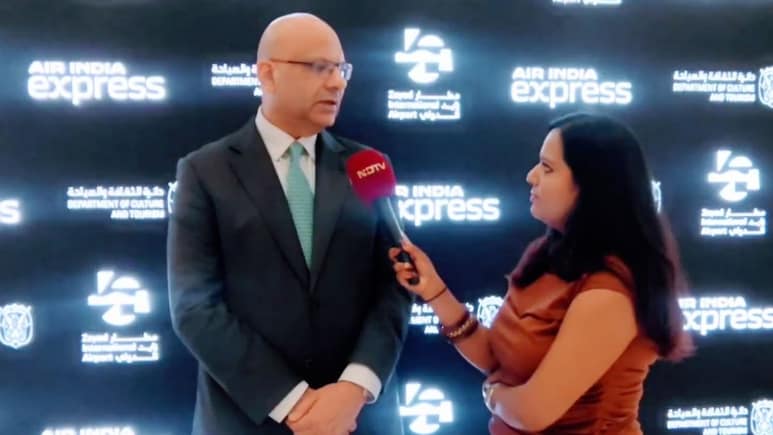
Air India will restore its full network in the Middle East from the winter schedule as geopolitical disruptions ease, with most affected flights already back on sale, Air India Express Chairman and Air India Chief Commercial and Transformation Officer Nipun Aggarwal told NDTV in an exclusive conversation.
"Most of those flights are already on sale. The network has already been deployed and, if the situation continues to improve the way it is, we should be able to maintain that network," Aggarwal said.
He said the airline's biggest challenge during the recent tensions in the Middle East was not a fall in passenger demand but operational restrictions caused by airspace closures.
"The demand here is very strong because of the large Indian diaspora. As long as airports are open, airspace is available and we can operate safely, we will continue deploying capacity. Our biggest constraint has been the ability to fly, not passenger demand," Aggarwal told NDTV.
He said Air India continuously monitors the evolving geopolitical situation and carries out operational risk assessments in coordination with airports and local authorities before deciding whether to operate flights.
"This is a very dynamic situation. We continuously assess the risks and adapt accordingly. As long as we can operate safely, we will continue to deploy capacity," he said, adding that the airline remains in constant consultation with airports and local governments in the region.
When asked about the impact of rising aviation turbine fuel (ATF) prices amid geopolitical tensions, Aggarwal said airlines have limited ability to shield themselves from external shocks.
"ATF prices are a market reality driven by geopolitical factors that are beyond our control. We can redeploy the network, manage capacity and do our best operationally, but beyond a point there is only so much one can do," he said.
"We hope the worst is behind us. We are keeping our fingers crossed - hope for the best, prepare for the worst."
The Air India Group's fleet growth plans remain on track, as Aggarwal told NDTV that the airline expects to induct 60 to 70 aircraft every year over the next seven to eight years as deliveries from its nearly 600-aircraft order accelerate.
"We have an aircraft order book of almost 600 aircraft, of which less than 10 per cent has been delivered so far. Deliveries will pick up from the end of this year, and from next year onwards we will have a steady stream of aircraft coming in," he said.
Over the next 12 to 18 months, the airline group expects to receive around 60 to 70 aircraft, including 10 to 15 wide-body aircraft and 40 to 50 narrow-body planes. Boeing production is also improving, Aggarwal said, with deliveries of Boeing 787-9 Dreamliners and 737 MAX 8 aircraft already underway.
The airline expects to be among the first carriers to receive the Boeing 737 MAX 10 after certification, which it hopes will happen early next year. Aggarwal told NDTV that the Air India Group is simultaneously undertaking a large-scale fleet modernisation programme.
Air India's narrow-body fleet has already been retrofitted with new cabins, while Air India Express is expected to complete the harmonisation of its fleet by March next year. The retrofit of Air India's wide-body aircraft has also begun, with Dreamliners expected to be upgraded by the middle of next year and Boeing 777 aircraft to follow.
"We have been through a painful phase where we had to sustain older aircraft with older cabins. That period is now behind us. Fleet modernisation is picking up pace and by the beginning of the next financial year we should be in a much better position," he said.
Describing the UAE as one of the group's most strategic international markets, Aggarwal told NDTV that nearly two-thirds of Air India Group's capacity and revenue comes from international operations. Of that, almost half is generated from the Middle East, while nearly two-thirds of the region's traffic comes from the UAE alone.
"That makes the UAE roughly a quarter of our entire business as a group. It is a very strategic and very fast-growing market for us," he said.
Tracing Air India Express' evolution, Aggarwal said the airline, which was launched in 2005 to connect Kerala with the Gulf, has expanded rapidly since privatisation.
"Air India Express has grown from a 25-aircraft airline four years ago to more than 100 aircraft today. We will double our fleet over the next five years, and naturally the UAE remains our home market," he said.
The airline is also expanding beyond its traditional south India network. It has recently launched flights from Lucknow, Indore and Navi Mumbai to the UAE, while services from Guwahati are scheduled to begin in the first week of August.
"Initially, we connected South India to the Gulf. Today, we are connecting North, Central, Western and soon Eastern India with the UAE. Our ambition is growing and you will continue to see this network expand in the months and years ahead," Aggarwal said.
Track Latest News Live on NDTV.com and get news updates from India and around the world

