

)
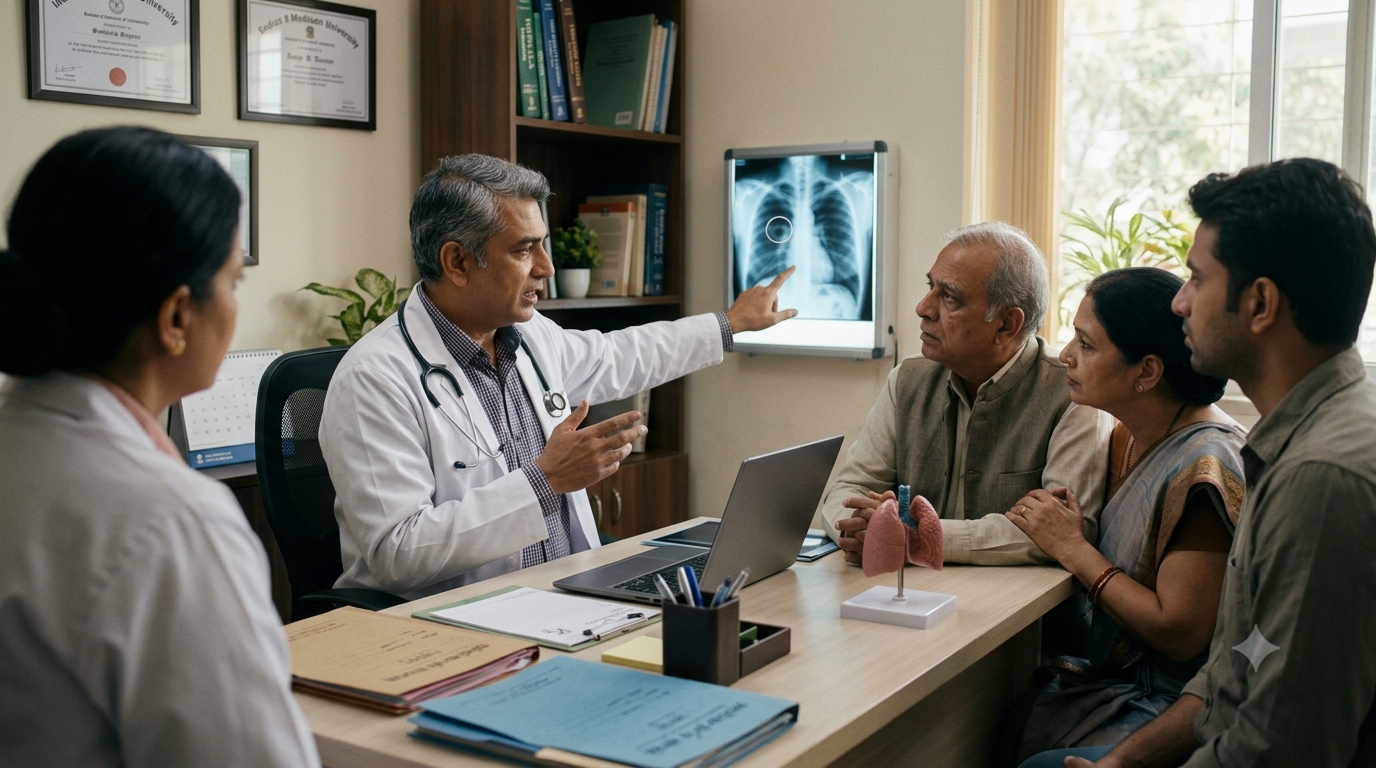
A cough that would not go away led one woman to the hospital. The cough itself turned out to be nothing serious, but her CT scan revealed something unexpected: a 12 mm nodule in the outer part of her right lung. She had never smoked. She had no other symptoms and felt completely well. Yet, the tiny shadow on the scan raised an important question: Was it an old tuberculosis scar, a harmless growth or something that needed to be investigated further, including the possibility of early lung cancer? A lung nodule does not automatically mean cancer. In fact, many nodules detected incidentally on CT scans are benign. But because imaging cannot always determine exactly what a nodule is, some require careful monitoring or further investigation.
What Is A Lung Nodule?
A lung nodule is a small, rounded or irregular spot seen in the lung on an imaging scan, particularly a CT scan. With the increasing use of CT scans, doctors are detecting more small lung nodules, including in people who undergo imaging for completely unrelated health concerns. Some nodules may be caused by previous infections or inflammation. Others can represent benign growths. In some cases, however, a nodule can be an early sign of lung cancer. "The CT scan can show us that a nodule is there. It cannot always tell us what it is," said Dr Shyam Krishnan, Lead Consultant, Clinical and Interventional Pulmonology, CK Birla Hospitals.
Why Lung Nodules Can Be Tricky To Diagnose In India
India has a particularly important consideration when doctors evaluate a suspicious lung lesion: tuberculosis. Previous tuberculosis infection can leave scars or other changes in the lungs that may appear as abnormalities on imaging. This means that a lung shadow may sometimes be attributed to previous or active TB. While timely diagnosis and treatment of tuberculosis remain essential, not every lung nodule is caused by TB.
"India has another challenge. Tuberculosis and its scars are common, and a lung shadow can sometimes be attributed to TB without tissue confirmation," Dr Krishnan said. The clinical history, imaging characteristics and previous scans therefore need to be considered before deciding what the finding represents.
Does Every Lung Nodule Need A Biopsy?
The discovery of a lung nodule does not automatically mean that a patient needs an invasive procedure. Doctors consider several factors, including the size and appearance of the nodule, whether it has changed over time, previous imaging findings and the person's overall risk profile. In some cases, the safest approach may be to monitor the nodule through follow-up CT scans. Stability over time can provide important information. In other situations, particularly when a nodule has characteristics that warrant further evaluation, obtaining a tissue sample may be recommended.
Why Can A Lung Biopsy Be Difficult?
The location of a nodule can make a major difference. A needle biopsy through the chest can be used to obtain tissue from certain lung lesions, but the procedure carries risks, including pneumothorax, or a collapsed lung. Conventional bronchoscopy allows doctors to examine and access the airways. However, reaching very small nodules located deep in the lung or close to its outer edges can be technically challenging. Surgery may be considered in selected cases, but it is a more invasive approach. Advances in bronchoscopic technology are providing doctors with additional ways to reach some difficult-to-access lung nodules.
How Navigation Bronchoscopy Helps
Navigation bronchoscopy uses information from a patient's CT scan to create a three-dimensional map of the airways. The doctor can then use this map to guide a thin catheter through the bronchial passages towards the area containing the nodule. In simple terms, the technology helps the doctor navigate through the complex network of airways towards the target. But reaching the right area is only part of the challenge.
What Is Cone Beam CT?
Cone Beam CT can provide three-dimensional imaging during the procedure. This allows the doctor to check the position of the instruments in relation to the lung lesion before collecting tissue. "Navigation helps us find the way; Cone Beam CT helps us confirm we are there," Dr Krishnan explained.
Once the target is reached, tissue samples can be collected for pathological examination. Where appropriate, the sample can also be assessed during the procedure to determine whether adequate tissue has been obtained and whether additional material may be required for further testing.
What Happens After A Lung Nodule Is Found?
The next step depends entirely on the individual case. A doctor may recommend surveillance with another CT scan, further imaging or a tissue biopsy. The decision is based on the characteristics of the nodule and the person's overall clinical risk rather than simply the fact that a nodule has been detected. This is why previous scans can be extremely valuable. Comparing a current nodule with older images can help doctors determine whether it is new, stable or changing.
What Should Patients Do?
If a lung nodule is discovered incidentally, the first step is not to panic. A lung nodule does not mean that you have lung cancer. At the same time, an unexplained nodule should not simply be ignored. Patients should keep copies of their previous imaging reports and scans and ask their doctor:
- What could be causing the nodule?
- How large is it and where is it located?
- Does it need follow-up imaging?
- Why is a biopsy being recommended, if it is?
- Could previous infections such as tuberculosis explain the finding?
Most importantly, patients should follow the recommended surveillance schedule if their doctor advises repeat imaging. For a person who feels completely healthy, finding a small shadow on a CT scan can understandably be frightening. But the purpose of investigating it is to replace uncertainty with information. As Dr Krishnan puts it, advances in bronchoscopy are helping doctors turn a worrying shadow into something far more useful: an answer.
Disclaimer: This content including advice provides generic information only. It is in no way a substitute for a qualified medical opinion. Always consult a specialist or your own doctor for more information. NDTV does not claim responsibility for this information.