- Comedian Samay Raina revealed intense fear, guilt, and anxiety after a controversy on India's Got Talent
- Mental health experts link fear, anxiety, and guilt as factors in the development of psychosis symptoms
- Stress triggers activate the brain's threat system, leading to fear and evolving into anxiety over time
Comedian Samay Raina has opened about one of the most difficult phases of his life following the controversy around India's Got Latent. In his 1 hour 21 minutes-long video of his comeback special Still Alive, he revealed experiencing intense fear, guilt, anxiety attacks, and even moments he described as "psychosis". The controversial episode of India's Got Latent, aired in 2025, involved YouTuber Ranveer Allahbadia, and led to multiple FIRs being filed, which triggered extreme stress in the comedian. But beyond the headlines, mental health experts say Samay Raina's experience reflects a deeper and often misunderstood reality, that these symptoms are rarely isolated and tend to build on each other.
A study published in 2026 in the journal Current Topics In Behavioural Sciences says that fear, anxiety, and guilt are closely intertwined with the onset, persistence, and experience of psychosis. These emotional states often serve as mediating factors that link traumatic experiences of person to the emergence of psychotic symptoms. Anxiety affects nearly 60% of people dealing with psychosis, which signifies its critical role in both the development of a symptom and clinical management.
How Stress Can Spiral Into Multiple Mental Health Symptoms
According to Dr Neha Aggarwal, Consultant Psychiatrist, Fortis Hospital, Manesar, such experiences often begin with an intense stress trigger. "Situations involving public scrutiny, uncertainty, or financial threat can activate the brain's threat system, leading to an immediate fear response," she says. This fear is a natural survival mechanism. However, when it persists, it can quickly evolve into anxiety.
People may experience panic attacks, racing thoughts, restlessness, and a constant sense of unease. Over time, anxiety can narrow thinking patterns, making worst-case scenarios feel more real and harder to dismiss.
Also read: 1 In 7 Indians Affected By Mental Health Disorders And Face Treatment Gaps: Experts
The Role Of Guilt And Overthinking
Closely linked to anxiety is guilt, especially in situations involving public backlash or perceived mistakes. "Thoughts like 'this is my fault' can lead to constant rumination," explains Dr Aggarwal. These repetitive overthinking traps the mind in a loop, intensifying emotional distress and making it harder to move forward. The brain keeps replaying events, reinforcing both anxiety and fear.
When Sleep Breaks Down, Symptoms Worsen
One of the most overlooked factors in mental health crises is sleep. Stress and anxiety often disrupt sleep patterns, and even a few nights of poor sleep can significantly impact emotional stability. Lack of rest reduces the brain's ability to process reality accurately, increasing vulnerability to distressing thoughts and perceptions.
When Reality Starts To Feel Uncertain
In extreme cases, prolonged stress can lead to experiences like Derealisation or Depersonalisation. "The need to check objects to feel real may point to severe anxiety with possible dissociation or transient psychosis-like experiences," says Dr Aggarwal. It is important to note that these are often stress-induced and temporary, not necessarily signs of a chronic psychiatric disorder.
The Vicious Cycle Explained
Experts describe this as a reinforcing cycle where each emotional state feeds into the next:
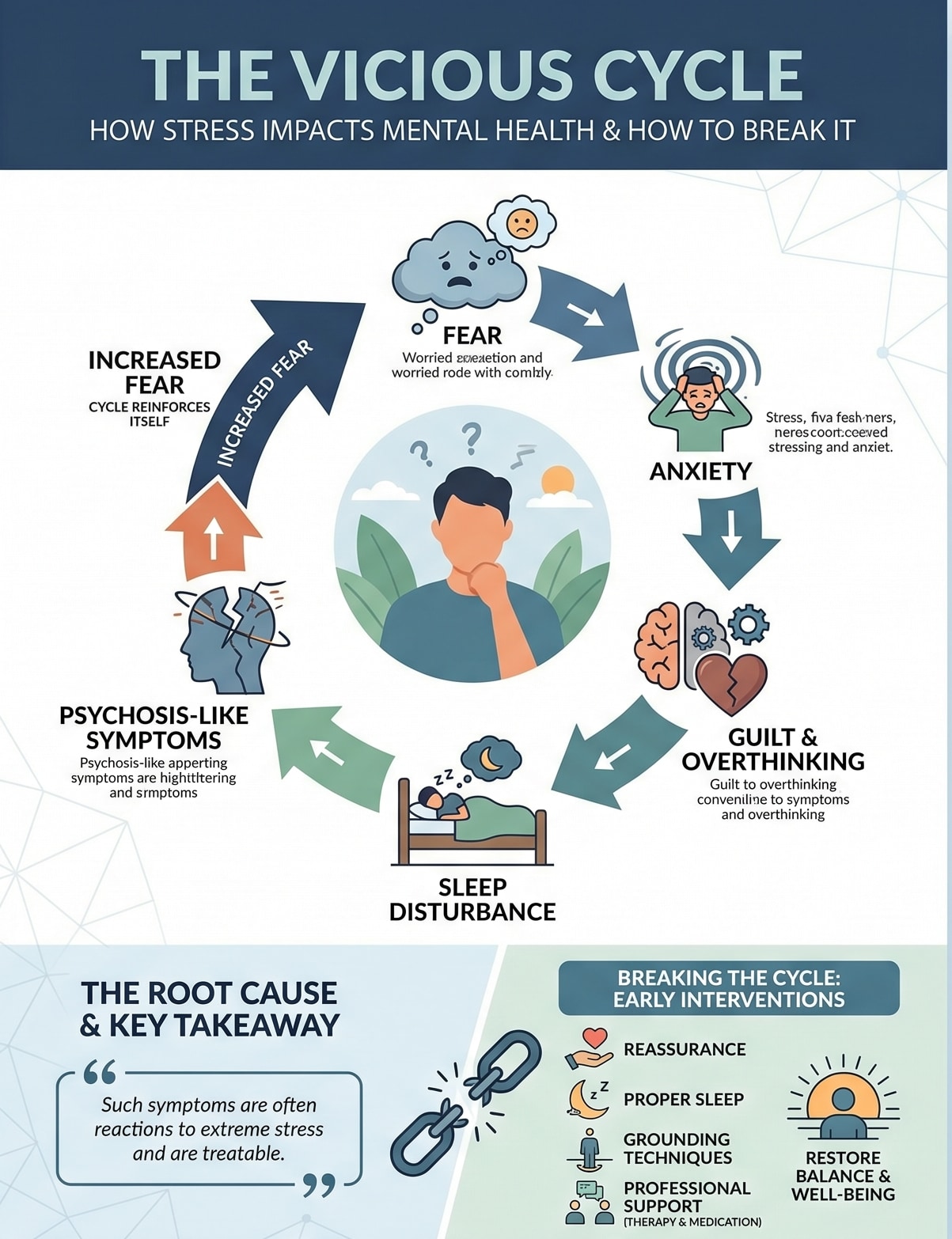
As this loop continues, the intensity of the experience grows, making it harder for individuals to break free without support.
Why Masking Emotions Makes It Worse
Another layer to this issue is emotional suppression. Mrs Anusha G S, Consultant Clinical Psychologist, Maarga Mind Care, says, "Masking emotions can feel like a way to cope, but over time it builds stress and can lead to anxiety, irritability, burnout, or poor sleep." When people constantly hide their feelings, they may lose touch with their own emotional state. This makes it harder to process experiences or seek help when needed. It can also strain relationships, as genuine connection depends on openness and honesty.
Also read: Stressed Out? The Ancient Japanese Secret Of 'Shinrin-Yoku' Can Help Regulate Your Nervous System
The Way Forward: Breaking The Cycle
The key takeaway, experts say, is that these symptoms are treatable and often reversible when addressed early. Effective strategies include:
- Prioritising sleep and rest
- Practising grounding techniques
- Seeking professional help such as therapy
- Using medication when clinically required
"Early intervention can break the cycle and restore balance," Dr Aggarwal emphasises. Samay Raina's experience highlights how mental health struggles can escalate under intense stress, especially when fear, guilt, and anxiety begin to overlap. It also underlines an important truth: mental health is not about isolated symptoms, but interconnected experiences that need timely attention and care.
It becomes important to recognise your emotions, rather than suppressing them, and seeking support early can make all the difference in navigating such challenging phases.
Disclaimer: This content including advice provides generic information only. It is in no way a substitute for a qualified medical opinion. Always consult a specialist or your own doctor for more information. NDTV does not claim responsibility for this information.