

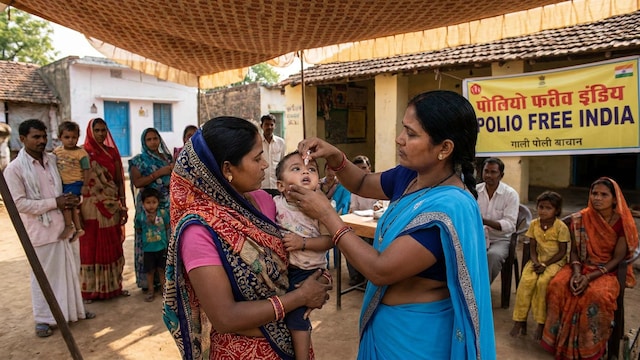
Polio is a highly infectious viral disease that can cause permanent paralysis and, in severe cases, death. Great progress has been made towards eliminating polio worldwide, but global eradication has not yet been achieved. India was certified polio-free in 2014. This was a major public-health achievement, but maintaining it requires continued vigilance, high vaccination coverage and public awareness. As long as poliovirus continues to circulate anywhere in the world, it can potentially be imported into countries where it has already been eliminated.
Parents often ask why a child who has received oral polio drops also needs an injectable polio vaccine. They may also wonder why additional drops are given during Pulse Polio campaigns after a child has completed routine vaccination.
The answer lies in the different but complementary ways in which the two vaccines protect children.
What Is The Oral Polio Vaccine?
The oral polio vaccine, or OPV, contains weakened live polioviruses and is administered by mouth. It produces strong immunity in the intestine, the main site where poliovirus multiplies.
This intestinal immunity reduces the multiplication of the virus and its shedding in stool. As a result, it lowers the possibility of the virus spreading from one person to another through the faecal-oral route. This protection is particularly important in communities where sanitation or hygiene may be inadequate.
The Sabin oral vaccine was initially introduced between 1961 and 1962 as three separate monovalent vaccines. These were replaced by a trivalent vaccine in 1963. Bivalent OPV has since replaced trivalent OPV in countries using the oral vaccine in their national immunisation programmes.
OPV is inexpensive and easy to administer because it does not require an injection. It is therefore well suited to large supplementary immunisation programmes, including India's Pulse Polio campaigns. By reaching many eligible children within a short period, these campaigns help interrupt the circulation of poliovirus in the community.
After receiving OPV, non-immune recipients may shed vaccine viruses in their stool for one to six weeks and from the throat for one to three weeks. The vaccine virus can sometimes spread to non-immunised contacts, contributing to community immunity. However, because OPV contains a weakened live virus, it carries a rare but recognised risk of vaccine-associated paralytic poliomyelitis, or VAPP. In populations with inadequate vaccination coverage, the vaccine virus may also change over time and circulate as a vaccine-derived poliovirus.
What Is The Injectable Polio Vaccine?
The inactivated polio vaccine, or IPV, is administered by injection. It contains polioviruses that have been killed or inactivated and therefore cannot multiply or cause polio.
IPV stimulates the production of antibodies in the blood. These antibodies provide strong protection against poliovirus entering the nervous system and causing paralysis. IPV protects against all three poliovirus serotypes. Because it contains no live virus, it cannot cause VAPP or generate vaccine-derived polioviruses.
Although IPV provides excellent protection against paralytic disease, it generally produces less intestinal immunity than OPV in children who have not previously encountered a live poliovirus. An IPV-vaccinated child may therefore still develop an infection in the intestine and shed the virus, although the risk and extent of transmission depend on several factors.
People with significant immunosuppression may not develop an adequate antibody response to IPV. The vaccine may also be unsuitable for individuals with hypersensitivity to certain substances used during manufacturing, including streptomycin, neomycin, polymyxin, formaldehyde or 2-phenoxyethanol. Such circumstances should be discussed with a qualified doctor. As an inactivated vaccine, IPV poses no risk to breastfeeding individuals or breastfed children.
Why Are Both Vaccines Necessary?
OPV and IPV are not competing vaccines. OPV develops strong intestinal immunity and helps reduce community transmission. IPV produces strong immunity in the blood and protects an individual child against paralytic disease without the risks associated with a live vaccine.
Using both allows immunisation programmes to protect individual children while reducing the chance of the virus spreading. This is especially valuable in India, where population density, movement and differences in sanitation can affect disease transmission.
Why Are Campaign Doses Given?
Routine immunisation protects individual children according to the national schedule. Pulse Polio campaigns rapidly strengthen immunity across the eligible population and reach children who may have missed routine doses.
An additional campaign dose does not mean that earlier vaccinations have failed. It strengthens intestinal immunity, helps close immunity gaps and reduces viral circulation.
India's Universal Immunization Programme includes OPV at birth and at 6, 10 and 14 weeks, followed by a booster at 16-24 months. Fractional-dose IPV is scheduled at 6 and 14 weeks. Campaign doses complement routine vaccination; they do not replace it.
Parents should maintain vaccination records, participate in eligible campaigns and confirm the current schedule with their child's paediatrician or the latest national guidance. Continued cooperation among families, healthcare professionals and public-health authorities is essential to keep India polio-free.
(By Dr Prashanth S Urs, Senior Consultant Neonatologist & Pediatrician, Apollo Hospitals, Bangalore)
Disclaimer: The opinions expressed within this article are the personal opinions of the author. NDTV is not responsible for the accuracy, completeness, suitability, or validity of any information on this article. All information is provided on an as-is basis. The information, facts or opinions appearing in the article do not reflect the views of NDTV and NDTV does not assume any responsibility or liability for the same.