

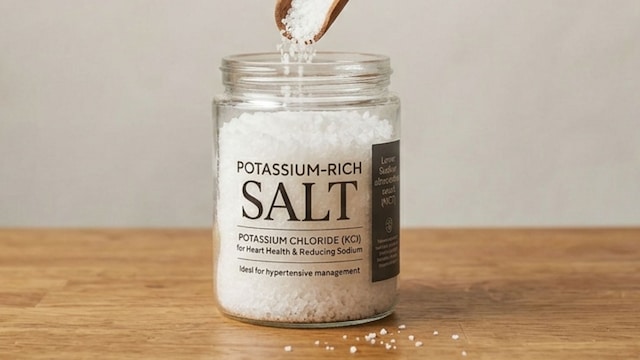
Potassium-enriched salt, made by replacing some of the sodium chloride in regular table salt with potassium chloride, could avert about four lakh deaths and more than 15 lakh cases of cardiovascular and kidney disease in a year in India, a study has estimated.
Globally, almost thirty lakh deaths and one crore new cases of cardiovascular and kidney disease could be prevented each year, the study that looked at 193 countries and is published in the journal Nature Health found.
Bruce Neal, senior professorial fellow at The George Institute for Global Health, Australia, said the health gains of switching to potassium-enriched salt would be widespread and could avert as many as one in ten cardiovascular deaths in most countries.
"Consuming too much sodium and not enough potassium are well established causes of high blood pressure -- a major risk factor for life threatening conditions like strokes, heart attacks and kidney disease. Switching to potassium-enriched salt addresses both these dietary issues at the same time, with substantial health benefits," he said.
Potassium-enriched salt looks, tastes, and cooks like regular salt. The World Health Organization (WHO) suggests replacing regular table salt with lower-sodium salt substitutes containing potassium.
It says reducing sodium intake is a cost-effective method to improve health and decrease burden of noncommunicable diseases.
"While a global shift from regular salt to a potassium-enriched substitute is aspirational, this is a starting point to get countries thinking about the opportunity -- with much greater potential and at much lower cost than many drug-based treatments," Neal said.
The study examined a range of hypothetical scenarios, from a full global switch of all salt to more targeted use among people with diagnosed and treated high blood pressure.
Even the most limited level of switching still showed major health gains, the researchers said.
Switching only regular table salt at home to potassium-enriched salt could prevent 18.5 lakh deaths and about 62 lakh cases of cardiovascular and chronic kidney disease, while switching salt only in processed and restaurant foods could prevent 15.6 lakh deaths and 54.6 lakh cases of cardiovascular and chronic kidney disease, they estimated.
However, switching both regular table salt at home and salt in processed and restaurant foods could together avert nearly thirty lakh deaths and over one crore cases of cardiovascular and chronic kidney disease, the team found.
"Worldwide replacement of all salt could prevent 2.96 million deaths, 10.17 million new cases and 69.43 million disability-adjusted life years each year from cardiovascular disease and chronic kidney disease," the authors wrote.
A concern the researchers cited was the risk of high potassium levels (hyperkalaemia) in people with advanced kidney disease.
The study found, however, that even among patients with advanced kidney disease the benefits outweighed the risks.
"People with serious kidney disease and those taking medications that significantly raise blood potassium levels need to take precautions. Risks for this group can be managed effectively through patient education, product labelling, and clinical oversight," nephrologist Vivek Jha, senior professorial fellow at The George Institute in India, said.
(This story has not been edited by NDTV staff and is auto-generated from a syndicated feed.)