

)
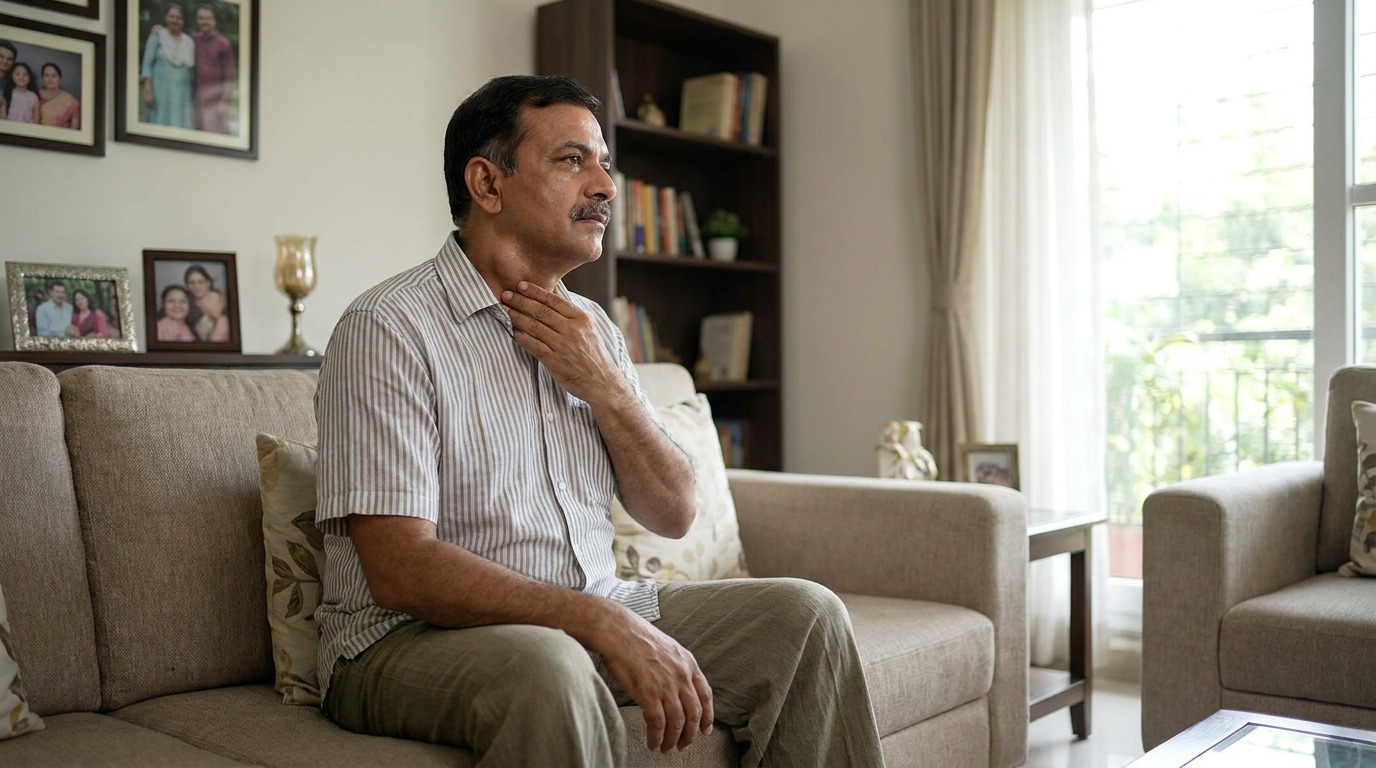
For most of his adult life, a 65-year-old man carried something at the back of his neck that he had long stopped mentioning to anyone. It started small - a soft, painless swelling he barely noticed in his forties. There was no pain, no urgency, nothing that screamed for a doctor's attention. So he let it be.
Twenty-five years later, that "nothing" had become a 15 x 12 cm mass sitting squarely on the nape of his neck - impossible to ignore, difficult to hide, and increasingly hard to live with.
This is the story of that lump, and of the surgery that finally gave the man back the neck - and the confidence - he'd quietly lost over two and a half decades.
When "It's Probably Nothing" Stretches Into Decades
Lipomas are common. Most people who develop one will tell you the same thing: a soft lump under the skin, no pain, slow growth, easy to forget about. In the vast majority of cases, that casual attitude is medically reasonable - lipomas are benign fatty tumours, and small ones rarely cause trouble.
But size changes the equation. What started as an unremarkable lump on this patient's neck kept growing, year after year, until it stopped being something he could tuck away under a collar or ignore in the mirror. It began to affect how his clothes sat, how he held his head, how he felt walking into a room. The tumour had become part of his identity in a way no one would choose.
By the time he sought treatment, he wasn't dealing with a cosmetic inconvenience anymore. He was dealing with a giant lipoma - rare, physically cumbersome, and quietly corrosive to his self-image.
Looking Closer Before Cutting Anything
Dr Anmol Chugh, Associate Director at CK Birla Hospital, Gurgaon, who led the case, knew that a lump of this size couldn't simply be approached with a scalpel and good intentions. Large neck lipomas are uncommon enough that they demand a proper look before any surgical decision is made - not just to confirm what the mass is, but to understand exactly how it sits among the muscles, nerves, and blood vessels of the neck.
An MRI gave that clarity. It showed a well-encapsulated, fat-containing lesion measuring roughly 10.8 x 7.8 x 4.5 cm, tucked within the subcutaneous tissue of the left suboccipital region - the nape of the neck. The scan revealed thin internal septations running through the mass and a smooth indentation pressing against the underlying posterior paraspinal and sternocleidomastoid muscles, but crucially, no invasion into the muscle itself and no extension toward the spine.
There was no internal heterogeneity, no solid component - none of the warning signs that would suggest a more aggressive, cancerous process. Radiologically, this was reassuringly, unambiguously benign.
That reassurance mattered. It meant the surgical goal wasn't to chase margins around a potential malignancy - it was to remove the mass cleanly while protecting everything around it.
Planning For More Than Just Removal
Dr Chugh's approach to the case rested on four priorities that shaped every decision in the operating room:
- Complete excision of the lipoma, to make recurrence as unlikely as possible.
- Careful preservation of the nerves, blood vessels, and healthy tissue surrounding the mass.
- Minimising dead space left behind after removal, reducing the risk of fluid collecting under the skin during recovery.
- Restoring the natural contour of the neck, while holding onto as much of the stretched skin as could safely be kept, rather than defaulting to aggressive skin removal.
That last point is easy to overlook but matters enormously to the patient's eventual quality of life. After 25 years of gradual stretching, the skin over the lipoma had adapted to accommodate the mass. Handled thoughtfully, that same skin could be preserved and redraped, rather than replaced or grafted - sparing the patient a more complicated reconstruction.
In The Operating Room
The surgery itself called for patience as much as precision. Twenty-five years of growth meant the tumour had developed a long-standing relationship with the tissue around it, and separating the two required careful, deliberate dissection rather than a hurried approach.
Working through the layers, the surgical team freed the lipoma from the surrounding structures and removed it as a single piece. Given its size, controlling bleeding throughout the dissection was as important as the excision itself - a large cavity left behind is only a good outcome if it's a clean one.
Once the mass was out, the focus shifted to reconstruction: closing the space so fluid wouldn't collect, smoothing the contour of the neck, and positioning the incision to keep tension off the healing skin - a detail that plays a large role in how a scar eventually settles.
Six Months Later
By the six-month mark, the change was clear. The neck had regained a natural contour. The scar had settled and matured well. And the man who had spent a quarter of a century quietly accommodating a growing lump was, for the first time in a long while, simply living his life without thinking about the back of his neck.
For Dr Chugh, the case underlined something that gets lost in casual conversations about lipomas: benign does not mean insignificant. A tumour with zero malignant potential can still take a real toll - physically, in the strain and discomfort of carrying extra tissue for years, and emotionally, in the slow erosion of confidence that comes from living with a visibly altered body.
Plastic surgery, at its best, isn't only about what's removed. It's about what gets restored - comfort, contour, and often, a version of confidence the patient had quietly given up on.
Disclaimer: This content including advice provides generic information only. It is in no way a substitute for a qualified medical opinion. Always consult a specialist or your own doctor for more information. NDTV does not claim responsibility for this information.