

)
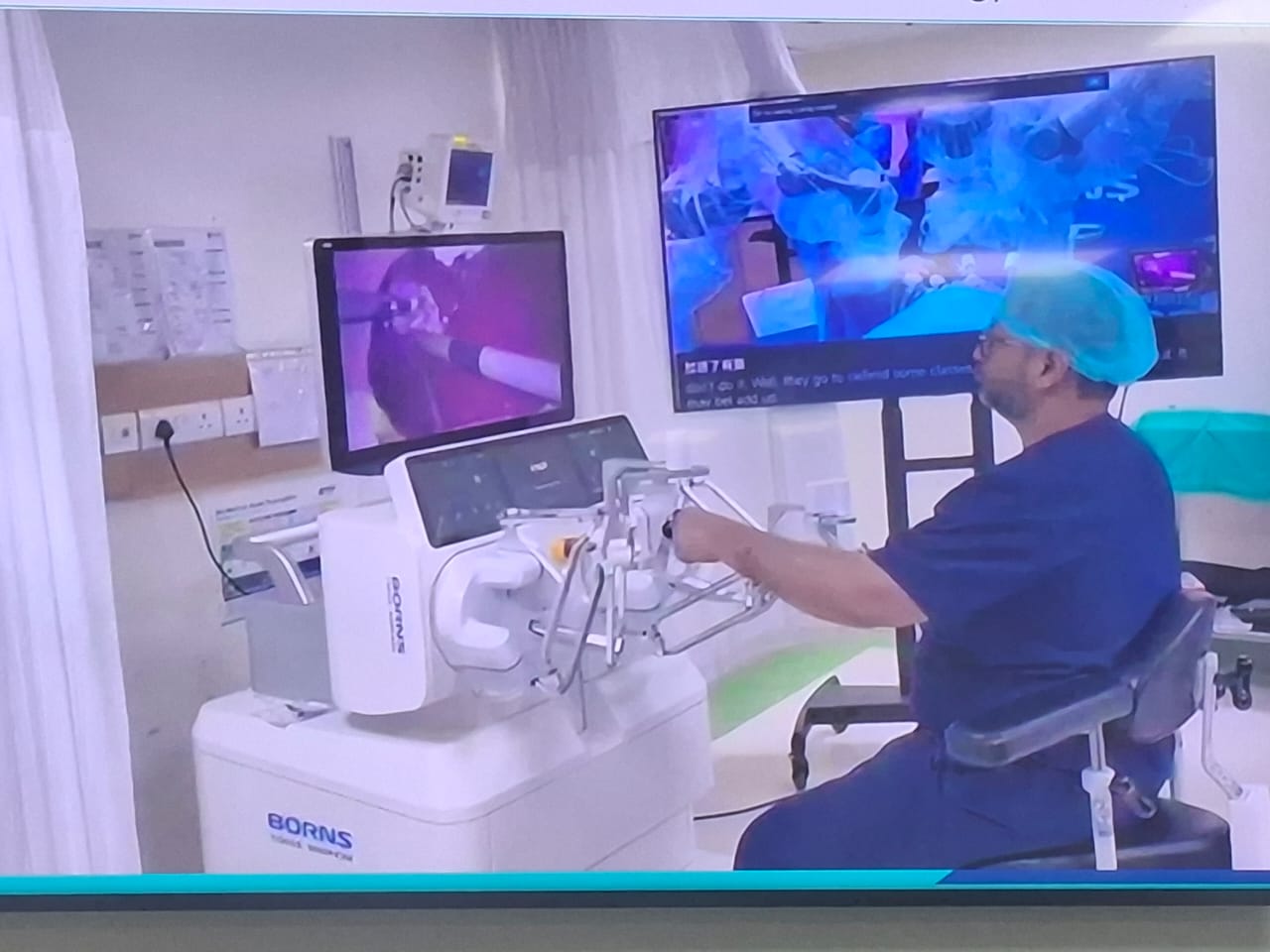
Advances in robotic technology, high-speed connectivity, and digital infrastructure have expanded the possibilities of delivering medical services beyond geographical boundaries. In a significant milestone, doctors demonstrated a live cross-border robotic telesurgery between India and China today. During the procedure, the surgical team in India was connected to a robotic surgical system located in Chengdu, China. The demonstration aimed to test the technical feasibility of performing remote surgery and to explore future possibilities for surgical collaboration and tele-mentoring between international experts.
The live telesurgery was led by Dr Vivek Bindal, Principal Director and Head of the Minimal Access, Bariatric, and Robotic Surgery Department, supported by the BORNS Robotics System. The primary objective was to assess how accurately and rapidly a surgeon's hand movements and critical real-time visual information could be transmitted over international distances, evaluating the potential for remote intervention in complex surgical procedures.
During this pre-clinical telesurgery, procedures such as gallbladder removal, abdominal surgery, hysterectomy, and kidney-related operations were performed on animal models. The demonstration proved that surgeons based in India can control a robotic surgical system in another country nearly 5,000 kilometres away, made possible through advanced robotics and high-speed connectivity.
The availability of specialized medical services in India remains unevenly distributed. Expertise in complex surgeries and advanced treatments is largely concentrated in major metropolises, making access difficult for patients in tier-2 and tier-3 cities. In the future, long-distance and cross-border connectivity will extend beyond remote operations; it will enable experts to conduct tele-proctoring, offer real-time guidance, deliver training, and collaborate with surgical teams in disparate locations.
Reflecting on the event, Dr Vivek Bindal said: "Healthcare is entering an era where expertise does not necessarily have to be confined by geographical boundaries. The highlight of this live telesurgery is that it combined surgery, robotics, connectivity, and international collaboration to test what is technically achievable. In the future, telesurgery will not be limited to operations alone; it will also serve as a vital medium for remote mentoring and proctoring, allowing experts to support and share their skills with surgical teams worldwide."
Dr Gaurav Agrawal, Director of Hospital Operations and Chief Operating Officer (NCR Region 3), added: "We continuously incorporate the latest technological advancements into medical services with the broader interests of patients in mind. As a leading institution performing a high volume of precision robotic surgeries, our primary focus remains on improving clinical outcomes. Although cross-border robotic telesurgery is still in an experimental phase, successful research and technological breakthroughs of this nature are crucial for the future of healthcare. These efforts lay the foundation for a future where cutting-edge surgical expertise is unbound by geography, ensuring patients in tier-2 and tier-3 cities, regional states, and international locations gain enhanced access to specialized, life-saving care."
This live cross-border telesurgery between India and China marks an important step toward understanding the feasibility and technical capabilities of the technology prior to clinical adoption. Full clinical application will require adherence to strict regulatory approvals, clinical protocols, and patient safety standards. Subject to these regulatory clearances, plans are underway to explore the integration of telesurgery across the broader hospital network.
The applications of this technology extend far beyond a single surgical discipline. Through this platform, specialists can guide distant surgical teams, provide remote assistance during complex procedures, and share expertise across cities and borders. This successful demonstration represents a major step towards a fully connected surgical ecosystem, utilizing cutting-edge technology to share expert medical knowledge well beyond geographical limitations.
Disclaimer: This content including advice provides generic information only. It is in no way a substitute for a qualified medical opinion. Always consult a specialist or your own doctor for more information. NDTV does not claim responsibility for this information.