

In a major relief for cancer patients, prices of 137 identified anti-cancer drugs are expected to fall by up to 70%. India's drug price regulator, the National Pharmaceutical Pricing Authority (NPPA), has capped trade margins at 30 per cent for 137 identified non-scheduled anti-cancer drugs. The revised, lower prices are scheduled to officially take effect on November 9, 2026. Patients can check revised prices on the NPPA website and Pharma Sahi Daam app. The initiative intends to tackle high trade margins and improve availability of cancer treatments.
The government has asked retailers, hospitals and medical institutions to charge the revised prices and display updated price lists. Additionally, pharmaceutical companies have been directed to maintain current production and supply levels to ensure uninterrupted access to medicines.
137 identified non-scheduled anti-cancer drugs include Immunotherapy drugs used for treating over 20 types of cancers, Denosumab used by breast and prostate cancer patients, Pegfilgrastim, which is used to prevent neutropenia in cancer patients and Bevacizumab, which is the approved drug to treat colon, ovarian, and cervical cancer.
Here's a complete list of the 137 drugs:
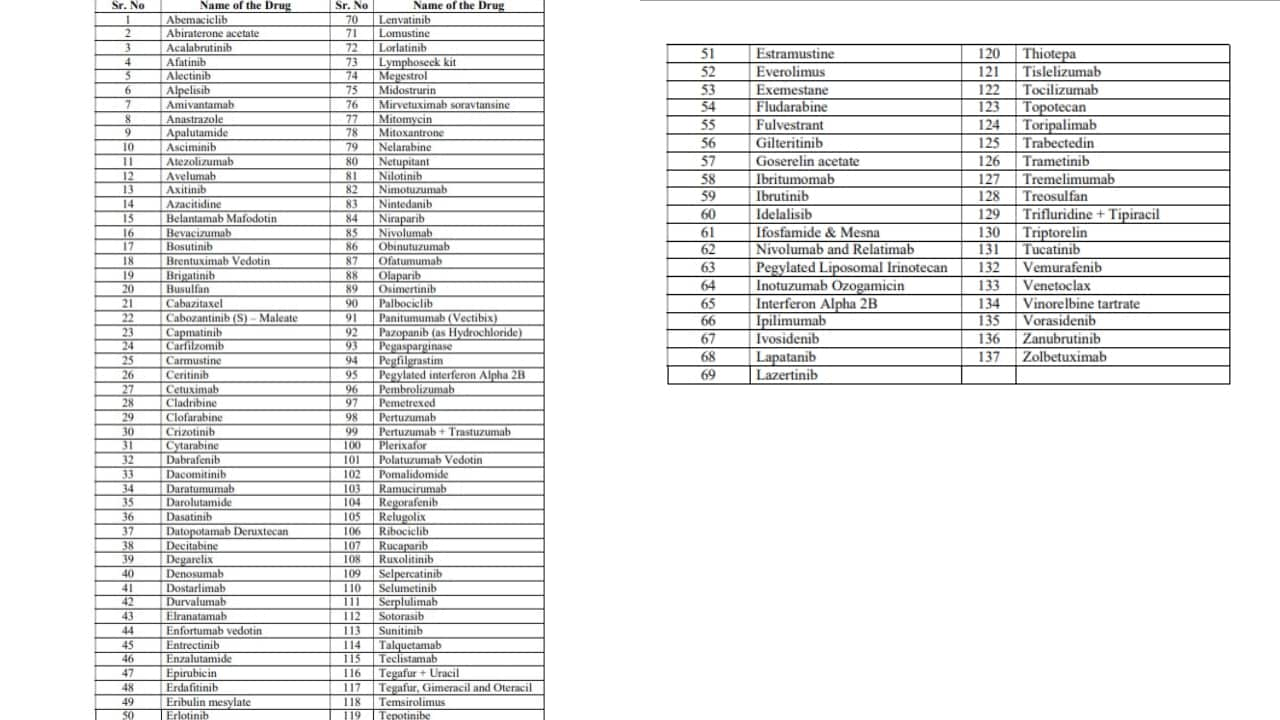
Photo Credit: National Pharmaceutical Pricing Authority
With this announcement, the maximum retail price of commonly used anti-cancer medications like Pembrolizumab, Durvalumab, and Osimertinib is anticipated to be more accessible for cancer patients.
"All manufacturers will be required to inform NPPA of their revised prices within 7 days of publication of the Gazette notification. The revised prices will become effective from November 9, 2026. Manufacturers will be required to display the price lists on their website and widely disseminate to all retailers and hospitals. All the retailers and hospitals shall charge reduced prices effective 9th November, 2026 and display the revised prices in their pharmacies," a government announcement states.
READ | Cancer Drug Prices May Fall By Up To 70% As Government Caps Trade Margins: Sources
Supreme Court previously raised severe concerns over the huge gap between the Price to Retailer (PTR) and Maximum Retail Price (MRP) of some cancer drugs, noting that the gap between what retailers paid and what patients were charged was sometimes as high as 10 times.
In response, the government is implementing Trade Margin Rationalisation (TMR), capping the trade margin at 30%. The actual percentage cut, which is up to 70%, will depend on each drug's current pricing structure.
The measure covers branded and generic medicines as well as domestic and imported drugs, including patented and non-patented medicines.
Disclaimer: This content including advice provides generic information only. It is in no way a substitute for a qualified medical opinion. Always consult a specialist or your own doctor for more information. NDTV does not claim responsibility for this information.