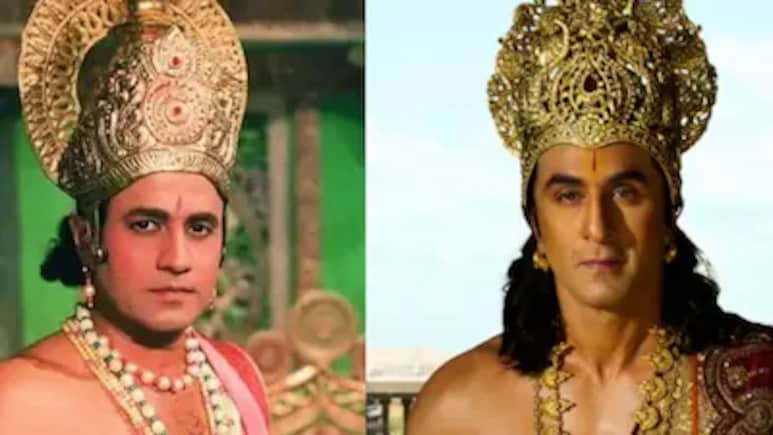
The Ramayana and the Mahabharata are intrinsic to Indian culture, and no matter how many times we have heard these mythologies narrated, read them or watched them unfold on screen, their stories continue to fascinate us.
Every retelling of these mythologies offers a fresh perspective, a different interpretation or a new way of looking at characters most of us have known all our lives. Director Nitesh Tiwari's Ramayana, starring Ranbir Kapoor, Yash and Sai Pallavi in the lead roles, is the latest contemporary interpretation of Ramayana in a long list of adaptations for television and cinema.
The earliest known adaptation of Ram and Sita's epic was possibly Lanka Dahan, one of India's earliest mythological films, which was made in 1917. This was followed in 1958 by the Tamil film Sampoorna Ramayanam, which was made by director K Somu based on Valmiki's Ramayana. A similar film with the same name was made in Telugu by director Bapu in 1972, but it was Ramanand Sagar's Ramayan that was released on Doordarshan in 1987 that took the nation by storm.
An Indo-Japanese animation in 1993 titled Ramayana: The Legend of Prince Rama was a more modern interpretation by directors Koichi Sasaki, Ram Mohan and Yugo Sako, but it didn't receive much theatrical support due to the Ram Janmabhoomi issue at the time. Going back to television, in 2008, director Anand Sagar, the son of the late Ramanand Sagar, retold the Ramayana in his series, while in 2015, Siya Ke Ram, the epic was presented through Sita's eyes by Nikhil Sinha, Dharmesh Shah, Pradeep Jadhav and Animesh Verma, in theirs. Om Raut's 2023 film Adipurush starring Prabhas was inspired by the Ramayana, but it bombed at the box office.
What is perhaps most fascinating is not how many times the Ramayana has been told, but that every generation has found a new way to tell the same story.
Director Nitesh Tiwari's Ramayana, produced by Namit Malhotra and Yash at a reported cost of Rs 4000 crore, is undoubtedly the most ambitious and lavish cinematic adaptation of the epic ever attempted. The extensive use of VFX creates a visually spectacular narrative that transports audiences to a world beyond their imagination.
However, the main challenge - and question - here is whether this technical grandeur is accompanied by an in-depth emotional story that captures the hearts and minds of audiences, especially those who have grown up with the epic. And that's where perhaps the biggest shortcoming lies in Ranbir Kapoor and Yash's 195-minute Ramayana.
The Ramayana, as a narrative, cannot be reinterpreted according to one's creative whims, as its fundamental story and values it represents are embedded in Indian culture and Hindu spirituality. Valmiki's Ramayana is the foundational text for most of these cinematic interpretations, and while filmmakers have the creative freedom to present it however they choose visually, the central narrative remains the same, as do the characters.
Thus, one's creative liberty is curbed right from the outset while making the Ramayana and director Nitesh Tiwari also acknowledged this in an interview (The Direct) when he stated, "With Ramayana, it's a part of our story; you really can't take much liberty with it, because it is a part of our life.
It's a voice of our collective conscience. So, we wouldn't do that. However, there are certain portions where we can re-visualise them to make it more exciting, so that people, when they see it, they're watching the same story, but they get a feeling of watching something that happens fresh, for the first time. So, for example, there are creatures, there are demons, the way Ayodhya looks, the way Lanka looks, the way Mithila looks, all these cities, the way costumes look, the way wars are going to be fought. Those are things which are going to be absolutely fresh for people, while the core values remain intact."
While visual grandeur attracts the audience and makes the experience immersive, as in the case of Tiwari's Ramayana, it is emotional storytelling that engages audiences and invests them in Ram, Sita, Raavan and Hanuman, and their journeys. Ramayana is more than just a battle of good versus evil - it explores and presents moral, emotional, social and spiritual principles. Duty, sacrifice, truth, love, devotion, compassion, humility and responsibilities are fundamental to the epic, and it teaches us why these principles are important to live by. And it is precisely because of this deep emotional connection that Ramanand Sagar's Ramayan continues to hold a special place in the collective consciousness of Indian audiences even after four decades. The 78-episode TV series that ran for over a year (1987 to 1988) captivated people with its simplicity and sincerity, and every Sunday morning families instinctively gathered around their TV sets at 9: 30 am to embrace the epic and its lessons. The series became a shared cultural experience, and in 2020, when the TV series was re-aired during the COVID pandemic, it again broke viewership records worldwide.
In fact, it was the episodic format of Sagar's series that allowed him to explore the emotions of characters in-depth, and every episode carried an emotional angle that hooked the viewer and drew them deeper into the characters' journey. While the visual effects used in the 1987 TV series were quite primitive and mostly camera-based special effects, the team knew that they had to use these special effects for some aspects of the story. But the special effects never became the story; instead, Sagar always ensured that the focus in every episode was on the characters, their relationships, the emotions and spirituality which bound them all.
Today, as we watch Ranbir Kapoor, Yash, Sai Pallavi and the other characters in Tiwari's Ramayana: Part 1 stand tall and resplendent in their expensive costumes, lavish sets and VFX-laden landscapes, one cannot help but marvel at the scale of the production.
But visual spectacle alone doesn't bring mythological characters to life - it is the emotional depth with which these characters and their relationships are portrayed that draws audiences close to them. Again, the Ramayana can be retold in many ways, but its emotional and philosophical essence must resonate with audiences. And this is the real challenge for anyone attempting to bring this timeless epic to the big screen.
