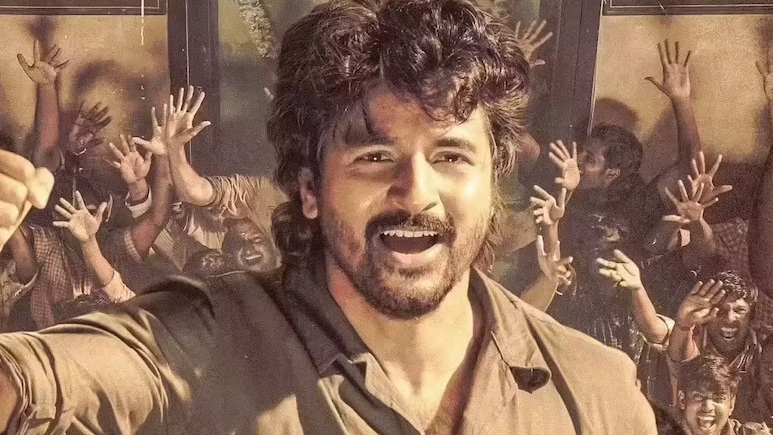
In her fifth outing and first collaboration with actor Sivakarthikeyan, director Sudha Kongara crafts a relevant but way less than scintillating Tamil period drama that, notwithstanding the numerous censorial excisions it has suffered, makes full use of all the ingredients one expects from a star vehicle targeted at a mass audience.
The balancing act is by no means easy and Parasakthi frequently teeters on the edge of a pulpy precipice. To her credit, the director, who is also the film's co-writer with Arjun Nadesan, does not let the commercial aims of the project overly blunt the edges that the emotive subject matter imparts to it.
She informs the tale with a degree of gravitas amid dramatic highs and lows and struggles a tad to ensure that the primary focus is more on the substance and treatment of the political theme than on the frills that the presence of a star in the cast demands.
A love story is rather loosely appended to the plot, which takes some of the sting out of the film, especially in the first half. But once Parasakthi gets down to brass tacks post-intermission, it regains some lost ground and unfolds at a fair clip.
For Sivakarthikeyan, there is a lot at stake here in the wake of the below-par box-office outcome of his last release, Madharaasi. Conscious of the innate potential of Parasakthi, the actor gives it his all.
Parasakthi, in spite of the star power, is a completely different kettle of fish because it does not for the most part look to deliver big-on-booming-ballistics kind of entertainment.
What the film does instead is seek to balance its crowd-pleasing elements - there is no dearth of that - with an intrinsic singularity of purpose. It succeeds on that count only in fits and starts. Some passages tend to fall between two stools. Thankfully, there aren't that many.
The key characters and the plot strands that Kongara weaves around them are entirely fictional, but the context in which they are set is derived wholly from the turbulence of the real world as it existed in the state of Madras (now Tamil Nadu) in the mid-1960s.
Parasakthi, released nationwide in Telugu too, plunges headlong into a period of great unrest when the youth of the state led an agitation against the imposition of Hindi. The fear that the central government diktat would subsume the Tamil language and culture sparked violent clashes between students and law enforcers, leading to several deaths in police firing.
Employing that era of tumult as an effective backdrop, the film homes in on Sivakarthikeyan as government servant Chezhiyan - "Che" in short - who is buffeted by the repercussions of the youth movement because his brother (Atharvaa), a committed student activist, faces grave danger as the fire of rebellion spreads and threatens to engulf the entire state.
In trying to keep his family out of harm's way, Chezhiyan goes toe to toe with a predatory intelligence bureau agent (Ravi Mohan) who is out to make life difficult for the siblings and those of their ilk. The latter's strongarm methods push the protagonist to a corner.
The bitter battle of attrition between the two men generates its share of intrigue and tension but it is served up with generous helpings of romance, music and action that keep the entertainment quotient high even as the film doubles down to tackling serious questions.
Sreeleela, in her first Tamil film, plays the male protagonist's romantic interest and not much else. Her character, Rathnamala, is at best decorative. She serves as a foil to the sedate but spirited man thrown into the vortex of history and then steps away from the narrative spotlight.
There is, however, undeniable depth in Chezhiyan. He is unlike the hero of Kongara's Soorarai Pottru, a real-life low-cost aviation pioneer who was placed in a story that blended actual events with fictional flourishes. His struggles are not strictly factual but the compulsions that he must contend with are rooted in the conflagrations that actually occurred in Tamil Nadu in 1965.
Not only does the enmeshing of the real and the imagined pose a daunting set of challenges to the screenwriters, it also requires the director to find ways to make the story throb with resonance for audiences watching the fictionalised reenactment of events that took place 60 years ago.
The film's contemporary relevance stems from the fact that the language conflict that Parasakthi addresses continues to be a thorny issue, albeit in a form that is markedly different from the one depicted here.
The core of Parasakthi is reminiscent of Mani Ratnam's 2004 Suriya-starrer Aayutha Ezhuthu, which was based on true incidents involving an influential student leader of Osmania University, Hyderabad, who ran foul of the powers that be.
That Kongara learnt the ropes from Ratnam, who she assisted for many years before making her first film, is obvious in some of the sleights that she uses in order to blend the conventions of Tamil popular cinema with avowed principles of historicity. She pulls off the coalescence impactfully with the help of a star who is always in tune with the requirements of the script.
Sivakarthikeyan sinks his teeth deep into his meaty role and imparts to it sustained intensity and dynamism. The support that Atharvaa as the feisty brother whose world collides with oppressive forces and Ravi Mohan as the ruthless police officer extend is inconsistent because the script leaves them adrift at crucial junctures.
In the politically charged world that Parasakthi creates, Sreeleela is never more than a peripheral presence. If anything, she is a mere speck swamped by a tide of events.
That is pretty much the case with some of the means Sudha Kongara falls back on to piece together the story of the anti-Hindi agitations of a bygone era. Be that as it may, Parasakthi is a watchable film mainly because the director and the lead actor work well in tandem and the evocative production design and the top- notch cinematography (by Ravi K. Chandran) enhance its texture and visual sheen.
The near-perfect technical inputs help the film skirt around its many fumbles. Well, almost.
-
Sivakarthikeyan, Atharvaa Murali, Sreeleela
