- The Sri Lankan civil war caused loss, displacement, and trauma for many families
- Neelira is set in 1988 during the war, focusing on Vasuki's wedding night in a village
- Eight Indian soldiers seek refuge in Vasuki's home, leading to a hostage situation
The civil war in Sri Lanka was one that changed the lives of thousands due to the loss of loved ones, displacement, destruction of homes, livelihoods, and families, and creating a generation that grew up amid violence, loss, and uncertainty.
The Indian Peacekeeping Force (IPKF) was also deployed during the time to restore peace but many Sri Lankan Tamils were caught in the middle between them and Tamil militants.
Neelira (a long night) is set during this period in 1988 in a small village and revolves around a house where preparations are in full swing for Vasuki's wedding. The entire film showcases what happens over the course of over one night in Vasuki's home.
Vasuki and her family are hurriedly making plans for her wedding with just a few relatives gathered for the occasion. Duie to the ongoing war, the celebrations are not large and restricted to a tight knit group of around15 people. Despite permission having been sought from both the Sri Lankan army and the Indian army for the festivities, Vasuki and her family are on constant tenterhooks not knowing who will turn up on their doorstep at any given moment.
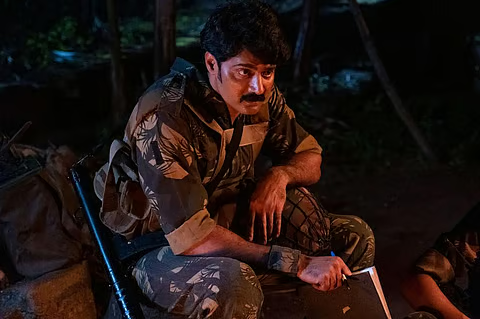
A sudden stern and frantic knock on their door the night before the wedding, puts the entire family on high alert. When Vasuki's grandfather opens the door, he finds a group of eight Indian army soldiers seeking refuge as they have lost their way while en route to joining the rest of their troops. They are stuck there for the night and the Captain (Naveen Chandra) decides to move his men into Vasuki's home to ensure their safety. But what ensues is unexpected - the men end up holding the family captive and when Tamil militants end up there looking to take out these men, chaos erupts. What happens to the family? Do they survive the night? Does the wedding take place?
Director Someetharan clearly informs the audience that this chamber film is shaped by his own life experiences as someone who grew up in Sri Lanka during the civil war. This is not a war film in the traditional sense. There are no heavy battle sequences and no clear villains or heroes. Instead, Neelira is about what war does to ordinary people who are simply trying to live their lives.
The film touches upon the politics of war but is more centred around the psychological cost of war - the fear, the suspicion, the mistrust, the grief and the silence that becomes a way of survival. Someetharan's storytelling is deeply internal as he's far more interested in what his characters are feeling than what they are doing.
The civil war has made the people emotionally fragile and there's a sense of alienation that they feel too - for instance, if Deva has taken up arms in the belief that Tamizh has died, then Vasuki is married off to a refugee abroad whom she may or may never meet. People here cannot afford to break down because survival itself requires emotional restraint.
Someetharan uses music and the atmosphere to effectively create a strong build-up and add tense drama to the proceedings inside the house. This is heightened by the measured performances of the cast - there is no melodrama or over-the-top acting; instead, facial expressions, silences and movements beautifully express the characters' emotions and life experiences.
At just 90 minutes, Neelira is a deeply affecting portrait of life shaped by conflict, but what it ultimately lacks is depth. The characters seem to carry histories and emotions that are far more complex than what the film allows them to express.
As a result, what the director presents to us feels more like the surface of a story rather than its emotional core. There is a sense that each character has an entire past shaped by war, loss, displacement and survival, but the film only gives us fragments, never fully allowing these lives to breathe on screen.
-
Naveen Chandra, Roopa Kodayur, Rohit Kokate
