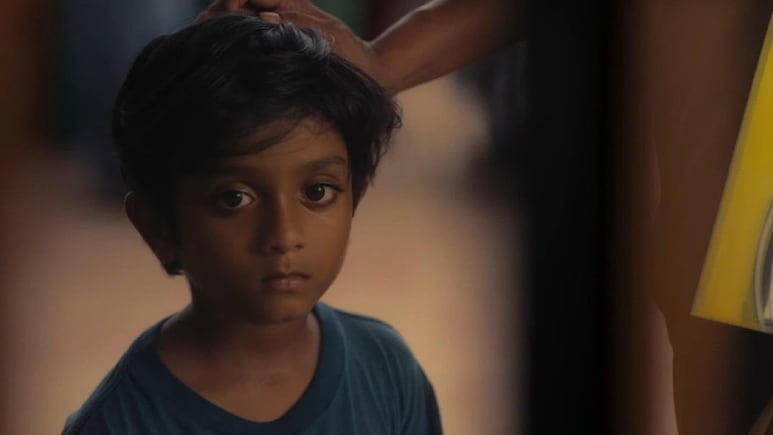
When the story is about a mother and child, there is bound to be love, tenderness and a complicated bond that transcends every challenge in their lives.
And director Chidambaram's latest film, Balan: The Boy, takes this relationship and presents it in a novel manner as a survival drama.
After the success of Jan.E.Man and Manjummel Boys, the director heads in a new direction with this film that's written by Jithu Madhavan, who is known for the superhits Romancham and Aavesham.
Interestingly, Balan: The Boy is also a psychological thriller focusing on the themes of identity and survival (which was key in Manjummel Boys) in a world that is unforgiving.
At its core, the film revolves around a young boy and his mother who are in jail for a crime unbeknownst to the audience. When the mother and son are released from Kannur jail, she is told by the queenpin of the prisoners, sex worker Shamnatha (Beena Antony), that she would come in search of her when she is released.
The frightened mother, who wants to protect her son at all costs, leaves Kannur with him and the duo head towards smaller villages where they live sans identity or status and blend into the background, wishing to be invisible.
With every move from village to village, the mother feeds the boy fresh stories at bedtime - not like those in the fairytales that kids generally hear - but stories which give them new identities and backstories that give them anonymity and protection. The mother, who refrains from developing any kind of attachment to anyone, becomes Indhu, Mary and Sherly, while the boy becomes Abhijit Kumar, Adiseshan and Vasudev, obediently remembering every detail about their life that his mother has drilled into him.
It's finally when the mother ends up looking after an elderly lady, Ammoomma, in a wheelchair in a village, that they begin to find some semblance of normalcy and the boy starts to go to school.
The two forge a bond with the elderly lady, accepting her as a grandmother (Ammoomma), and when they think that perhaps they could stop lying and running, things take a nasty turn. Balan and his Amma are separated. What does eventually happen to her and Balan?
The first half of the film builds up beautifully as a thriller, and the second half of the film moves towards the emotional consequences of what has played out in the lives of the mother and son.
The director and writer have ensured that the lives of the mother and son are built upon layer by layer gently in the first half, and Chidambaram doesn't rush to tell us their story. They have added thriller elements to the story in layers too so as not to make them jarring in the film nor take away from the essence of the mother-son story.
The ultimate victory for both Chidambaram and Jithu Madhavan is the brilliant characterisation of both the mother and the son - the key players in the movie.
The characters are very authentic and really compelling the audience to immediately connect with them. Their struggles, joy and fear are relatable, and empathy builds up for them as the movie plays out. There are many elements in the film that are narrated eloquently or visually subtly established, and this adds depth to the film.
For instance, the mother's traumatic marriage and her courageous escape from that toxic situation to protect her child. Or in the instance where a murder is committed but we see only the blood being cleaned.
Even when it comes to the son, there are facets of his personality we innately understand thanks to the visual narrative and/or his behaviour. Balan, who had a traumatic childhood despite all the love and care he got from his mother, doesn't end up just as a victim of circumstances and events beyond his control.
Balan is someone who has learnt how to navigate this world thanks to the lessons of poverty, homelessness, and personal loss he has faced right from the time he was born. He grows up to be a confident boy (despite his status as a nobody in life) who easily embraces the role reversal of wanting to protect and save his mother at all costs.
Of course, the film does have flaws, and this is truer perhaps more of the second half. Some characters could have been better written and the scenes trimmed as well.
Given that this movie is a slow burner and unconventional, the audience's expectations of it being a commercial entertainer may lead to some disappointment.
Technically, the movie has stunning cinematography by Shyju Khalid, who has captured the beauty of the environs in every single frame. The camera allows us to experience the harsh realities and emotions of Balan and his mother as they proceed on their journey.
Sushin Shyam's background music plays up the emotions on screen, while Vivek Harshan's editing could have been tighter.
Balan: The Boy is about the mother-son bond, love, hope, resilience and surviving in a world that's often dark and demeaning. It is a human story that touches you, thanks to the superb performances by Adhisheshan as a child, Muhammed Zinaan as a teenager, and a captivating Farzana Palathingal as the mother.
The cameo by Tovino Thomas as Abbas adds value to the film as well. At the end of the film, what truly stays with you is the heartfelt story about a mother and a son.
-
Chandu Salimkumar, Girish A D, Farzana Palathingal
