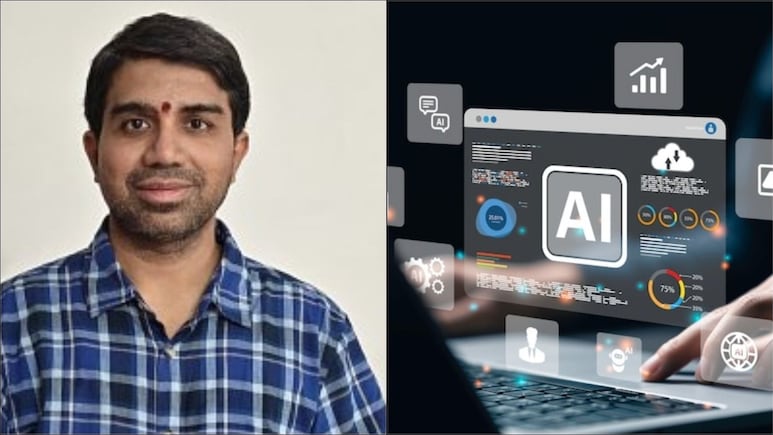

Karthik Raman, Professor in the Department of Data Science and AI at the Wadhwani School of Data Science and AI, IIT Madras, outlined a clear path for students navigating the growing use of artificial intelligence (AI): build AI literacy, strengthen core domain expertise, and develop computational thinking. He was speaking at a Business Standard BSmart panel discussion.
Professor Raman cautioned students against treating AI as a black box, stressing that AI systems can produce confident but misleading or incorrect outputs. He said students must question and verify AI-generated information and understand the limitations of such systems.
"Students should not treat AI as a mysterious black box whose answer can't be questioned," he said.
He also stressed that while AI can assist with coding, design, research, and writing, humans must continue to define problems, evaluate results and make judgment calls.
In a message to students, Professor Raman said: "Learn before you automate. Use AI to refine your work, not to skip the thinking. And be ready to explain your reasoning, not just submit polished outputs."
He added that students do not need to become AI scientists, but they do need to understand how to apply AI responsibly in their respective fields.
What AI literacy means for students
Explaining what AI literacy means for students and employees who are not programmers or do not work in technical roles, Professor Raman said it is important for everyone to understand how AI systems work at a basic level and recognise their limitations.
"It's very important for everyone to be AI literate today because students, or anyone for that matter, have started using AI without figuring out what it actually is," he said.
He noted that while it may not be practical for everyone to understand the mathematical nuances behind AI systems, users should understand that such systems can generate "confident yet misleading output".
"Everybody doesn't have to understand all the mathematical nuances. But what is important is that people need to understand that the system is flawed in its own right. It can give you confident yet misleading output. So, these are things that everybody has to know," he said.
Beyond understanding the limitations of AI, students also need to learn how to use the technology effectively in their respective fields, he said. This includes learning how to frame prompts and use AI tools appropriately for tasks such as content creation, image design and other professional applications.
According to Professor Raman, the most important skill students need to develop is a new way of thinking about AI rather than simply learning to operate AI tools.
"Everybody doesn't have to be a programmer. That's very critical. They also don't need to be fond of mathematics. But no matter whether you like mathematics or programming or you don't like mathematics or programming, AI is going to be with you," he said.
He said this makes it important for students to understand how AI can best be used in their respective fields.
"You could be a content writer, you could be a script writer, you could be an image designer. You need to be able to use AI appropriately for your job," he said.
Computational thinking and AI curriculum
Professor Raman also highlighted the importance of introducing computational thinking and AI concepts at an early stage of education. He said the curriculum should focus on key concepts from a non-mathematical perspective so that students can understand AI without necessarily becoming programmers.
He said a computational thinking curriculum has been proposed for Classes 3 to 5, while the basics of AI have been proposed for Classes 6 to 8.
"Students should not treat AI as a black box because, at that young age, it is very easy to get overawed by AI without really understanding what's inside that so-called box. So, students must try to understand it. And if you see the curriculum, that's how it has been structured. We have proposed a computational thinking curriculum for Classes 3, 4 and 5, and the basics of AI for Classes 6, 7 and 8. It all tries to address key concepts from a very, very non-mathematical perspective," said the professor.
Professor Raman was also part of the CBSE expert committee on computational thinking and AI curriculum for Classes 3 to 8.
His research focuses on developing computational tools and scalable algorithms to understand complex biological systems, with work spanning biological data analysis, systems biology and computational modelling. His interests also include the use of generative AI in education, and he is coordinating work involving faculty and industry partners in this area.
