





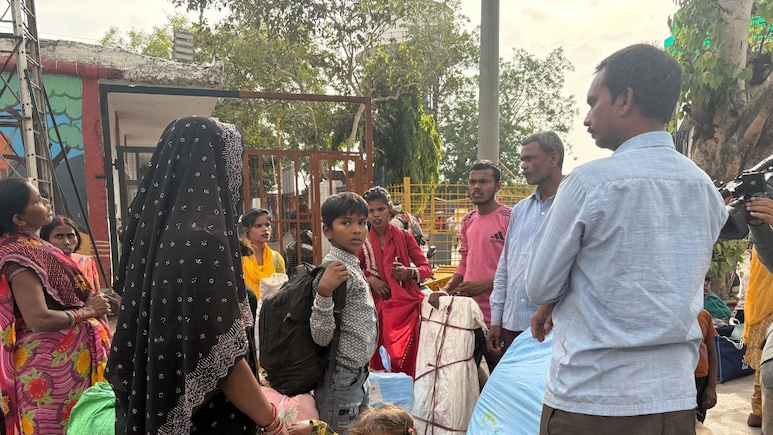
- Families at Old Delhi station leave city due to rising LPG and fuel costs affecting livelihoods
- Daily wage workers and migrants struggle with unaffordable LPG prices and irregular cylinder supply
- Black market LPG costs soar to Rs 250-700 per kilogram, far above official Rs 900 per 14.2-kg cylinder
Near the unreserved ticket counter at the Old Delhi Railway Station, a family sat on the floor beside their bundled belongings - white sacks, stitched bedding and small suitcases.
"Hum toh bhai ki shaadi ke liye gaon wapas ja rahe hain (We are going to our village for my brother's wedding)," said Sanjugta, who lives in Nangloi, while wiping her eyes with the edge of her dupatta. When asked why she was carrying a mattress and so many bags, she paused and corrected herself quietly. "There is no wedding. We just can't afford to buy Rs 600 LPG gas cylinder when I earn Rs 200 hundred a day. I can't feed myself or my family here anymore. What is the point?"
She was preparing to board a train to her village in Boria district, Haryana. Her husband stood a few steps away, holding three large white sacks filled with utensils. "My factory shut down. My wife earns only Rs 5,000 rupees working as a domestic help. Maybe we'll do farming back home. At least we'll survive somehow," he said.
What began as a global fuel disruption because of the Iran war has now filtered into India's industries and kitchens, becoming something more immediate - a livelihood crisis.
A shortage of LPG cylinders, delays in refilling and rising black market prices have made cooking - once the cheapest way to survive in the city - expensive.
Vinod Kumar, 38, a daily wage labourer from Subhash Nagar, earning around Rs 400 on some days, echoed a similar sentiment as he waited for a train to Bihar's Darbhanga. "The government will find solutions, but we can't wait forever. We managed till we could - standing in long queues to get LPG, getting into fights", he said.
Vinod's wife shared how cooking on a stove got unbearable. "The house fills with smoke, I keep coughing, and the landlord yells at us to stop. How do we stay alive if we stop? The government is asking us to switch to PNG, but where is it? Our area doesn't have a connection, and even if it did, we can't afford the installation. For tenants like us, it's not a practical option".
Daily wage migrants, constantly shifting homes, often go without authorised LPG connections. A 14.2-kg domestic LPG cylinder costs just over Rs 900 in Delhi - far below what people pay on the black market. Local vendors are now said to be charging Rs 250-700 per kilogram, with rates changing hourly.
Across the city, the strain shows in small but telling ways. Students preparing for competitive exams speak of cutting back to the bare minimum. Street food carts - once a fallback for affordable meals - are fewer. Small eateries have raised prices or shut down, citing fuel costs.
Abhishek, 24, who had been staying in a PG in Mukherjee Nagar while preparing for UPSC exams, stood with a small suitcase and a backpack, waiting for a train to Uttar Pradesh's Prayagraj. "I came here fully prepared for coaching," he said. "But the mess food has deteriorated. They've increased prices and reduced quantity. Cooking on our own is not possible now. I was managing somehow, but this is not sustainable. I'll prepare from home for some time."
What makes this reverse migration difficult to quantify is its quietness. There are no demonstrations, no official counts - just families boarding unreserved compartments with whatever they can carry.
Authorities maintain that India's petroleum and LPG supplies remain secure, dismissing fears as misinformation. But for many on the ground, the issue is not availability - it is access. Delays in delivery, dependence on informal markets and lack of documentation for subsidised cylinders mean that those with the least often pay the most.
The government's promise of piped natural gas (PNG) as an alternative has also remained uneven in practice. While infrastructure has expanded, large sections of the city - unauthorised colonies, dense rental clusters and informal settlements- remain outside its reach. Nearly a third of Delhi's population lives in such areas, where narrow lanes, safety requirements and landlord constraints limit access.
A PNG connection, costing around Rs 7,000, is often not an option for tenants who move frequently. Landlords are reluctant to invest and tenants cannot apply independently.
"Once again, we are being forced to rely on firewood because of an inefficient government," said Samajwadi Party chief Akhilesh Yadav, recalling the mass migrant exodus during the Covid lockdown. However, the Centre denies any LPG shortage, accusing the Opposition of spreading panic.
Track Latest News Live on NDTV.com and get news updates from India and around the world

