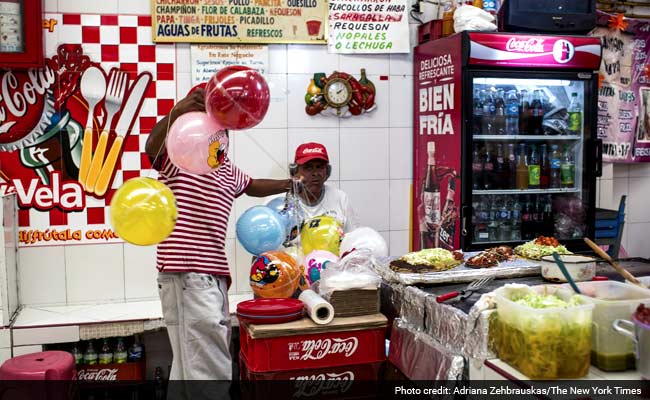
Coke merchandise at a neighborhood market in Mexico City, Oct. 11, 2013.
How long will consumers continue to pay more for less soda?
Consumers paying more for an ounce of soda served in a smaller package than they would pay for an ounce packaged in a 12-ounce can or a 2-liter bottle helped propel profits at the Coca-Cola Co., despite lower sales in the quarter that ended July 3.
Coca-Cola's earnings jumped 19 percent in the quarter to $3.1 billion, or 71 cents a share, from $2.6 billion, or 58 cents a share, in the same period last year. Sales declined 3 percent to $12.2 billion from $12.6 billion a year ago.
The company would have done even better on paper if not for the strong dollar, which dented its reported performance, although not more than it had expected earlier in the year.
"Our second-quarter results were in line with our expectations and mark continued progress toward restoring momentum in our global business," said Muhtar Kent, chief executive of Coca-Cola.
The company attributed its higher profits partly to strong growth in sales of small and "specialty" packages like 8-ounce cans and glass "contour" bottles of some sodas. Such sales account for somewhat less than 15 percent of all the soda it sells, according to Sandy Douglas, president of its North American business.
"The whole range of new and proprietary packaging is in the low teens in terms of sales but growing in the high teens," Douglas said in a conference call with reporters.
Asked how long the company could continue to rely on such higher pricing, Kent said it was not a matter of taking a package and increasing the price. Rather, it was about a "higher price per ounce," he said.
"The smaller the pack," he said, "the higher the price is per ounce."
He said consumers had voted for the strategy with their dollars, the proof of which was Coke's higher sales of products sold in such packages.
The company, which is based in Atlanta, also said it benefited from the success of marketing and advertising campaigns, in particular the Share a Coke program, which allows consumers to customize the labels on bottles of Coke.
Sales of teas and other noncarbonated beverages also rose smartly in the quarter, and sales of bottled waters grew 8 percent. But such drinks do not have the profit margins of what Coca-Cola calls "sparkling" drinks, or sodas.
Those beverages did not perform as well, with sales of Diet Coke falling 7 percent in the quarter. Pepsi, from Coca-Cola's archrival PepsiCo, recently outpaced Diet Coke to regain its post as the second-best-selling soda in America, behind Coke.
And PepsiCo announced in April that, in response to consumer concerns, it was replacing aspartame with another sweetener in Diet Pepsi. Coca-Cola has long said that science confirms that aspartame is safe for human consumption, and Douglas repeated that on the conference call Wednesday. Coca-Cola shares fell 0.7 percent Wednesday to close at $40.90.
"I think the confusion out there will abate as real science is reinforced," he said. "That said, I think the trend toward natural is more of an enduring trend."
Consumers paying more for an ounce of soda served in a smaller package than they would pay for an ounce packaged in a 12-ounce can or a 2-liter bottle helped propel profits at the Coca-Cola Co., despite lower sales in the quarter that ended July 3.
Coca-Cola's earnings jumped 19 percent in the quarter to $3.1 billion, or 71 cents a share, from $2.6 billion, or 58 cents a share, in the same period last year. Sales declined 3 percent to $12.2 billion from $12.6 billion a year ago.
The company would have done even better on paper if not for the strong dollar, which dented its reported performance, although not more than it had expected earlier in the year.
"Our second-quarter results were in line with our expectations and mark continued progress toward restoring momentum in our global business," said Muhtar Kent, chief executive of Coca-Cola.
The company attributed its higher profits partly to strong growth in sales of small and "specialty" packages like 8-ounce cans and glass "contour" bottles of some sodas. Such sales account for somewhat less than 15 percent of all the soda it sells, according to Sandy Douglas, president of its North American business.
"The whole range of new and proprietary packaging is in the low teens in terms of sales but growing in the high teens," Douglas said in a conference call with reporters.
Asked how long the company could continue to rely on such higher pricing, Kent said it was not a matter of taking a package and increasing the price. Rather, it was about a "higher price per ounce," he said.
"The smaller the pack," he said, "the higher the price is per ounce."
He said consumers had voted for the strategy with their dollars, the proof of which was Coke's higher sales of products sold in such packages.
The company, which is based in Atlanta, also said it benefited from the success of marketing and advertising campaigns, in particular the Share a Coke program, which allows consumers to customize the labels on bottles of Coke.
Sales of teas and other noncarbonated beverages also rose smartly in the quarter, and sales of bottled waters grew 8 percent. But such drinks do not have the profit margins of what Coca-Cola calls "sparkling" drinks, or sodas.
Those beverages did not perform as well, with sales of Diet Coke falling 7 percent in the quarter. Pepsi, from Coca-Cola's archrival PepsiCo, recently outpaced Diet Coke to regain its post as the second-best-selling soda in America, behind Coke.
And PepsiCo announced in April that, in response to consumer concerns, it was replacing aspartame with another sweetener in Diet Pepsi. Coca-Cola has long said that science confirms that aspartame is safe for human consumption, and Douglas repeated that on the conference call Wednesday. Coca-Cola shares fell 0.7 percent Wednesday to close at $40.90.
"I think the confusion out there will abate as real science is reinforced," he said. "That said, I think the trend toward natural is more of an enduring trend."
© 2015, The New York Times News Service
Track Latest News Live on NDTV.com and get news updates from India and around the world


