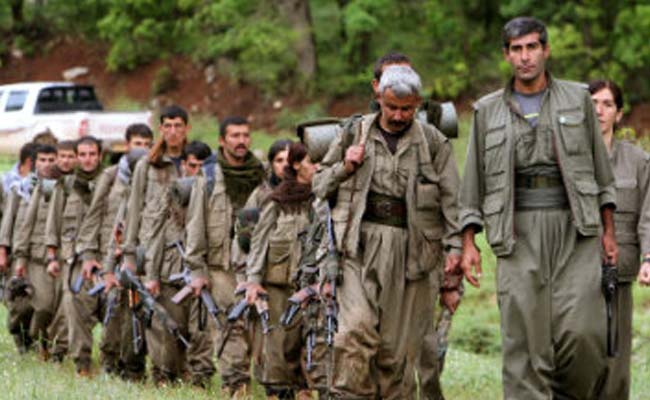
US President Donald Trump has backed a possible offensive by Iranian Kurdish fighters in support of the US-Israeli war against Tehran.
"I think it's wonderful that they want to do that, I'd be all for it," Trump emphasised in an interview with news agency Reuters. However, he declined to say if the US would provide air cover to the Kurdish forces. FOLLOW LIVE UPDATES
Who Are The Kurds?
The Kurds are an ethnic minority group in the Middle East, living mostly in Armenia, Iraq, Iran, Syria and Turkey. With an estimated population between 30 and 40 million worldwide, they are considered one of the biggest ethnic groups in the world without their own nation.
Post the collapse of the Ottoman Empire and World War I, Western Allied powers divide Ottoman lands and even proposed a Kurdish state. However, after the Turkish independence war, the new government in Ankara took control of the entire Anatolian Peninsula.
The Kurds were divided between the newly-drawn borders in Iran, Iraq, Turkey, and Syria. What followed was decades of protests and repression by authoritarian regimes in the region. Outside powers have tried to exploit the Kurds to gain leverage, frequently bringing disastrous results for the group, The Guardian reported.
In Iran, Kurdish people make up an estimated 8 to 17 per cent of the Middle Eastern nation's population, as per British government estimates. The Kurdish regions in western Iran have long pushed for improved rights as well as greater autonomy or independence.
In 1946, the Republic of Mahabad, a short-lived Kurdish state, lasted less than a year before Iranian forces under the shah dismantled it, CNN reported.
In the decades since, armed Iranian Kurdish groups have fought the regime in Tehran, operating from outposts on the region's border with Iraq.
More recently, the Kurdish regions in Iran became a major flashpoint during the large-scale protests in 2022 after the death of Iranian-Kurdish woman Mahsa Amini in custody, and again following anti-government protests late last year.
Why Does Trump Want The Kurds To Join The War In Iran?
The CIA is working to arm Iranian Kurdish forces to foment a popular uprising in the Islamic republic, several people familiar with the plan told CNN. Many Iranian Kurdish groups have released public statements since the start of the war, hinting at imminent action and urging military forces in their country to defect.
Iran has launched operations targeting Iranian and Iraqi Kurdish groups in Iraq's semi-autonomous Kurdish region. On Thursday, Iranian missiles hit the city of Sulaimaniyah in the semi-autonomous Kurdistan region, Al-Jazeera said, citing local news reports.
Any attempt to arm Iranian Kurdish groups would require support from the Iraqi Kurds for transportation of weapons and the use of Iraqi Kurdistan as a launching ground, as per CNN.
Meanwhile, the government of Iraqi Kurdistan slammed reports that it was part of a plan to send Iranian Kurdish opposition parties into Tehran's territory, calling them “completely unfounded.”
Backed by the CIA, Kurdish militia could seize and hold territory in Kurdish-dominated areas in Iran, but analysts say suggestions that they could advance much past the frontier are unrealistic.
The aim of backing Iranian Kurdish groups would be to force the Islamic republic's military commanders to divert troops and resources to marginal border battlefields and possibly encourage other ethnic communities within Iran to launch their own campaigns, potentially with US assistance.
However, multiple potential obstacles remain. Mainstream Iraqi-Kurdish leaders in northern Iraq have insisted on maintaining a neutral position. Not just that, the backing of Iranian Kurds could lead to more tensions with Turkey, a country that has been involved in a decades-long fight against the Kurdish far-left militant and political organisation, the Kurdistan Workers' Party (PKK).
The PKK declared a ceasefire in March 2025. Any prospect of Kurdish groups working more closely with the US would be concerning for the government in Ankara.
Moreover, the US has often backed Kurdish groups, but later withdrawn support due to a change in political climate, as past incidents in Syria and Iraq demonstrate.
As of now, whether the CIA's plan to back Iranian Kurdish groups will lead to positive results remains questionable.
Track Latest News Live on NDTV.com and get news updates from India and around the world


