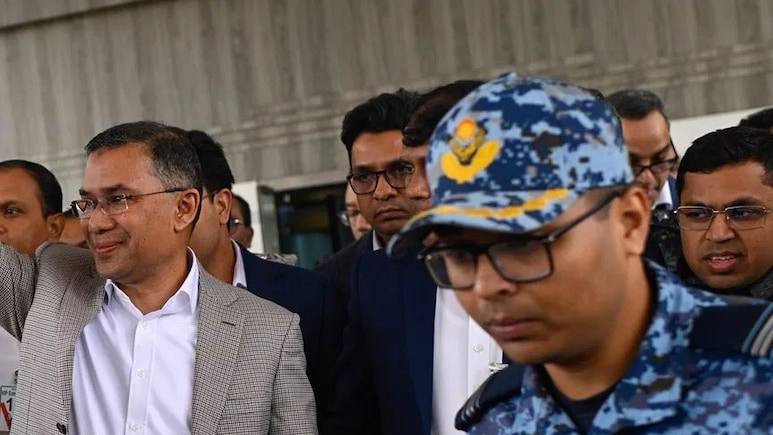
A lawyer aligned with the pro-Pakistan Jamaat-E-Islami Bangladesh has issued a death threat to Tarique Rahman, just hours after the Bangladesh Nationalist Party leader landed in the country after 17 years in exile. The threat had a mention of India.
Shahriar Kabir, a Jamaat-e-Islami–aligned lawyer, alleged that Tarique Rahman was "betraying his father" and "accepting India's conditions" by returning to Bangladesh. The remarks, seen as a direct provocation against India, come just a day after Rahman, son of former Prime Minister Khaleda Zia, landed in Dhaka and delivered a speech outlining his political vision for the country.
Anxiety Within Jamaat
Kabir's comments exposed the discomfort in the Jamaat as massive crowds welcomed the exiled leader into the country. It showed the unease of the Jamaat-E-Islami as it tries to ally with its own proxy during the August 2024 protests -- the National Citizens' Party (NCP) -- an offshoot of the August 2024 protests that led to the ouster of former premier Sheikh Hasina, ending her 15 years of iron-grip rule on Dhaka.
During the protest, student leaders were backed by Jamaat. NCP leaders said the party's top leadership has already held discussions with senior Jamaat leaders over seat-sharing for the upcoming national elections in February.
ALSO READ: "Attack On Hindus Worrisome": India After 2 Men Lynched In Bangladesh
Rebellion in NCP
Within NCP, while there are voices that want an alliance with Jamaat, there are also strong voices against it. A well-known NCP leader, Mir Arshadul Haque, resigned from the party as seat-sharing talks progressed.
With the Awami League out of the picture due to a ban imposed by the interim government in Bangladesh, the February 12 election in Bangladesh is going to be fought between two groups. The Jamaat wants to delay the scheduled polling and has been blamed for the disturbances in the country, where radical mobs have targeted journalists, media houses, cultural institutions, and Indian missions.
As the Jamaat and the NCP firm up an alliance, the main contest in this election is likely to be between the Jamaat and the BNP. Which is why the Jamaat has now started targeting Tarique Rahman, as he has been pushing for elections at the earliest.
Osman Hadi's Killing And Conspiracies
What aggravates things for the Jamaat are the statements over the motives of Sharif Osman Hadi's killing by his family members, which have begun to expose a deep-rooted internal conspiracy to create unrest ahead of the elections so that polling can be delayed. The attacks on minorities, institutions and the press are part of a game plan, according to Bangladesh experts.
ALSO READ: Anti-India Protests At Dhaka University: NDTV Reports From Ground Zero
What Rahman's Entry Means for India
In Tarique Rahman, India will have to deal with a leader who puts Bangladesh first. But he's also someone who recognises the historic India-Bangladesh relationship. The Jamaat, on the other hand, is just anti-India and is not bothered about security, welfare, education, poverty alleviation and other causes that Tarique Rahman has spoken about in his vision for Bangladesh.
With a firm belief in Islamic principles and faith, Rahman envisions Bangladesh as a country that has space and security for people of all religions, rather than taking the country down a path of religious extremism. He has also outlined a very clear foreign policy position.
"Just as there are people of the hills in this country, there are also people of the plains. Muslims, Buddhists, Christians, Hindus, and people of different faiths live in this country. Together, we want to build such a Bangladesh, the Bangladesh we have dreamed of, the Bangladesh a mother dreams of. That is, we want to build a safe Bangladesh," Rahman said in his first speech after landing in the country.
The BNP acting chairman had also outlined his party's vision, prioritising Bangladesh's interests above all else. He had made it clear that Bangladesh will not seek closer ties with Rawalpindi or Delhi but will put Bangladesh first. "Not Dilli, not Pindi, Bangladesh before everything," he had declared at a massive rally in the Nayapaltan area of Dhaka, urging supporters to repeat the slogan.
ALSO READ: Tarique Rahman, The 'Dark Prince' And A 'Shadow PMO' That Ran Bangladesh
Jamaat's Agenda
This position is different from the Jamaat-E-Islami, which is anti-India with an agenda set by Pakistan to destabilise and cause problems for India. Barrister Shahriar Kabir, known for his anti-India positions and proximity to the radical Islamist group Jamaat-E-Islami Bangladesh, has made a statement that amounts to a death threat over Rahman's position when it comes to dealing with neighbours in South Asia, especially India.
"If you come to this country with a signature given to India, your death is near. You are betraying your father's blood. You are betraying your mother's blood. Your father spoke against the Talpotti Island. Your father was killed within 17 days of Sheikh Hasina's arrival. Your father talked about blowing up the Farakka dam under the water deal. Your mother even went to the United Nations demanding this water. That's why your mother left the power. I think your mother's pain has not yet gone. If you are feeling your mother's pain now, do not trust India. Trusting is dying," Kabir said.
The Farakka Water Treaty
The Farakka Water Treaty is a 30-year-old agreement that is up for renewal in 2026 and will require apt diplomacy given the current state of India-Bangladesh relations under the interim government led by Muhammad Yunus. Signed in 1996 for thirty years, the treaty allocates an equitable share of water from the Ganges River to both India and Bangladesh during the dry season. Whenever the next government comes, it will have to engage with India to ensure Dhaka and New Delhi have a mutually acceptable solution as the treaty comes up for renewal.
Reference to History
What has also irked the Jamaat is Tarique Rahman's reference to history, which the Jamaat wants to wipe out from people's memory to push its Islamist radical agenda.
"This beloved motherland was achieved in 1971 by the blood of hundreds of thousands of martyrs. In the same way, on 7 November 1975, the country was saved from the clutches of hegemony through the sepoy-people's uprising to protect it from domination. Similarly, later in 1990, the people of this country – the working masses – wrested back their democratic rights by rising up against autocracy. Yet even then, the conspiracies of the conspirators did not stop," Rahman said in his first speech on Bangladesh soil.
Stressing the importance of law and order in the country, the BNP leader said, "We must preserve law and order in this country at any cost, and we must remain calm and composed in the face of any provocation."
In his appeal to youth, Rahman said, "Members of the younger generation, you will lead the country in the days ahead and build the nation. Members of the younger generation must take on this responsibility today so that we can beautifully build this country on a strong democratic foundation and a strong economic foundation."
Why Rahman Irks Jamaat
Rahman's focus on law and order and democracy has upset the Jamaat-E-Islami, as continuing the arson, vandalism and mob justice on the streets works for radical organisations like it. That is why radical voices like Kabir targeted journalists for speaking up against the attacks by Islamist radicals on minorities, cultural institutions and the press. And even in this, he regurgitated the conspiracy theory of an India link, an idea the Jamaat has been desperately pushing to whip up anti-India hate.
And this is why, over the last few days, as support builds for BNP, Jamaat associates have targeted Rahman, who had to live in exile as the Sheikh Hasina-led government had targeted him. He is anti-Sheikh Hasina and had to live abroad under her rule, so he is seen as much of a victim. This makes the Jamaat wary, as his anti-Hasina credentials mean they cannot target him in the same manner as they target the Awami League.
Besides, the Jamaat and the BNP even had an alliance earlier. This time, the BNP has also checkmated the Jamaat-E-Islami with the announcement of an alliance with the Jamiat Ulama-e-Islam (JUI).
The JUI is different from the hardline radical Jamaat-e-Islami, and even though both are Islamist parties, they have different ideologies. The JUI focuses on religious scholars and traditional Islamic law, while the radical Jamaat-E-Islami aims for a comprehensive Islamic state and is pro-Pakistan.
Veena Sikri, former ambassador of India to Bangladesh, said, "Tarique Rahman has been in exile in London for 17 years. All this while he was not allowed by the regime to come back. Even now, when he wanted to come back a little earlier because his mother was ill, even then, the regime said that if he wanted, he could ask for a one-time travel pass, which means that they were controlling his arrival."
"So now they have given him the travel pass, and he has arrived in Bangladesh. Certainly, I think there will be a huge surge in popularity for the BNP because he's returning after 17 years. The Jamaat-e-Islami does not favour the BNP very much right now. They have earlier been in alliance with the BNP. Right now, they're showing a preference for bringing together the other Islamist parties," he added.
Track Latest News Live on NDTV.com and get news updates from India and around the world


