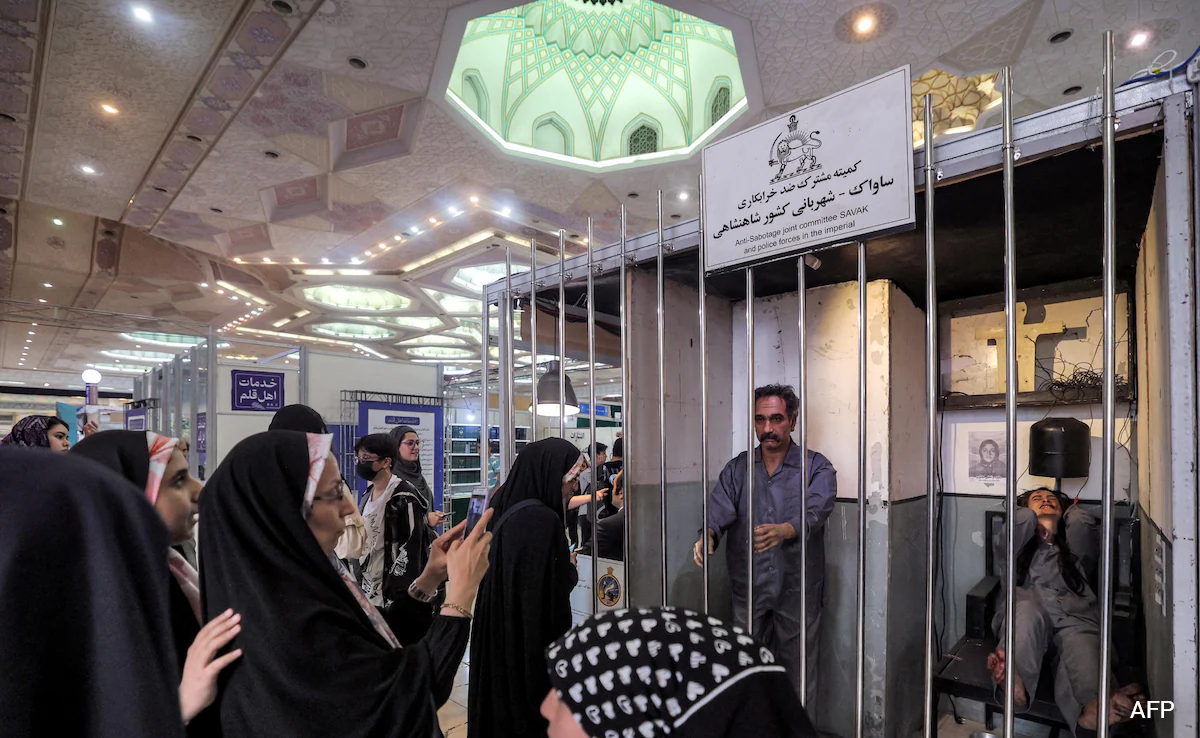
Weeks of nationwide anti-government protests in Iran against the ever-deepening economic crisis, which has shown no signs of improvement in years, have brought renewed focus on the nation's pre-revolution history, notably Savak, the Shah-era intelligence agency.
The unrest has heightened global tensions, with concerns over possible intervention by US President Donald Trump and Tehran's preparations to counter external attacks. Against this backdrop, Savak's history and its final, controversial days once again entered public debate.
Savak And The Shah's Security State
Prior to the 1978-79 Islamic Revolution, Iran's secret police and intelligence service, Savak, short for the Organization of National Security and Information, was tasked with protecting the Shah's regime. The agency became notorious for arresting, torturing and executing dissidents. After the fall of the Shah's regime, Savak was formally dissolved, marking the end of one of the most dreadful institutions of pre-revolutionary Iran.
Khomeini's Assassination Request
In the final days of the Shah of Iran's reign, as protests engulfed the country and Ayatollah Ruhollah Khomeini's return appeared imminent, a dramatic proposal surfaced. Shapour Bakhtiar, appointed caretaker prime minister by the Shah in an attempt to stem the unrest, sought foreign help to halt the Islamic movement led by Khomeini.
In January 1979, Bakhtiar approached Israel's newly appointed Mossad chief, Eliezer Tsafrir, with a request to assassinate Khomeini, who was then in exile in France. Former Mossad official Yossi Alpher revealed this in his book Periphery: Israel's Search for Middle East Allies, according to a report in The Guardian.
The plan was never carried out. On February 1, 1979, two weeks after the Shah fled Iran, Khomeini returned to Tehran on an Air France flight, welcomed by millions of supporters, reported The Jerusalem Post.
Savak's Collapse
Bakhtiar dissolved Savak shortly after Khomeini's return. The agency's final director, Nasser Moghaddam, was executed weeks later. Bakhtiar himself fled to Paris, where he was assassinated by Iranian agents in 1991.
Reflecting on Khomeini's missed assassination attempt, Yossi Alpher later said, “If the Mossad had killed Khomeini, history might have taken a better course.”
How Savak Operated And Why It Was Hated
According to the US Department of State website, Savak was established in 1957 under a national security law. It assumed counter-intelligence functions previously handled by the police, gendarmerie and military intelligence.
Al-Manar TV Lebanon, citing a study by the Union Center for Research and Development, said that Savak was formed with direct support from US intelligence services. Its organisational structure was reportedly modelled closely on the US Central Intelligence Agency (CIA) and the Federal Bureau of Investigation (FBI).
From the outset, Savak operated across two main domains -- intelligence gathering and internal security. Over time, it became synonymous with surveillance, intimidation and political repression.
As popular mobilisation gathered pace during the Iranian Revolution, Savak's tactics grew severe, fuelling public hatred. By 1978, Savak offices and facilities came under attack in several cities. Its heavy-handed control over newspapers also provoked criticism. From mid-1978, Savak's grip on the print media began to weaken. Despite this, the agency continued its campaign of suppression against opposition forces.
Savak Returned To The Spotlight In 2025
Savak resurfaced in the news in 2025 when Parviz Sabeti, the alleged head of the secret police and “chief torturer” under the Shah's government, faced a $225-million civil lawsuit in Florida over atrocities committed in prisons in Tehran and elsewhere.
Sabeti, then 89, had built a successful and largely low-profile life for himself and his family after fleeing Iran in 1978. According to The Guardian, neighbours knew him and his wife as Peter and Nancy, a friendly retired couple.
Track Latest News Live on NDTV.com and get news updates from India and around the world


